


Key Takeaways
- Employee identity exposure feeds payroll diversion and phishing, so it lands on HR, not just the employee.
- A strong benefit pairs dark web monitoring with data broker removal and monthly re-checks.
- IRS Announcement 2016-02 excludes employer-provided identity protection services from employee income.
- HR should see aggregate participation only; each employee alone sees their exposures and listings.
- Renewals depend on evidence: activation rate, exposures found, opt-outs completed, and re-listings caught.
Identity theft rarely stays at home. When an employee’s personal data leaks, the fallout often reaches payroll, HR, and the company inbox. That is why an identity protection employee benefit has moved from a nice extra to a risk control. For HR and benefits platforms, the hard part is building one that employees use.
The cost of skipping it is already visible. The FBI’s 2025 Internet Crime Report logged more than $3 billion in business email compromise losses. Meanwhile, the Identity Theft Resource Center counted a record 3,322 data compromises in 2025. In the same report, 54% of consumers said targeted phishing rose after a breach notice. Each of those attempts can land in a work inbox.
Employees feel this strain on the job, too. A 2025 workplace study of more than 1,000 U.S. employees found that 77% faced identity theft or cybersecurity issues in the past year. Also, 42% said identity theft concerns raise their stress at work.
This guide is written for benefits platforms. Here, that term covers HR tech platforms, PEOs, and benefits administrators. First, it explains what an identity protection employee benefit should cover and how to fund it. Next, it shows how to keep employee results private from HR. Finally, it covers integration, renewal metrics, and the security review that decides most deals.
Why Employee Identity Exposure Becomes an Employer Problem
Most employers treat identity theft as a personal matter. However, the attack paths run straight through business systems. Two patterns show why.
Personal Data Feeds Payroll Fraud
The FBI has flagged payroll diversion as a recurring business email compromise tactic. In this scheme, a criminal poses as an employee and emails HR to change direct deposit details. The request looks real because the criminal already knows the basics.
Data brokers sell exactly those basics. A typical people-search profile lists a home address, phone number, employer, and relatives. As a result, a public profile can help a stranger pass a casual identity check. Removing that profile shrinks the material a criminal can work with.
Breach Fallout Lands During Work Hours
Recovery work happens when banks, agencies, and card firms are open. In practice, that means the workday. The FTC reported that consumers lost $15.9 billion to fraud in 2025. That figure was up from more than $12 billion the year before. Every victim on staff spends time on calls, forms, and account resets.
Consider an illustrative PEO with 20,000 worksite employees. Assume 1% face an identity incident each year that touches payroll or HR. That equals 200 cases. Next, assume each case takes four hours of HR time to verify, correct, and document. The total reaches 800 HR hours a year. These numbers are illustrative, not drawn from client data. Still, the pattern holds at any company size.
What an Identity Protection Employee Benefit Should Cover
Many employee identity tools stop at alerts and help after a theft. A stronger identity protection employee benefit cuts exposure before fraud starts. It combines three connected functions: exposure checks, continuous monitoring, and data broker opt-out. As a result, each one solves a different part of the problem.
Dark Web Monitoring for Personal Identifiers
Monitoring watches breach dumps, marketplaces, and forums for an employee’s email, phone number, and card numbers. When a match appears, the employee gets an alert. Keep in mind that monitoring is an alert-only function. It tells the employee what leaked, so they can reset a password or freeze an account. Strong monitoring also covers infostealer logs, which can expose saved passwords and session cookies.
Data Broker Removal With Monthly Re-Checks
Removal targets the people-search sites that publish home addresses and phone numbers. The service files opt-out requests and tracks each one to a final status. However, brokers rebuild removed records from public filings and reseller feeds. So a one-time cleanup fades within months. Look for monthly re-checks that resubmit requests when a listing returns.
Family and Executive Coverage
A benefit that covers only the employee leaves gaps. For example, spouses and children share addresses, accounts, and last names. Therefore, family coverage reduces the data a criminal can cross-reference. Executives need a separate tier as well. Their home addresses and phone numbers draw targeted fraud and impersonation attempts. A dedicated executive tier can include more monitored identifiers, such as secondary emails and phone numbers.
Funding Models and Tax Treatment
Funding shapes enrollment more than any feature list does. Benefits platforms often set up one of three models:
- Employer-paid core, where every staff member gets covered by default
- Voluntary, where employees opt in and pay through payroll deduction
- Core plus buy-up, where the employer funds a base tier and employees add family coverage
Employer-paid coverage takes the buying choice away, so every staff member starts covered. In contrast, voluntary plans suit employers that want to offer the benefit with no new budget line.
How IRS Announcement 2016-02 Treats Employer-Paid Coverage
Tax treatment often comes up early in HR talks. Under Announcement 2016-02, the IRS will not assert that employer-provided identity protection services count as employee income. That position applies even when no data breach has occurred.
Still, two exclusions matter here. First, the announcement does not cover cash paid in place of the services. Second, it does not cover proceeds from an identity theft insurance policy. Employers should confirm treatment for their own plan design with tax counsel.
Tiering by Monitored Identifiers
Seat-based pricing treats every employee the same way. Yet a single employee might monitor two emails, three phone numbers, and a passport. Tiered packaging tied to monitored assets fits that reality better than a flat per-seat fee. In practice, a base tier covers core identifiers. Higher tiers then add family members, more identifiers, and executive coverage.
The Privacy Firewall Between HR and Employee Results
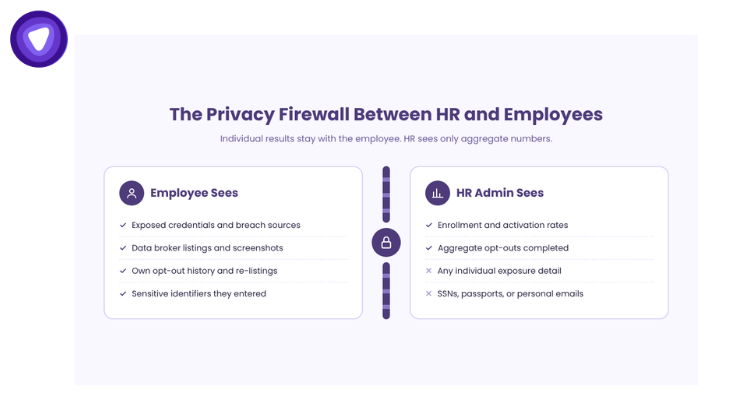
Employees will not turn on a benefit that reports to their boss. So an identity protection employee benefit needs a clear wall between each result and employer reports. HR should see participation and outcomes in aggregate only. The employee alone should see what leaked and where.
| Data Point | Employee Sees | HR Admin Sees | Benefits Platform Handles |
| Exposed credentials and breach sources | Full detail with alerts | Never | Alert delivery under its own brand |
| Data broker listings and screenshots | Full detail | Never | Opt-out submission and status tracking |
| Enrollment and activation | Own status | Aggregate rates | Eligibility sync and reminders |
| Opt-outs completed and re-listings caught | Own history | Aggregate counts | Monthly re-check cycle |
| Sensitive identifiers such as SSN or passport | Entered directly | Never | Storage under the vendor’s audited controls |
In addition, the eligibility file sets the tone for this wall. It should carry only what provisioning needs:
- Legal name and work email
- Employee ID and coverage tier
- Dependent flags for family coverage
Sensitive identifiers, such as Social Security or passport numbers, should pass directly from the employee to the service. As a result, HR never holds a copy it does not need. This design also makes the benefit easier to explain during enrollment.
How Benefits Platforms Integrate Identity Protection
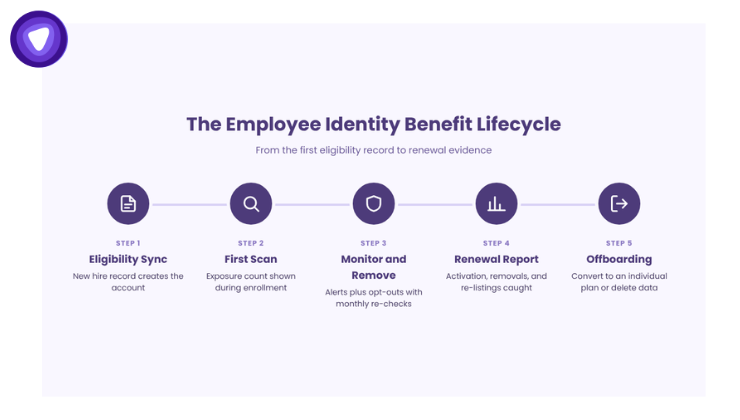
Each platform decides how much of an identity protection employee benefit it wants to own. Most deployments follow one of three models:
- A full white label platform, where the vendor hosts the dashboard under the platform’s brand
- Modular integration, where monitoring or removal is embedded through an API and SDK
- A hybrid, where monitoring sits in the platform’s app and the vendor hosts removal
The steps below apply to all three models.
Eligibility Sync and Provisioning
First, account setup should follow the same eligibility feed that drives other benefits. A new hire record creates an account. A tier change updates coverage. Then a termination record triggers offboarding. Platforms should avoid manual account creation, because manual steps fall out of sync as headcount changes.
Enrollment and the First Scan
Activation is where most identity benefits lose value, so it needs a plan. An employee who enrolls but never adds a personal email gets no protection. One fix is to run a quick exposure scan inside the enrollment flow. A fast historical scan can return an employee’s total exposure count within seconds. Seeing a real number turns an abstract benefit into a reason to finish setup.
Offboarding and Portability
Departures also need a set path before launch. The platform should decide whether leaving employees can convert to an individual plan. Otherwise, the vendor should delete monitored identifiers and removal records on a set schedule. Document that schedule in the data processing agreement. Employees and auditors both ask about it.
Measuring the Benefit at Renewal
HR buyers renew an identity protection employee benefit they can measure. So reporting should prove activity, not just enrollment. Track these numbers each quarter:
- Activation rate, meaning enrolled staff who added at least one email or phone
- Exposures found across breach and infostealer sources
- Opt-out requests submitted, completed, and still pending
- Re-listings caught and resubmitted after the first removal
- HR hours spent on payroll or identity issues before and after launch
Beyond counts, evidence matters too. Listing details, screenshots, and request status records give HR something concrete to show leadership. In short, a timestamped record outlasts a satisfaction survey at renewal time.
Security Review Questions HR Buyers Will Ask
An identity protection employee benefit holds some of the most private data a workforce has. For that reason, expect a security review before any contract. Strong vendor due diligence starts with certifications and independent audit reports. Prepare answers to these questions:
- Which certifications cover the service, such as SOC 2 Type II or ISO 27001
- Whether full audit reports are available under NDA
- Who acts as controller and processor under the data processing agreement
- How long identifiers and removal records are kept after an employee leaves
- How the service separates one employer’s data from another’s
Answering these in the first meeting keeps the review from stalling the deal, so prepare them early.
Why Benefits Platforms Partner Instead of Building
Building an identity protection employee benefit in-house means running opt-out workflows for hundreds of broker sites. It also means sourcing breach data and running monitoring around the clock. In fact, building removal systems alone takes 12 to 24 months. A white label partner can launch in weeks instead.
The platform also keeps the brand, the employee relationship, and the renewal story. By contrast, referring employees to a third-party consumer removal service gives all three away. Timing matters as well. Most January 2027 benefit menus are already locked. So the next realistic windows are an off-cycle launch or the 2028 plan year.
How PureVPN White Label Data Privacy Protection Fits
PureVPN White Label Data Privacy Protection runs dark web monitoring and data broker removal on one engine. HR and employee benefits platforms can offer it as a workforce benefit under their own brand. Coverage spans 400+ people-search and broker sites, with monthly re-checks and evidence for each request. The service holds SOC 2 Type II and ISO 27001 certifications, with full audit reports shared under NDA.
Platforms can deploy the full white label platform, embed modules through the API and SDK, or run a hybrid. Monitoring covers breach data and infostealer logs, with alerts delivered under the partner’s brand. The 150+ partner figure is PureVPN’s own reported number, not an independently audited one.
Conclusion
An identity protection employee benefit earns its place by preventing work disruption. A spot on a menu is not enough. That requires monitoring, removal with re-checks, and a privacy wall employees trust. It also requires reporting that proves value at renewal. Benefits platforms that design for those four needs will own the employee relationship. Those that refer it out will watch another brand collect the credit.
Request a 20-minute walkthrough of the employee benefit integration.
Frequently Asked Questions
What does an identity protection employee benefit include?
It combines dark web monitoring, data broker removal with monthly re-checks, and alerts for each enrolled employee.
Is employer-paid identity protection taxable to employees?
No. IRS Announcement 2016-02 excludes employer-provided identity protection services from employee income, even before a breach.
Can HR see an employee’s identity protection results?
No. HR sees aggregate enrollment and outcome counts, while each employee alone sees exposures and broker listings.
Why does the benefit need data broker removal, not just monitoring?
Monitoring only sends alerts, while removal takes down the public profiles criminals use to impersonate employees.
How long does it take a benefits platform to launch identity protection?
A white label partnership launches in weeks, compared with 12 to 24 months for an in-house build.