

Quick answer: Secure browsing for banking apps is an encrypted tunnel built into the bank’s own app. It protects customer sessions on untrusted networks under the bank’s brand. The bank pays far less than an in-house build, but it takes on vendor oversight, app store rules, and fraud-engine tuning.
Key Takeaways
- Every $1 of fraud costs US financial services firms $5.47, up from $4.00 in 2021.
- Websites and mobile apps carry 69% of fraud losses, and mobile apps alone carry 30%.
- A bank-provided tunnel with fixed exit addresses lets fraud teams score that traffic as trusted.
- Under DORA, a VPN vendor belongs in the ICT third-party register with Article 30 contract terms.
- Google Play limits device-wide tunnels to VPN-core apps, so settle the store plan before build.
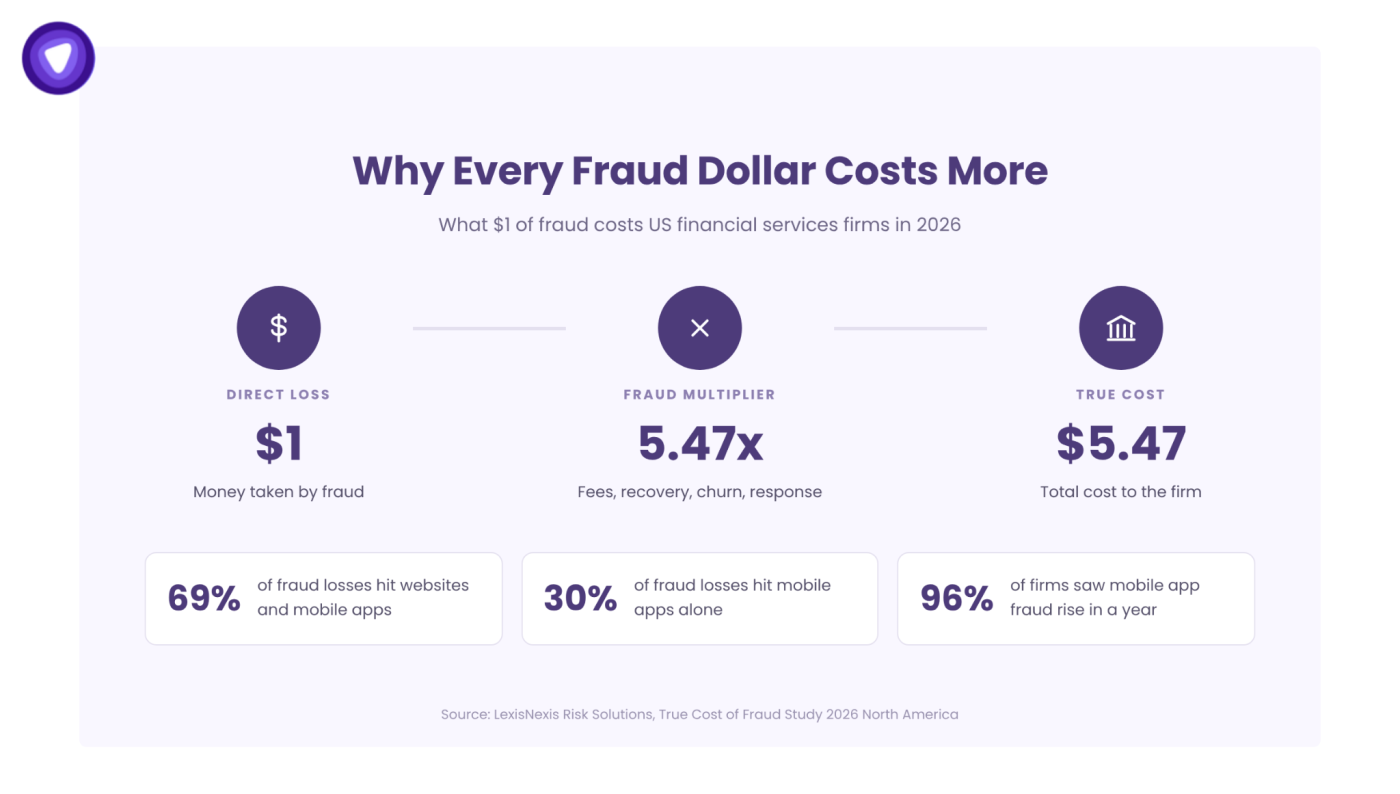
Every dollar a bank loses to fraud now costs it far more than a dollar. In October 2026, LexisNexis Risk Solutions put that fraud multiplier at $5.47 for US financial services firms. In 2021, the same figure was $4.00.
The same LexisNexis study found that websites and mobile apps carry 69% of all fraud losses. Mobile apps alone carry 30%. Also, 96% of institutions said fraud aimed at mobile apps rose over the past year.
That is the cost of doing nothing. However, many customers already patch the gap themselves with a free VPN. That choice creates a second problem, because your own fraud tools often treat those connections as risky. Secure browsing for banking apps closes both gaps at once. This guide covers what it costs, which rules apply, and how it builds trust.
What Secure Browsing Means Inside a Banking App
Before you price the feature, define it. Teams that skip this step overpromise in marketing and underbuild in product.
What It Protects
In plain terms, secure browsing for banking apps routes the customer’s traffic through an encrypted tunnel. The tunnel runs from the phone to a server the vendor operates. As a result, anyone on the same café or airport network sees only scrambled data.
A complete build usually includes these parts:
- An encrypted tunnel that starts inside the banking app, with no second download.
- A kill switch that blocks traffic if the tunnel drops mid-session.
- Split tunneling, so chosen traffic can skip the tunnel.
- Private name lookups, so the network cannot see which sites the phone requests.
- Auto-connect rules that turn protection on when the phone joins an untrusted network.
What It Does Not Replace
Secure browsing adds a layer. It does not replace the app’s own encryption between the phone and your servers. It also cannot stop a customer from typing a password into a fake site.
So keep the claim narrow. Say the feature secures the connection on public Wi-Fi. Do not say it secures the Wi-Fi itself, because the network stays exactly as unsafe as before.
The Real Cost of Secure Browsing for Banking Apps
Cost has three parts. There is the build or license cost, the fraud cost it offsets, and the friction cost of false alerts.
Build Cost Line Items
Building a VPN in-house means running servers in many countries. It also means patching protocols, rotating certificates, handling abuse reports, and passing app store review. Each of those tasks pulls engineers away from the banking product.
PureVPN estimates an equivalent in-house build takes 12 to 18 months and $500,000 or more in infrastructure. That figure is the company’s own estimate, not an independent study. Even so, it explains why many teams price a white label VPN for banks before they staff a build.
A licensed banking app VPN moves those costs to the vendor. Your team still owns the in-app experience, the support scripts, and the vendor review. Plan headcount for those three jobs before launch.
An Illustrative Fraud Math Example
Here is a simple model. The numbers are illustrative, not a forecast.
- Assume a neobank loses $1 million a year in direct fraud tied to sessions on untrusted networks.
- At $5.47 per dollar, the true cost of that slice reaches $5.47 million.
- Now assume secure browsing cuts that slice by 10%.
- The bank then saves about $547,000 a year in true fraud cost.
Swap in your own loss data before you build a business case. The method matters more than these round numbers.
The Friction Cost of False Alerts
Fraud controls carry their own price. In the same LexisNexis study, 56% of firms said their fraud prevention strategies increased customer churn. Every needless step-up check teaches a good customer that your app is hard to use. Secure browsing can lower that friction, as the next section shows.
The Fraud Signal Problem Most Banks Never Budget For
Fraud models can score a VPN connection as a warning sign. Here, neobank fraud prevention and customer privacy pull in opposite directions. That rule punishes careful customers along with fraudsters.
Why Your Risk Engine Flags Careful Customers
Fraud guidance for fintech risk engines advises checking logins against databases of known VPN exit points. A match then adds weight to the risk score. Good customers on a privacy tool can trigger the same checks as fraudsters.
Meanwhile, the tools many customers pick carry real risk. The Tech Transparency Project studied the top 100 free VPN apps in the 2024 US App Store. It found that one in five were secretly Chinese-owned. Your customer’s banking session then runs through a company you never reviewed.
How a Bank-Provided Tunnel Changes the Signal
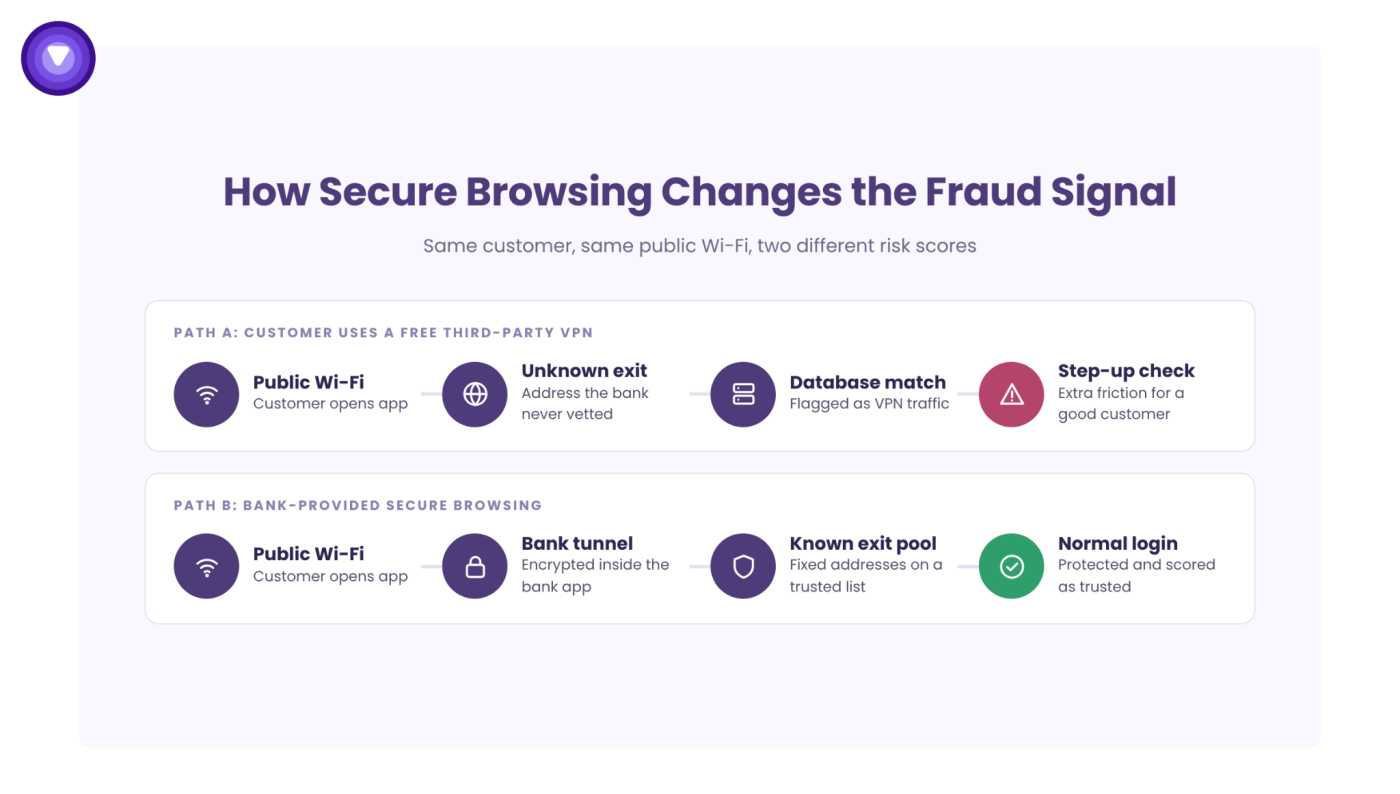
When the bank supplies the tunnel, the bank knows where that traffic exits. Dedicated IP pools make this simple, because the exit addresses stay fixed and listed. Your fraud team can then score those addresses as known and trusted.
In addition, split tunneling gives you a second option. You can send your own banking traffic outside the tunnel, so your fraud tools see the normal network path. The customer still gets protection for everything else on the phone.
Here is how the three common situations compare:
| Factor | Customer Uses a Free Third-Party VPN | No VPN at All | Bank-Provided Secure Browsing |
| Exit address known to your fraud engine | No | Not applicable | Yes, with dedicated IP pools |
| Data handling reviewed by your team | No | Not applicable | Yes, through vendor due diligence |
| Exposure on public Wi-Fi | Lower, but trust is unknown | Highest | Lower, under your brand |
| False step-up checks | Frequent | Rare | Rare, once exit ranges are listed |
| Who the customer credits for protection | Another brand | No one | Your bank |
| Entry in your vendor register | No | No | Yes |
Compliance: What Changes When a VPN Vendor Joins Your Stack
Adding secure browsing for banking apps brings a new vendor into a regulated stack. That vendor touches customer traffic, so regulators expect you to track it. The rules differ by market, so map each one before the contract.
DORA in the EU
The Digital Operational Resilience Act has applied since January 17, 2025. Under Article 28(3), each financial firm must keep a register of every ICT third-party contract. So every VPN vendor counts as a DORA ICT third-party provider and belongs in that register.
Article 30 also sets minimum contract terms. These include a clear service description, the places where data is processed, and service levels. Ask the vendor for a DORA-ready contract draft early.
Enforcement is already active. On November 18, 2025, EU supervisors named 19 critical providers for direct oversight. They built that list from the registers banks filed, and they will update it each year. So decide before your next register filing, not after a supervisor asks.
Service Provider Oversight in the US
In the US, the GLBA Safeguards Rule requires firms to oversee service providers that touch customer information. That means three steps. You select a capable vendor, bind it by contract, and reassess it on a schedule. Keep the vendor’s audit reports in your oversight file from day one.
GDPR Roles and the Data Processing Agreement
In an embedded model, the bank becomes the GDPR controller for its customers. The VPN vendor then acts as a processor under a data processing agreement. A strong vendor checklist asks the vendor to name every subprocessor in that agreement.
Watch where traffic exits, too. Routing customer traffic through another country can raise cross-border transfers questions. Choose exit regions that match your data residency rules.
Also note what a no-log audit covers. It covers the vendor’s network. Your own app logs, billing records, and support tickets stay your duty.
App Store Rules
App stores add their own gate. Under Google Play policy, only apps with VPN as a core function may build a device-wide tunnel. A short list of app types gets an exception, and banking apps are not on it.
Every app that uses the Android VPN feature must also file a declaration form. It must describe that use in its store listing and encrypt traffic to the tunnel endpoint. Our guide to SDK integration adds one more rule. The in-app disclosure must appear before the permission prompt.
So settle the store plan before engineering starts. One option is to declare secure browsing as a core feature. The other is a small companion app under the same brand. Confirm the approach with Google Play review before build. On iOS, Apple requires VPN apps to come from an organization developer account.
Customer Trust: Why Your Brand Should Own the Tunnel
Trust is the third line in the business case, and it is the hardest to win back. In the LexisNexis study, 49% of firms said fraud had hurt customer trust.
Recommending a Tool vs Owning It
Some banks simply tell customers to use a VPN on public Wi-Fi. That advice sends people to a store full of tools you cannot vet. If one of those tools leaks data, the customer still blames the bank.
Owning the tunnel flips that story. The protection carries your name, your support team, and your privacy policy. Customers credit the bank every time the shield icon appears.
Turning Protection Into a Reason to Stay
Secure browsing also gives customers a daily reason to open the app. One option is to place it in premium tiers next to travel and cashback perks. Another is to offer it free to every account as a trust signal.
Either way, keep the message honest. Tell customers what the feature does, when it turns on, and what it cannot stop. Clear limits build more trust than broad promises.
A Four-Step Rollout Plan for Product Teams
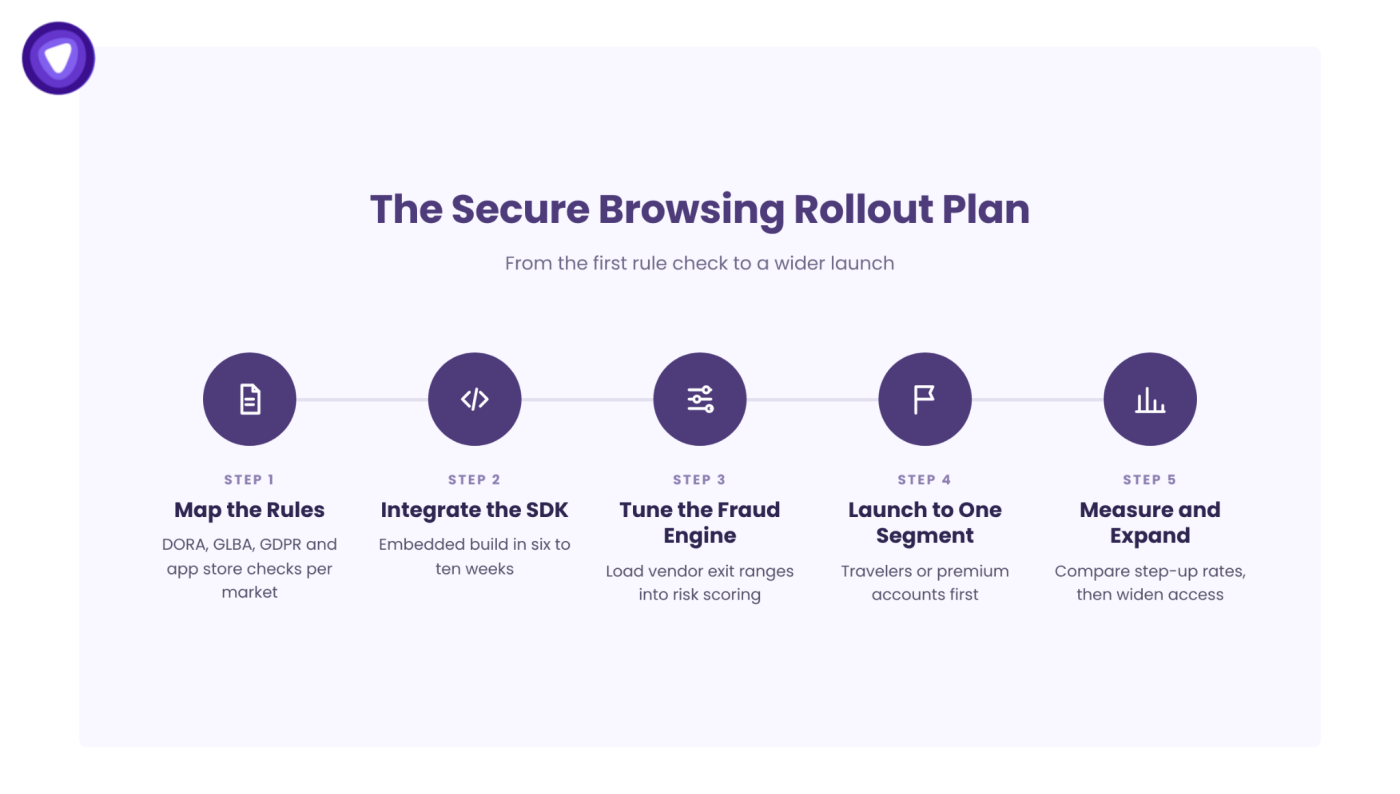
A clean launch of secure browsing for banking apps follows a fixed order. Each step removes a risk before the next one starts.
- Map the rules first. List every market you serve, then match each to DORA, GLBA, GDPR, and store requirements.
- Integrate the embedded VPN SDK. Embedded deployments typically take six to ten weeks.
- Tune the fraud engine. Load the vendor’s exit ranges into your risk scoring before any customer sees the feature.
- Launch to one segment. Start with frequent travelers or premium accounts, then track usage, step-up rates, and support tickets.
After step four, compare false step-up rates before and after launch. That single metric shows whether the fraud signal fix is working.
Proof: Secure Wi-Fi Built Into an Existing Product
The closest proof comes from a device maker, not a bank. In the Samsung case study, PureVPN built its privacy layer into Samsung’s Secure Wi-Fi feature on Galaxy devices. It shipped as an integrated part of the existing product, not as a separate app.
That build mirrors the banking app pattern. A trusted brand added connection privacy inside a product customers already use. The case study is vendor-authored and publishes no outcome figures. Treat it as proof of the integration model only.
How PureVPN White Label VPN Solution Supports Banking Apps
PureVPN White Label VPN Solution gives banks a white label VPN they can embed through iOS and Android SDKs. It includes a kill switch, split tunneling, and dedicated IP pools as a custom option. The network spans 6,500+ servers in 88+ countries, and a Big Four firm audited its no-log policy.
The server and country counts are the company’s own reported figures. The no-log claim rests on that independent audit. PureVPN quotes pricing per partner, based on scope.
Conclusion
Secure browsing for banking apps is now a cost, compliance, and trust decision in one. The fraud multiplier makes every prevented loss worth more than its face value. DORA, GLBA, and store rules make vendor choice a regulated act. Meanwhile, a bank-owned tunnel turns a fraud-engine headache into a known signal. Map the rules, license the layer, and tune your risk scoring before launch.
Request a 20-minute partnership and margin review call.
Frequently Asked Questions
What is secure browsing for banking apps?
It is an encrypted tunnel built into the bank’s own app that protects sessions on untrusted networks.
Does secure browsing replace a banking app’s own encryption?
No. It adds a network layer on top and cannot stop a customer entering details on a fake site.
Will a bank-provided VPN trigger the bank’s own fraud alerts?
No. The bank can list its fixed exit addresses as trusted in its own risk scoring.
Is a VPN vendor an ICT third-party provider under DORA?
Yes. It belongs in the Article 28(3) register, and its contract needs Article 30 terms.
Can a banking app add a VPN on Google Play?
Yes. Banking is not a listed exception, so declare VPN as a core feature or ship a companion app.
How long does it take to add secure browsing to a banking app?
Embedded SDK deployments on a white label platform typically take six to ten weeks.
Is it cheaper to license or build a banking app VPN?
PureVPN estimates licensing avoids 12 to 18 months and $500,000+ of in-house infrastructure work.