

QUICK ANSWER
A private label privacy app needs about $824 in fixed platform and trademark fees in year one. The provider license and paid acquisition make up most of the real budget. Plan for about 30 days from company setup to a live app.
Most founders price a private label privacy app by one number: the provider license. That number rarely sinks the business. Instead, the costs around it do. Store accounts, trademarks, platform commissions, and ad spend decide how long your cash lasts.
The revenue math is harsh for new apps. RevenueCat’s State of Subscription Apps 2026 report puts median monthly revenue at about $72 one year after launch. The same 2026 report found that apps launched in 2025 or later earn just 3% of subscription revenue.
So a launch budget must cover the full path to paying users, not only the product. This guide breaks down each cost line a founder pays in 2026. It also gives you a 30-day launch plan and the contract questions to ask before you sign.
Key Takeaways
- Platform and trademark fees for a private label privacy app total about $824 in year one.
- Apple accepts VPN apps only from organization accounts, so a D-U-N-S number comes first.
- Apple’s Small Business Program cuts year-one subscription commission from 30% to 15%.
- Hard paywalls turn downloads into paying users about five times better than freemium.
- Trials of 17 days or more convert far better than trials of four days or less.
- Web checkout saves commission, but tax, billing, and chargeback duties move to you.
- The provider license removes the build cost, but acquisition spend stays with the founder.
Why the License Is Not Your Biggest Launch Cost
A private label privacy app runs on a provider’s servers, apps, and protocols. In return, you own the brand, accounts, pricing, and billing. That ownership is the whole point. However, ownership also moves every go-to-market cost onto your books.
Demand is growing, so the market is not the problem. Security.org’s August 2026 survey of 1,008 US adults found 42% now use a VPN, up from 32% in 2025. However, the same Security.org survey found 56% of VPN users use none of the extra features on offer. In practice, a new brand wins on clear value, not a long feature list.
Even so, founders who budget only for the license run short before revenue settles. RevenueCat’s data shows that only 17.3% of new apps reach $1,000 in monthly revenue within two years. Meanwhile, just 4.6% reach $10,000.
Private Label vs Reseller vs Build: Pick Your Model First
Your model decides which costs you carry and what you own at the end. So choose it before you build a budget. The table below compares the three paths a founder can take.
| Model | Who Owns Accounts and Billing | Typical Launch Time | Your Upfront Cost Exposure | Best Fit |
| Reseller | The provider | Days | Lowest; you earn a commission | Testing demand with no brand |
| Private label | You | About two weeks | Store, trademark, legal, and ad costs | Founders building a sellable brand |
| Build in-house | You | 12 to 18 months | Full infrastructure and engineering | Teams with deep capital and VPN talent |
A reseller keeps no customer asset, because the provider keeps the account and the renewal. By contrast, a private label partner owns the user base, as this partnership model breakdown explains. That user base is what gives your brand resale value later.
The Five Cost Buckets of a Private Label Privacy App
Every launch budget falls into five buckets. Some are fixed fees with public rates. Others scale with your growth and your choices. Below, each bucket lists what you pay and when you pay it.
1. Company Setup and Store Accounts
Apple sets the first gate. Under its review guidelines, VPN apps must come from developers enrolled as an organization. As a result, a solo founder needs a registered company before the first iOS submission.
The setup costs look small on paper:
- Apple Developer Program: a $99 annual membership for the organization account.
- D-U-N-S number: free, though Apple’s D-U-N-S guidance allows up to 5 business days to receive it.
- Apple data sync: up to 2 more business days for Apple to receive your D-U-N-S details.
- Google Play Console: a $25 one-time registration fee.
- Google Play VPN declaration: apps using the Android VPN service must file a declaration form. The form needs two short demo videos.
Timing matters as much as the fees. The D-U-N-S wait alone can add a week and a half before enrollment. Store review then adds its own delay. So map the full launch sequence before branding work starts.
2. Brand Protection
A brand you cannot defend is a brand you rent. In the US, the trademark office now charges a $350 base fee per class. A free-form description of goods adds $200 per class, according to the 2025 fee changes.
For example, a filing that covers downloadable software and online software services spans two classes. That filing starts at $700 in government fees. Attorney fees sit on top of that number. Also, search your name before you design a logo, since a rebrand after launch costs far more.
3. Store Commissions and Payment Fees
Commission is the cost founders most often leave out of the model. On Apple, standard auto-renewing subscriptions pay 30% in the first paid year and 15% after that. In the EU, the standard Apple rate is 26%. Google Play charges 15% on auto-renewing subscriptions from day one, as RevenueCat’s fee guide explains.
Apple’s Small Business Program cuts the rate to 15% for new developers. It also covers developers who earned up to $1 million in proceeds the prior year. Enrollment takes a few steps in App Store Connect, including accepting the Paid Apps agreement.
The gap is large on a small plan. Take an illustrative $9.99 monthly plan. At 30%, you keep $6.99 per month. At 15%, you keep $8.49. Therefore, enroll in Apple’s program before your first sale.
Billing failures add a quieter cost. RevenueCat found that 31% of Google Play subscription cancellations come from failed payments. On the App Store, that share is 14%. Consequently, payment retry settings deserve a line in your launch checklist.
4. Customer Acquisition
Paid search is expensive in this category. US advertisers pay about $7.73 per click on “vpn cost” and “vpn prices.” That figure comes from public keyword data. And you pay it before a single install.
Here is an illustrative test. A $5,000 search budget at $7.73 per click buys about 647 clicks. Assume one in three clicks installs the app, which gives about 216 installs.
RevenueCat reports a median 10.7% download-to-paid rate for hard paywalls. For freemium apps, the median is 2.1%. At those rates, the test yields about 23 or 5 paying users. That works out to roughly $217 or $1,100 per paying user.
In short, paywall design moves your acquisition cost more than bid tweaks do. Decide your trial and paywall model before you spend on ads.
5. Provider License and Compliance
The provider license covers servers, protocols, apps, and updates. Providers quote this per partner, so request a written quote tied to your expected user volume. Also ask which platforms and features the quote includes.
Compliance still lands on your brand. Apple requires a clear data-use declaration before any purchase. It also requires a privacy policy that bars the sale of user data. Under GDPR, IP addresses and session logs count as personal data, as this compliance checklist notes.
Some territories also require a VPN license. Apple asks for that license in the review notes before release there. So pick launch markets with this cost in mind, and budget for a legal review of your privacy policy.
Build In-House vs Private Label Privacy App: Cost Comparison
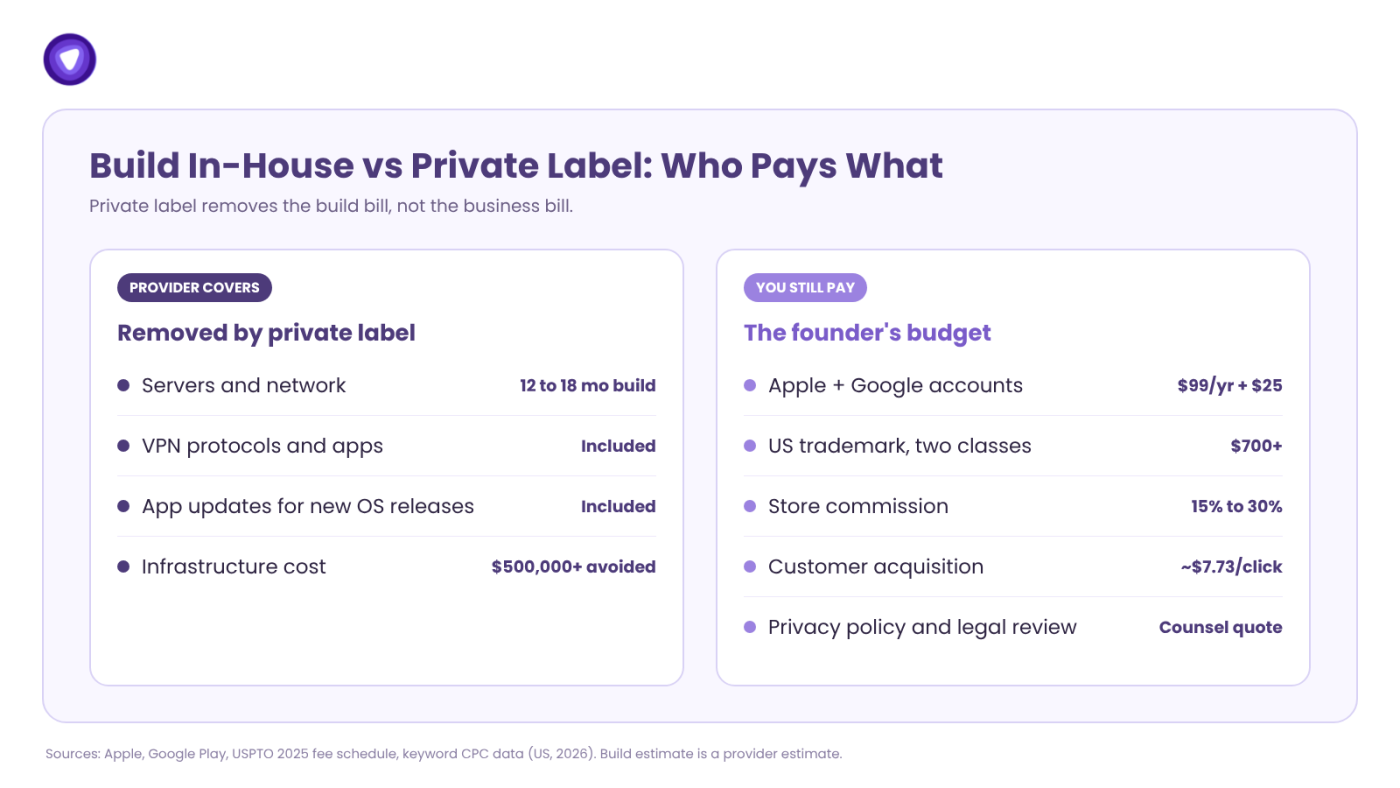
The two paths share more cost lines than most founders expect. The table below shows who carries each line. One provider’s infrastructure estimates put an in-house build at 12 to 18 months. The same estimate puts infrastructure costs at $500,000+.
| Cost Line | Build In-House | Private Label Privacy App | Who Pays |
| Servers and network | Your capital, 12 to 18 months | Included in provider license | Provider |
| VPN protocols and apps | Your engineering team | Branded apps from the provider | Provider |
| App updates for new OS releases | Your team, every release | Provider release cycle | Provider |
| Company, D-U-N-S, store accounts | $99 per year Apple, $25 Google | Same | You |
| Trademark filing | From $350 per class | Same | You |
| Store commission | 15% to 30% of revenue | Same | You |
| Customer acquisition | Your ad budget | Your ad budget | You |
| Privacy policy and legal review | Your counsel | Your counsel | You |
The pattern is clear. Private label removes the build bill, not the business bill. Plan both columns before you sign anything.
An Illustrative First-Year Budget for a Private Label Privacy App
The table below models a lean first year. Fixed fees use published rates. Variable lines are illustrative, so adjust them to match your own plan.
| Line Item | Year-One Amount | Type |
| Apple Developer Program (organization) | $99 | Published fee |
| Google Play Console | $25 | Published fee, one time |
| D-U-N-S number | $0 | Published, free |
| US trademark, two classes | $700 plus attorney fees | Published fee |
| Paid search test | $5,000 | Illustrative |
| Store commission | 15% of revenue (Apple program, Google) | Published rate |
| Provider license | Quoted per partner | Provider quote |
| Privacy policy and DPA review | Quoted by counsel | Illustrative |
The fixed platform and trademark fees total $824. Acquisition and the license make up nearly all of the rest. So the real question is how fast your ad spend turns into paying users.
Where Break-Even Sits
Next, turn the budget into a subscriber target. Take the $824 in fixed fees plus the $5,000 search test, for $5,824 in total. At $8.49 net per month on the illustrative plan, you need about 686 paid subscriber-months.
That equals about 57 subscribers who stay for a full year. Add your provider quote to the total and divide again. The result is the subscriber number your launch plan must reach.
Three Founder Scenarios Compared
Budgets differ, so the table below runs the same model at three ad spends. Each row uses the $824 in fixed fees and $7.73 per click. Each row also assumes one in three clicks installs, plus RevenueCat’s median conversion rates.
| Scenario | Ad Test | Installs | Paying Users (Hard Paywall) | Paying Users (Freemium) | Annual Subscribers to Break Even |
| Lean | $2,000 | About 86 | About 9 | About 2 | About 28 |
| Standard | $5,000 | About 216 | About 23 | About 5 | About 57 |
| Aggressive | $15,000 | About 647 | About 69 | About 14 | About 155 |
All figures are illustrative and exclude the provider license. Still, the table shows one key point. Cost per paying user stays near $217 on a hard paywall at every spend level. On freemium, it stays near $1,100.
In other words, a bigger ad budget buys more users but no better unit cost. Conversion, trial length, and retention move unit cost. So start with the lean test, fix conversion, and scale only after the numbers hold.
Pricing and Trial Choices That Change Your Payback
Pricing choices move payback faster than cost cuts do. Three levers matter most for a new privacy brand. Each one has public data behind it.
Trial Length
Longer trials convert better at the median. RevenueCat’s 2026 data shows a 42.5% median conversion for trials of 17 days or more. For trials of four days or less, the median falls to 25.5%, per its trial length analysis.
Paywall Type
Hard paywalls convert about five times better than freemium by day 35. Yet RevenueCat also found year-one retention is nearly identical across both models. So a hard paywall with a trial is the faster route to payback.
Web Checkout
In the US, Apple currently charges 0% on web checkout linked from your app. This rate depends on the ongoing Epic v. Apple case. Card fees still apply on the web. For example, Stripe’s standard rate is 2.9% plus 30 cents per US card payment.
On the illustrative $9.99 plan, that fee is about $0.59. So you keep about $9.40 instead of $8.49. International cards add another 1.5%, so model your market mix first.
The Hidden Cost of Web Checkout
Web checkout looks cheaper on a card fee alone. However, the app stores do more than take a cut. They also collect tax in listed regions and run billing for you. Once you sell on the web, those jobs move to you.
Tax Moves to Your Books
Apple collects and remits sales tax and VAT for store sales in the regions its Paid Apps agreement lists. On your own checkout, that duty becomes yours. Stripe’s tax tool charges 0.5% per transaction where you are registered to collect.
Billing and Disputes Add Up
Subscription billing on Stripe costs 0.7% of billing volume on the pay-as-you-go plan. Each chargeback also costs $15 when it arrives. Responding manually costs another $15, refunded only if you win.
The Real Web Margin
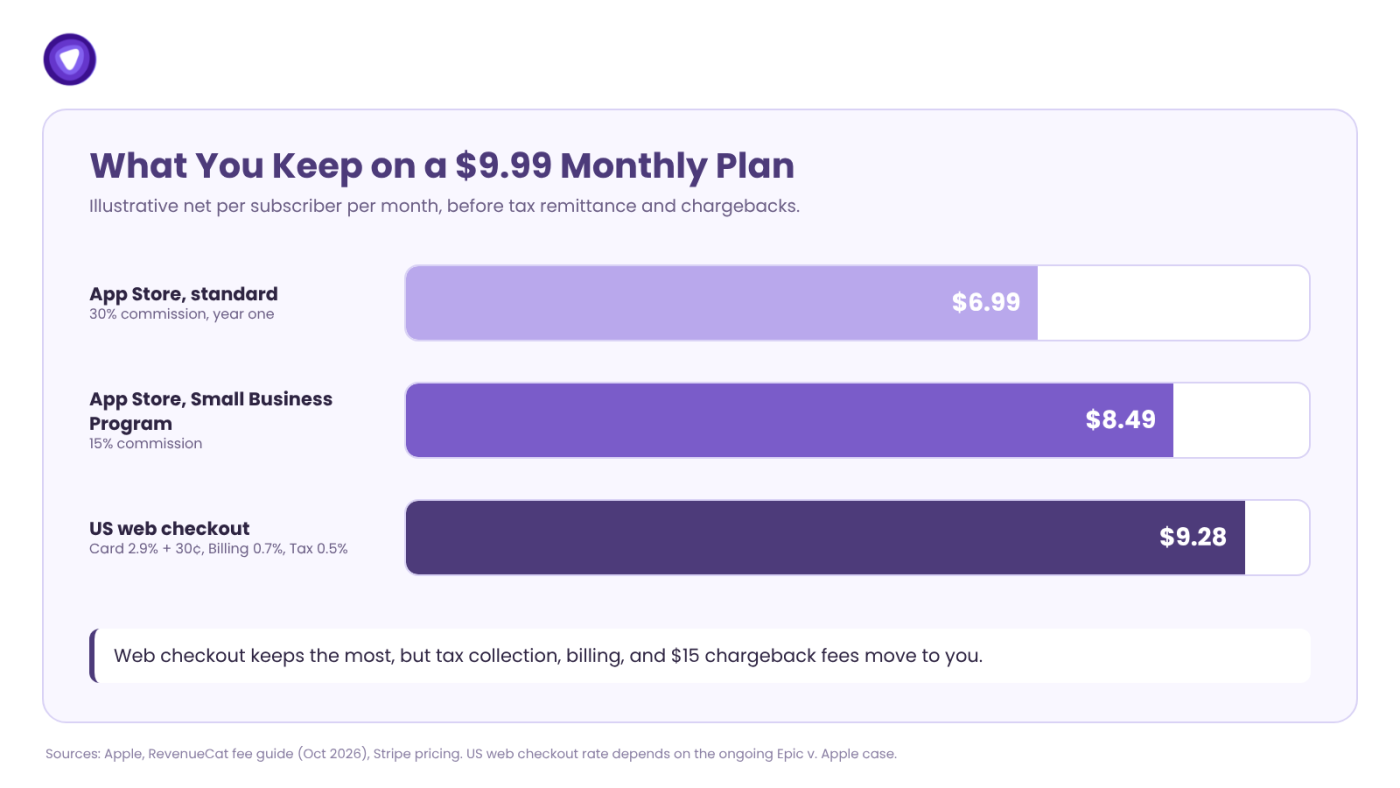
Add card, billing, and tax fees on the $9.99 plan, and the total comes to about $0.71. So you keep about $9.28, before tax remittance and chargebacks. That still beats $8.49 through a store at 15%.
The lesson is simple. Web checkout pays off once you handle tax and disputes well. Until then, store billing is the safer default for a new brand.
Your 30-Day Private Label Launch Plan
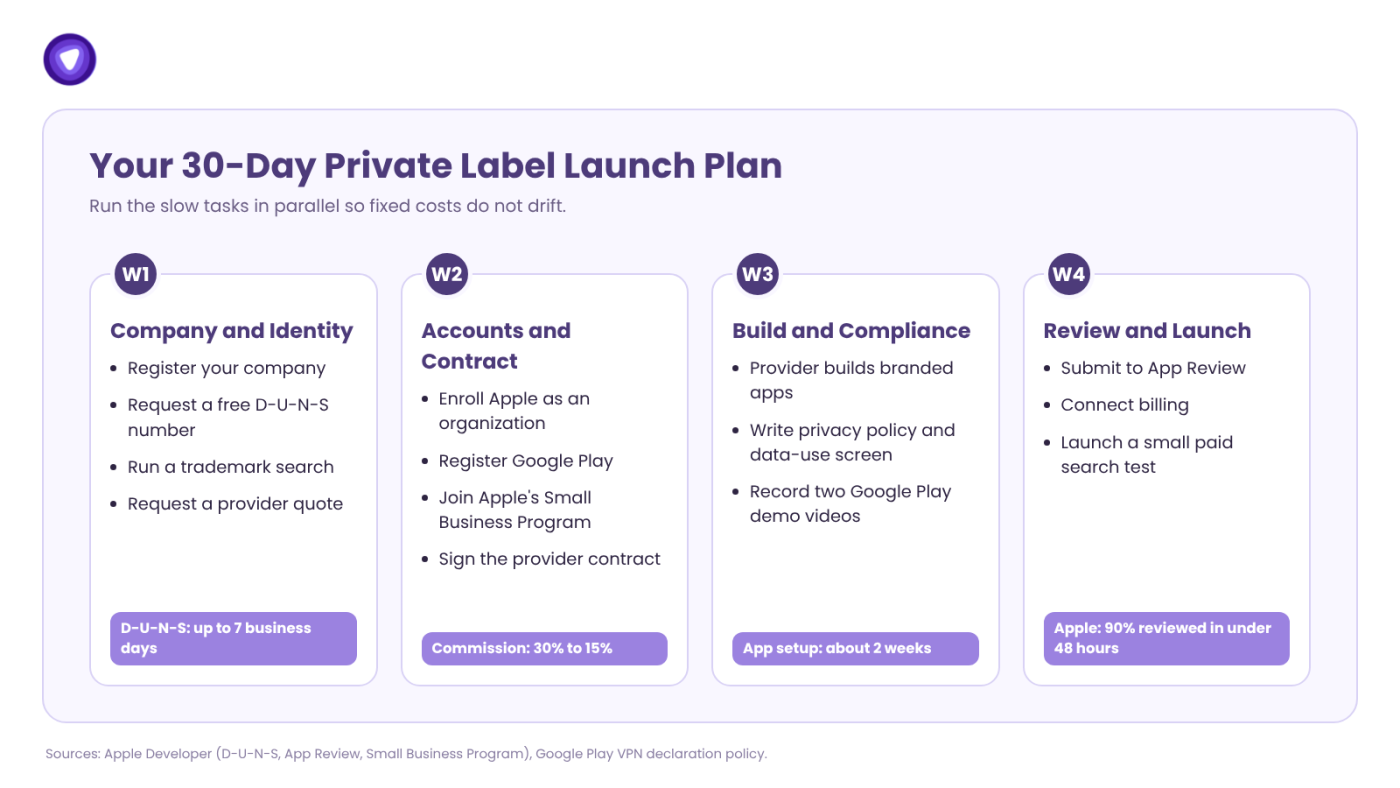
A tight plan keeps fixed costs from drifting. The schedule below runs the slow tasks in parallel. Adjust each week to your own legal and brand timeline.
Week 1: Company and Identity
- Register your company and request a free D-U-N-S number.
- Run a trademark search on your chosen name.
- Request a written provider quote and a sample contract.
Week 2: Accounts and Contract
- Enroll Apple as an organization and register Google Play.
- Enroll in Apple’s Small Business Program right away.
- Sign the provider contract and hand over brand assets.
Week 3: Build and Compliance
- The provider builds branded apps; private label setup takes about two weeks from signing.
- Write your privacy policy and in-app data-use screen.
- Record the two demo videos for the Google Play VPN declaration.
Week 4: Review and Launch
- Submit to Apple, which reviews at least 50% of submissions in under 24 hours.
- Plan for 90% within 48 hours, per Apple’s App Review page.
- Connect billing, then launch a small paid search test.
Questions to Ask Before You Sign a Private Label Contract
The contract decides your exit costs, not just your launch costs. So settle these points before you sign. Then get each answer in writing.
- Developer account ownership: Apps must publish under your own organization account, as Apple requires.
- User and data export: Confirm you can export users and data on exit. Your user base is your main asset.
- Platform coverage: Confirm iOS, Android, Windows, macOS, and browser extensions separately in the base quote.
- Update speed: Ask how fast updates ship after a new OS release, so your app keeps working.
- Audit scope: Ask what the no-log audit covered and when it ran, not only for the badge.
- Pricing model: Confirm whether you pay per active user, per seat, or by tier.
- Billing control: Confirm whether billing runs through your system or the provider’s, since you need direct control of renewals.
- Licensed territories: Ask which markets need a VPN license and whether the provider supports them.
A Ready-to-Sign Scorecard for Your Private Label Privacy App
Use this scorecard before you request a final quote. Each line is a yes or no answer. Six or more yes answers mean you are ready to sign.
- You have a registered company and a D-U-N-S number, or a request in progress.
- You have run a trademark search on your brand name.
- You have chosen a launch market and checked its VPN license rules.
- You have set a first test budget for paid acquisition.
- You have picked a paywall model and a trial length.
- You know whether you will sell through the stores, the web, or both.
- You have a privacy policy draft that bars the sale of user data.
- You have a provider shortlist with written answers to the contract points above.
When Private Label Is the Wrong Fit
Private label is not right for every founder. A reseller deal fits better if you only want to test demand. It also fits if you have no budget for acquisition yet.
By contrast, an embedded SDK fits better if you already run an app with paying users. The proof case below shows that route. Private label fits best when you want a standalone brand you can grow and sell.
Five Cost Traps That Hit New Privacy Brands
The fees above are predictable. The traps below are not, and each one costs weeks or margin. Each trap also has a simple fix if you plan for it early.
- Launching under a personal account: Apple requires organization enrollment for VPN apps. In one forum report, a developer moved a VPN app from a closed personal account to a company account. Apple then rejected the app as a copy of a terminated account’s app. Enroll as an organization from day one.
- Submitting an incomplete app: Apple says over 40% of unresolved issues fall under its App Completeness rule. Include a demo account and full setup notes in your review submission.
- Skipping the Small Business Program: Year-one subscriptions cost 30% without it. Enrollment cuts that rate to 15% from the first payment.
- Ignoring failed payments: Involuntary churn hits Google Play harder than iOS. Turn on payment retries and grace periods before launch.
- Competing on the tunnel alone: Large consumer brands already pair VPNs with antivirus and dark web monitoring. A privacy suite that adds identity protection gives a new brand a reason to exist.
Proof: A Subscription Bundle That Cut Acquisition Cost
An established software company bundled more than 40 iOS apps into one subscription. It wanted a privacy product without building VPN infrastructure. So it used a branded iOS VPN template and SDK, kept one checkout, and added a free tier.
The partner reported 2x subscription sales and a 40% higher conversion rate. It also reported a 56% lower acquisition cost and a 4.7-star rating, per the app bundle case. These figures are the partner’s own reporting, not an independent audit.
This partner embedded the VPN rather than launching a standalone brand. Even so, the lesson carries over to any private label privacy app. A privacy feature tied to an existing subscription lowers the cost of each paying user.
How PureVPN White Label VPN Solution Fits a Founder Budget
PureVPN White Label VPN Solution removes the build column from the table above. Partners get branded apps across eight platforms, including Windows, macOS, iOS, Android, Linux, and major browsers. The network runs on 6,500+ servers in 88+ countries, with WireGuard, OpenVPN, IKEv2, and IPSec support. Its no-log policy carries a KPMG certification, and billing APIs automate subscriptions.
The company reports 19 years of infrastructure history and 600+ partner brands. These are its own figures, not audited ones. The company quotes pricing per partner, so your quote reflects your user volume and platform mix. Founders who want a wider bundle can add Digital Privacy Protection. It covers dark web monitoring and data broker removal.
Conclusion: Budget for Growth, Not Just the Build
A private label privacy app is cheap to build and costly to grow. The platform and trademark fees stay under $1,000. The real budget sits in acquisition, commission, and the provider license. Plan those three lines before you file a single store account. Founders who model them first reach paying users with cash still in the bank.
Request a 20-minute launch budget review for your private label privacy app.
Frequently Asked Questions
How much does it cost to launch a private label privacy app?
Platform and trademark fees total $824; acquisition spend and the provider license make up most of the budget.
Can an individual developer publish a VPN app on the App Store?
No. Apple accepts VPN apps only from developers enrolled as an organization with a D-U-N-S number.
What commission do Apple and Google take on VPN subscriptions?
Google takes 15%; Apple takes 30% in year one, or 15% through its Small Business Program.
Can I avoid Apple’s commission on VPN subscriptions?
Yes. In the US, web checkout linked from your app currently carries 0% Apple commission, plus card fees.
How long does it take to launch a private label VPN brand?
About 30 days: up to seven business days for a D-U-N-S number, then two weeks of app setup.
How long does Apple take to review a VPN app?
Apple reviews at least 50% of submissions in under 24 hours and 90% in under 48 hours.
Should I sell VPN subscriptions through the app stores or my own website?
Start with store billing, since the stores collect tax and run billing, then add US web checkout later.
What is the difference between a private label and a reseller VPN?
A private label partner owns the brand, accounts, and billing; a reseller sells the provider’s product for commission.