

White Label VPN for Routers: Sell Built-In Privacy
A router used to sell on speed, range, and price. Privacy now belongs on that list, because buyers connect cameras, TVs, and consoles they cannot protect one by one. A white label VPN for routers lets device makers ship that protection under their own brand. It also turns a one-time hardware sale into a subscription that bills every month. This guide covers the business case, packaging models, firmware scope, and the claims that hold up on a retail box.
Key Takeaways
- UK and EU rules now make baseline router security mandatory, so it no longer sets a product apart.
- A router-level tunnel protects smart TVs and consoles that cannot run a VPN app.
- Device makers can include privacy for a fixed term, sell it as a tier, or build it into a premium model.
- White label keeps the brand, billing, and subscriber with the device maker; co-branded referrals do not.
- Firmware teams own the tunnel client, while provider APIs handle credentials, accounts, and server choice.
Why Baseline Security No Longer Sets a Router Apart
Security alone no longer sets a product apart. Laws in major markets now set a minimum bar for every connected device. Meanwhile, attackers keep going after network gear. The Forescout 2026 report found routers now hold one third of the worst flaws in business networks. Forescout also found routers and switches carry nearly 32 known flaws each on average.
For device makers, that creates a squeeze. Compliance work adds cost to every unit, yet buyers rarely see it. As a result, a product that only meets the floor competes on price alone. Two shifts explain why the floor keeps rising and why buyers now notice it.
Regulation Sets the Same Floor for Everyone
The UK product security regime took effect on 29 April 2024. It bans shared default passwords and requires a public way to report flaws. Makers must also state how long a product gets security updates.
In the EU, security rules for wireless gear became mandatory on 1 August 2025. A UK government factsheet confirms they cover radio products sold from that date.
The Cyber Resilience Act raised the stakes again. Its reporting duty began on 11 September 2026, according to Ireland’s national cyber centre. Full product rules, including CE marking, follow on 11 December 2027. In short, every compliant router on the shelf now clears the same bar. Clearing it earns market access, not a sale.
Labels Make Security Visible at the Shelf
In the US, the FCC issued a Public Notice on 27 October 2026 on Cyber Trust Mark rules. The notice covers label design, three-year renewals, and post-market surveillance, according to a Wiley law alert. The program stays voluntary. Even so, the FCC has suggested labeled products will hold a marketplace advantage.
Buyers respond to that signal. A Duke and Carnegie Mellon study found buyers would pay up to 50% more for devices with reassuring security labels. A label proves the floor. By contrast, a built-in privacy feature gives the box something extra to point at.
Compliance Security vs Sellable Privacy
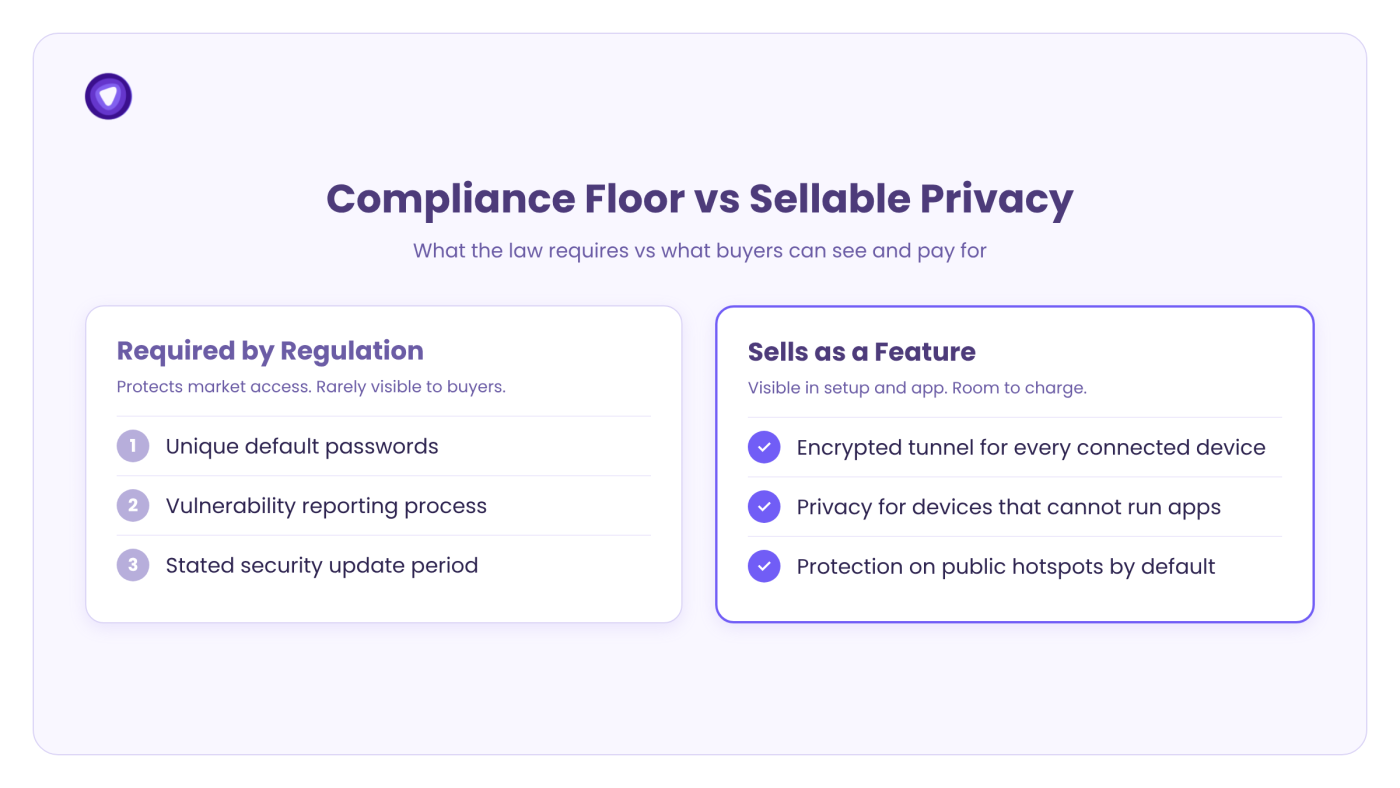
Device makers get more from a privacy budget when they separate what the law demands from what buyers pay for. The table below splits the two.
| Capability | Required by Regulation | Visible to the Buyer | Sells as a Feature |
|---|---|---|---|
| Unique default passwords | Yes (UK PSTI, EU RED) | Rarely | No |
| Vulnerability reporting process | Yes (UK PSTI, EU CRA) | No | No |
| Stated security update period | Yes (UK PSTI) | On the box or website | Weakly |
| Encrypted tunnel for every connected device | No | Yes, in setup and app | Yes |
| Privacy for devices that cannot run apps | No | Yes, for TVs and consoles | Yes |
| Protection on public hotspots by default | No | Yes, for travel routers | Yes |
The top half of the table protects market access. The bottom half is where a device maker can charge, stand out, and build a recurring relationship.
Why a White Label VPN for Routers Beats a Per-Device App
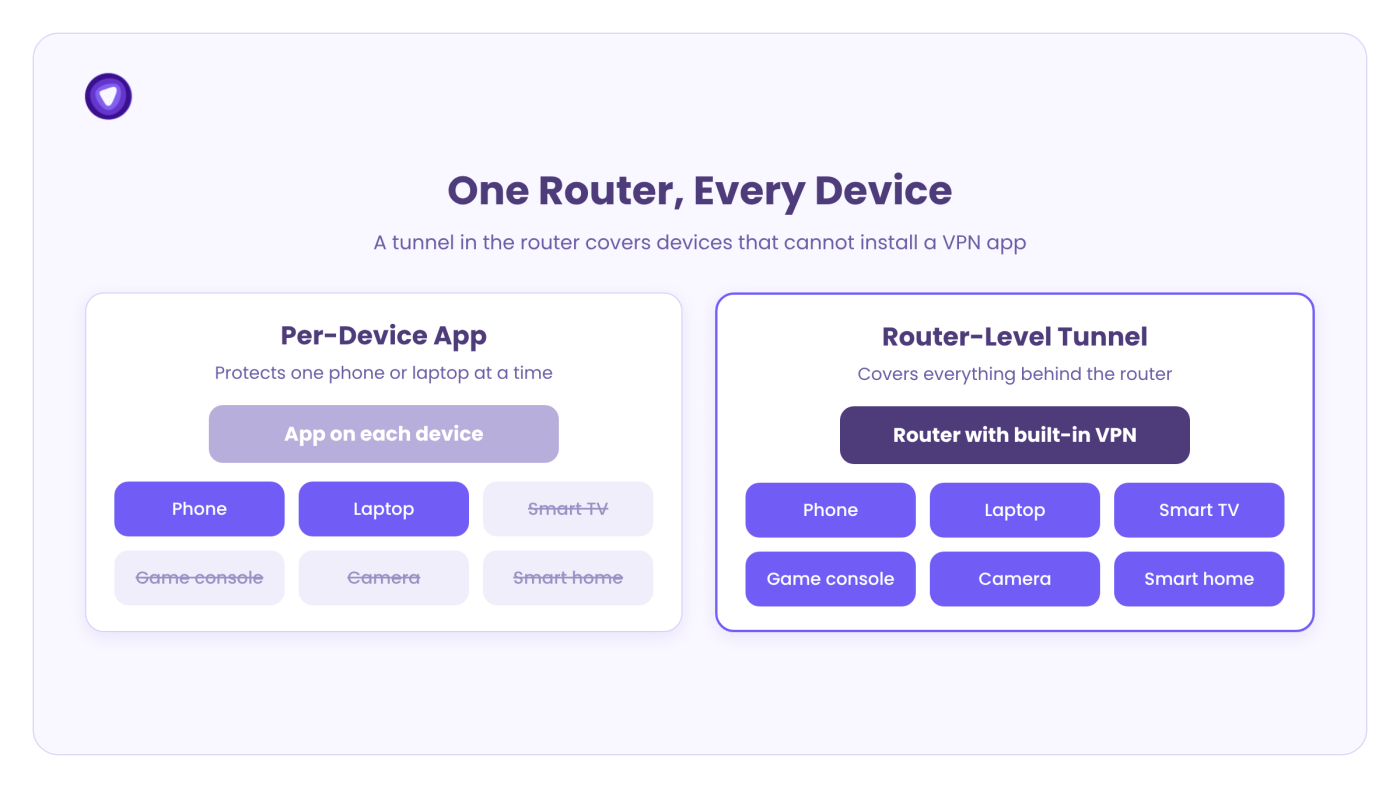
Placement decides how much of the home a privacy feature can reach. An app protects one phone or laptop at a time. A router covers everything behind it.
Smart TVs, game consoles, and many smart home devices cannot install a VPN app. A tunnel that runs in the router covers them anyway. It also removes the setup step that stops most buyers from protecting more than one device. The guide on VPN for IoT explains how constrained devices rely on a gateway to manage encryption.
A white label VPN for routers also keeps the feature inside a product the buyer already trusts. The privacy toggle lives in the same companion app that manages Wi-Fi, parental controls, and updates. Therefore, the buyer never meets a second brand or a second login.
The same logic extends past routers. Phone makers can build privacy into a native Wi-Fi feature instead of shipping a separate app. The Samsung case study shows protection added to Secure Wi-Fi with no second app and no new interface.
Three Ways to Package a White Label VPN for Routers
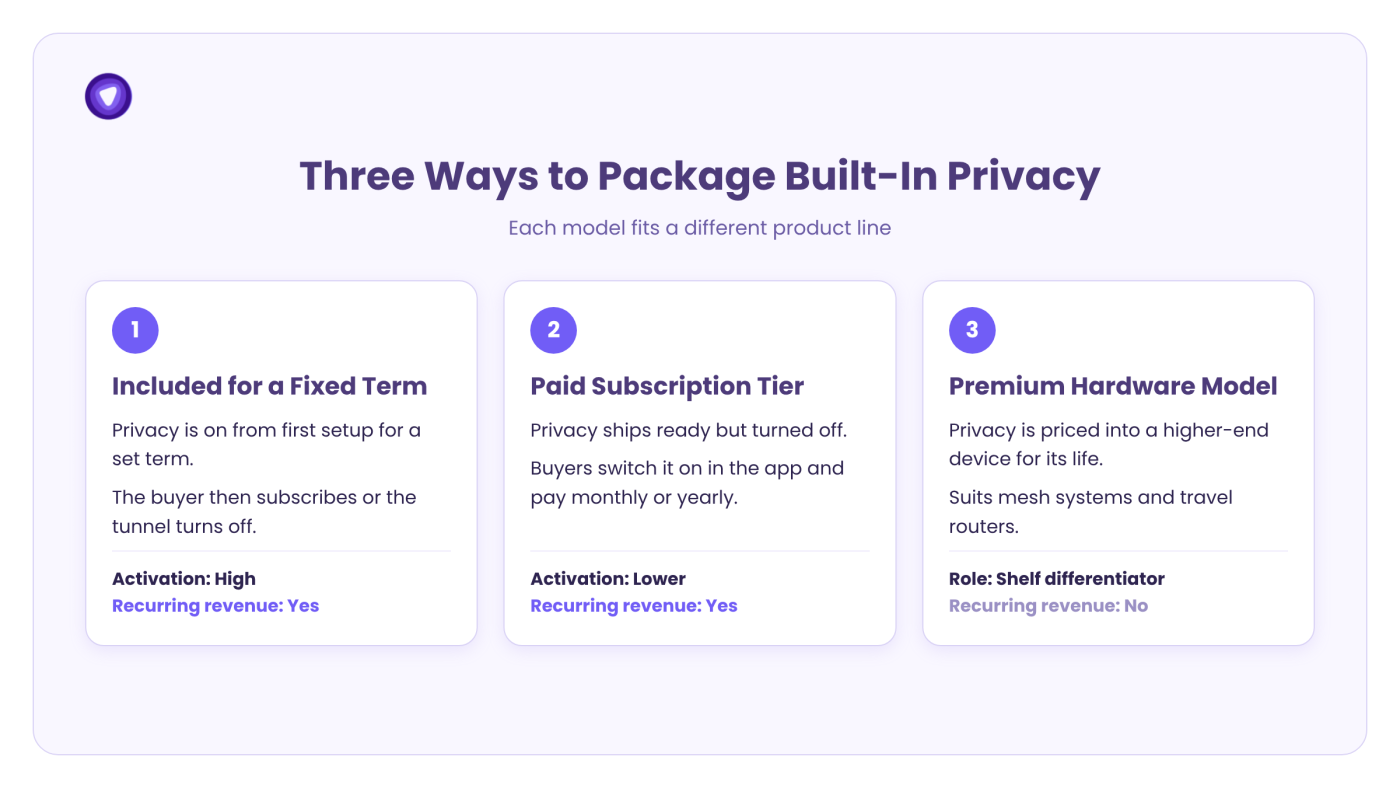
Once the feature exists, the packaging decision sets its revenue. Most device makers choose one of three models, and each fits a different product line.
Included for a Fixed Term
The router ships with privacy switched on for a set term, such as the first year. After that, the buyer subscribes or the tunnel turns off. This model drives high activation, because the feature works from first setup. The key is a fixed expiry set at account creation, as the paid feature guide recommends for any trial.
Paid Subscription Tier
The router ships with privacy ready but turned off. Buyers switch it on in the app and pay each month or year. Activation runs lower than the included model. However, every activation is a paying subscriber from day one.
Premium Hardware Model
A higher-end model includes privacy for the life of the device, priced into the hardware. This option suits mesh systems and travel routers, where buyers already pay for premium features. It creates no recurring revenue, so it works best as a shelf differentiator.
Illustrative Subscription Math
To see the difference, consider an illustrative line of 200,000 routers a year. If 4% of buyers convert to a paid plan, that is 8,000 subscribers. Each subscriber creates 12 billing events a year instead of one hardware sale. With no churn over a three-year device life, that cohort produces 288,000 billing events. These figures are illustrative, not a forecast. Still, they show why a white label VPN for routers changes the revenue shape of a hardware line.
Brand Ownership: White Label vs Co-Branded Referral
Packaging sets how the feature earns. The partner model sets who keeps the buyer after the sale.
A common model for built-in VPN routers is the co-branded referral. The router carries another VPN company’s logo, and the buyer creates an account with that company. Renewals, billing, and the customer relationship all sit with the VPN brand. As a result, the device maker earns a commission and loses the subscriber at checkout.
A white label VPN for routers works the other way. The feature carries the device maker’s brand, runs through its app, and bills through its account system. Meanwhile, the provider runs servers, protocols, and infrastructure behind the scenes. The full ownership tests cover brand, billing, and account control before a contract is signed.
What the Firmware Team Builds
Scope matters because it sets the launch date. The split between device maker and provider is narrower than many product teams expect.
What the Provider’s APIs Handle
Provider APIs cover credentials, account state, and server choice. A developer API guide shows this split in practice. First, a secret key is exchanged for access tokens. Endpoints then create VPN credentials, suspend or renew accounts, and extend expiry dates. A server endpoint returns the best location by country, city, protocol, or device type.
What the Device Maker Owns
The tunnel client itself runs on the device. The same API guide states that tunnel connect and disconnect calls are not exposed, so the device handles the connection. For routers, that means a WireGuard or OpenVPN client built into the firmware image.
The firmware team also owns the app toggle, the activation flow, and the link between subscription status and tunnel status. For example, when an included term ends, one suspend call stops access without deleting the account. Reactivation then takes one tap if the buyer subscribes later.
Who Owns Vulnerability Reporting
The VPN client becomes a component of the device. Reporting duties under the Cyber Resilience Act sit with the manufacturer, and that client ships inside the manufacturer’s product. For that reason, contracts should name who detects, patches, and reports flaws in the VPN layer, and how fast.
Privacy Claims That Hold Up on the Box
Marketing turns the feature into a reason to buy. However, each claim on the box is a promise that reviewers and regulators can test.
Claims that hold up describe what the feature does, not how safe it feels:
- Protects every device on your Wi-Fi, including smart TVs and consoles.
- No app to install on each device.
- Encrypted on public hotspots by default, for travel models.
- Security updates supported until a stated date.
Claims that invite trouble use absolutes, such as unhackable or total anonymity. They also include no-log promises the provider cannot back with an independent audit. A QR code on the box can link to a page that names the audit and the update period. That page also prepares the product for a digital label if the Cyber Trust Mark rules land as proposed.
Metrics That Show Privacy Is Selling
A built-in privacy feature should earn its place in the next product cycle. Five numbers show whether it does:
- Attach rate: the share of activated routers that turn the feature on.
- Trial-to-paid conversion: the share of included-term users who subscribe when the term ends.
- Monthly active users: subscribers with a live tunnel in the last 30 days.
- ARPU: average revenue per user, compared with hardware-only buyers.
- Support tickets per 1,000 activations: a check that setup stays simple.
Track these by model and region. For instance, a white label VPN for routers may convert well on travel models and poorly on budget ones. That gap shows where to place it next.
Proof: How One Router Maker Turned Privacy Into Recurring Revenue
Results from a live deployment show what this model looks like at scale.
A router maker building Wi-Fi and IoT networking hardware wanted to move from one-time sales to subscriptions. It also wanted privacy for devices that standard VPN apps could never reach. Instead of shipping an app, it embedded the VPN directly in its router through documented provider APIs.
The router case study reports 9x growth in ARPU and more than 110,000 monthly active users. Each connection protects up to 15 devices at once. The company also avoided about a year of in-house VPN development. These results are self-reported by the partner, not independently audited.
How PureVPN White Label VPN Solution Supports Device Makers
PureVPN White Label VPN Solution gives device makers a white label VPN for routers and smart devices. The white label platform runs 6,500+ servers across 88+ countries. It supports WireGuard, OpenVPN, IKEv2, and IPSec, on a no-log network audited by a Big Four firm.
Companion apps can use VPN SDKs for iOS, Android, Windows, and macOS. A billing API lets partners charge on their own model, while account endpoints tie subscriptions to tunnel access. The company reports 600+ global brands and 19 years of infrastructure, which are its own figures, not audited ones.
Conclusion
Regulation has made baseline security the price of entry for every router. Privacy that reaches every device on the network is what buyers can still see and pay for. A white label VPN for routers lets device makers add that feature without building VPN infrastructure. It also keeps the brand, the billing, and the customer in-house. Device makers who decide before the next product cycle ship privacy as a launch feature, not a retrofit.
Request a 20-minute router integration walkthrough.
Frequently Asked Questions
Can a VPN run directly on a router?
Yes, a router can run a WireGuard or OpenVPN client in firmware and encrypt traffic for every connected device.
Does a router VPN protect smart TVs and game consoles?
Yes, a router-level tunnel covers smart TVs and consoles, which cannot install most VPN apps.
How do device makers add a VPN to a router?
They build the tunnel client into firmware and use provider APIs for credentials, accounts, and server selection.
How is a white label VPN for routers different from a co-branded router VPN?
A white label VPN carries the device maker’s brand and billing, while co-branded referrals send renewals to another company.
Which regulations affect routers sold in 2026?
UK PSTI, EU Radio Equipment Directive cybersecurity rules, and Cyber Resilience Act reporting duties all apply in 2026.