


Most privacy proposals die in the budget meeting. They arrive framed as a compliance cost, and finance treats them as overhead. A privacy feature inside your product works differently. It can add a revenue line, protect renewals, and cut the cost of building security in-house. The problem is that few teams model privacy features ROI the way a board expects to see it.
The pressure on that model is real. The Cisco 2024 survey of consumers found that 75% will not buy from a company they distrust with data. The same survey found that 49% of consumers aged 25 to 34 have switched providers over data practices. For a subscription business, that switching rate shows up as churn. So the cost of doing nothing has a dollar figure attached, even when nobody has calculated it yet.
This guide gives product and finance leaders a model they can defend. It covers the three value lines, the cost side finance checks first, and a worked example with round numbers. It also shows how a white-label VPN fits the model as an embedded privacy feature.
Key Takeaways
- Boards approve privacy features when the case shows revenue lines, not only risk avoided.
- A credible privacy features ROI model splits value into new revenue, retention lift, and cost avoidance.
- Per-user vendor fees land in cost of revenue, so model the feature as its own margin line.
- Treat vendor cost as a variable and solve for the ceiling that meets your payback target.
- In the illustrative base case, a 5% attach rate pays back within 12 months below $2.60 per user per month.
- Stage gates at 90 days, 6 months, and 12 months give the board clear kill criteria.
Why Boards Reject Most Privacy Feature Proposals
Boards do not reject privacy. Instead, they reject proposals that only describe risk. A slide that says “breaches are expensive” gives a CFO nothing to approve. A slide that says “this feature adds $360,000 in annual revenue” gives them a decision.
Most privacy business cases borrow their logic from compliance programs. Those programs measure fines avoided and audit hours saved. That framing works for a privacy office budget. However, it undersells a product feature that customers pay for directly.
Finance also wants a short payback window. In a StrategicCFO360 poll, 26% of CFOs said they want positive ROI from new technology within 12 months. Another 60% expect a positive return within three years. Your privacy features ROI model needs to land inside one of those windows. It also needs to show which one.
What Waiting Another Budget Cycle Costs
Timing matters because many companies set next year’s budget in the final quarter. A privacy feature that misses the FY2027 plan waits another 12 months. During that wait, churn continues at the current rate.
Retention now sits at the top of the finance agenda. The Q4 2025 Grant Thornton survey of CFOs found that customer acquisition and retention ranked as the No. 1 priority. That survey covered more than 230 US finance leaders at companies above $100 million in revenue. A feature that improves retention speaks directly to that priority. So retention belongs at the center of any privacy features ROI case.
Demand for privacy tools is also rising. The Security.org 2026 report found that 42% of Americans now use a VPN, up from 32% in 2025. In addition, 43% of those users rely on a free VPN. That gap is a revenue opportunity. Your users already want the protection, and many of them use an unvetted free app to get it. Decide before the next budget locks, not after a competitor ships the feature first.
The Three Value Lines in a Privacy Features ROI Model
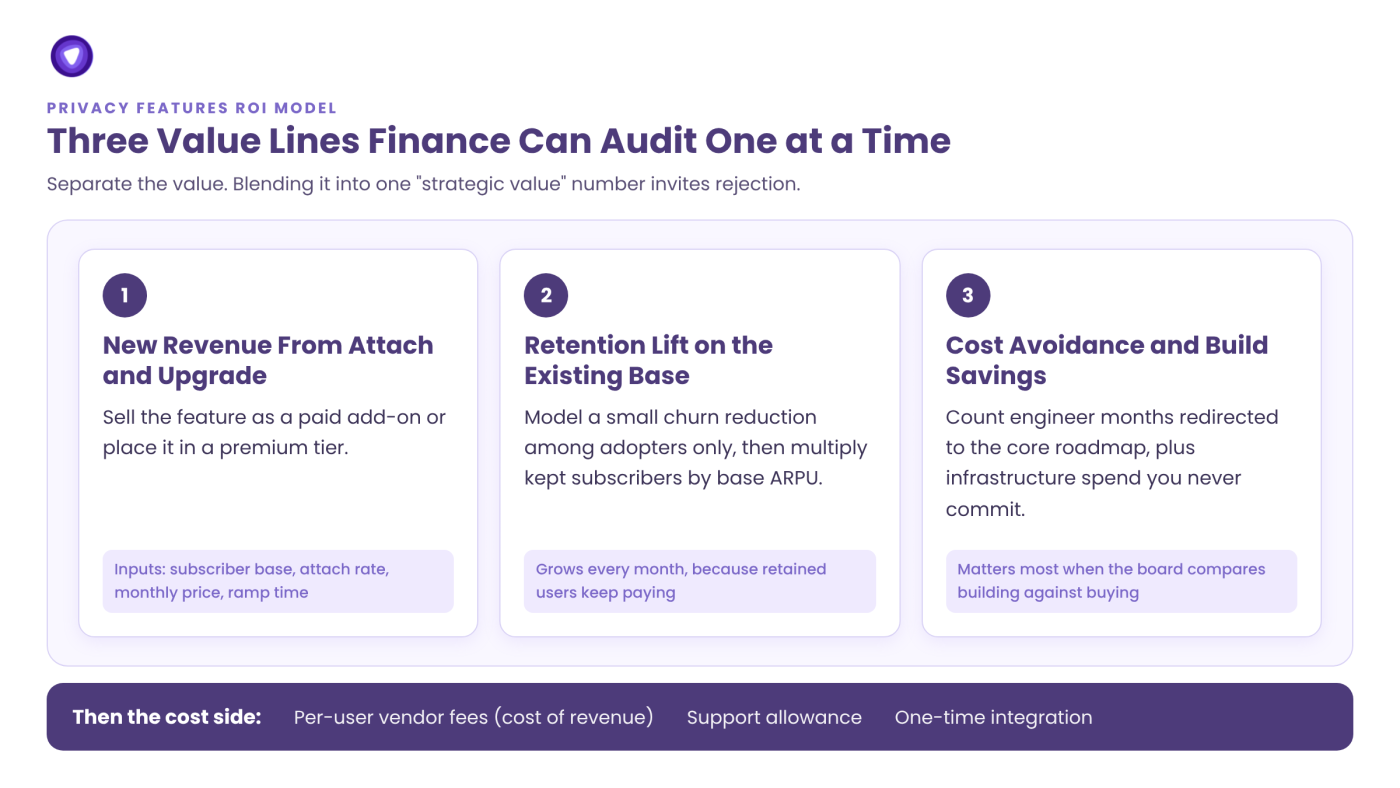
A credible model separates value into lines that finance can audit one at a time. Blending everything into one “strategic value” number invites rejection. Each line below has its own inputs, its own owner, and its own way to measure it after launch.
Line One: New Revenue From Attach and Upgrade
The first line is direct revenue. You sell the privacy feature as a paid add-on, or you place it in a premium tier. Either way, the inputs stay simple.
- Active subscriber base
- Attach rate, meaning the share of users who buy the feature
- Monthly price of the add-on or the tier uplift
- Ramp time before the attach rate stabilizes
Keep the attach rate conservative in the base case. A board trusts a 5% assumption that you beat more than a 15% assumption that you miss. Also, if you already have subscriber margins from other add-ons, use them as your benchmark.
Line Two: Retention Lift on the Existing Base
The second line is retention. A bundled feature gives a subscriber one more reason to stay. Subscription data shows how large that effect can get.
For example, a Bango report cited Antenna data on streaming bundles. Churn for one service dropped from about 8% to 3% inside a bundle. Another fell from 9% to 3% in a similar package. Those are streaming figures, not privacy figures. Still, they show the mechanism finance needs to model.
For a privacy feature, model a small churn reduction among adopters only. Then multiply the subscribers you keep by your base ARPU. This line grows every month, because retained users keep paying.
Line Three: Cost Avoidance and Build Savings
The third line is cost you do not spend. Building VPN infrastructure in-house means servers, protocol updates, app store reviews, and on-call staff. A white-label layer moves most of that work to the provider.
Count the engineering ROI separately from revenue. Price it as engineer months you redirect to your core roadmap. Then add the infrastructure spend you never commit. This line matters most when the board compares building against buying.
The Cost Side Finance Will Check First
Revenue gets attention, but costs decide approval. Most privacy features ROI models break on cost, not revenue. So a finance reviewer reads the cost side first. Three areas deserve a line each in your model.
Gross Margin, Not Just Revenue
A white-label provider usually charges per active user. That fee lands in cost of revenue, so it reduces gross margin. Model the feature as its own margin line, not as pure revenue.
Also include support load. Privacy features generate tickets about connection drops, location choices, and device limits. Add a per-user support allowance, even a small one. A model without support cost looks naive to anyone who runs a P&L.
Integration Spend and Accounting Treatment
Integration is a one-time cost. It covers SDK or API work, branding, QA, and app store submission. Ask your auditors early whether this work counts as capital or operating expense. The answer changes how the cost appears in year one.
Bundling also raises a revenue question. If you include the feature inside a premium tier, your auditors decide whether it counts as a separate performance obligation. Settle that before launch, so your revenue line matches what finance will report.
Vendor Pricing as a Variable
Do not hard-code a vendor price you have not negotiated. Instead, treat the per-user vendor cost as a variable. Then solve for the highest vendor cost that still meets your payback target. That number becomes your negotiation ceiling, and it gives procurement a clear target.
A Worked Privacy Features ROI Model
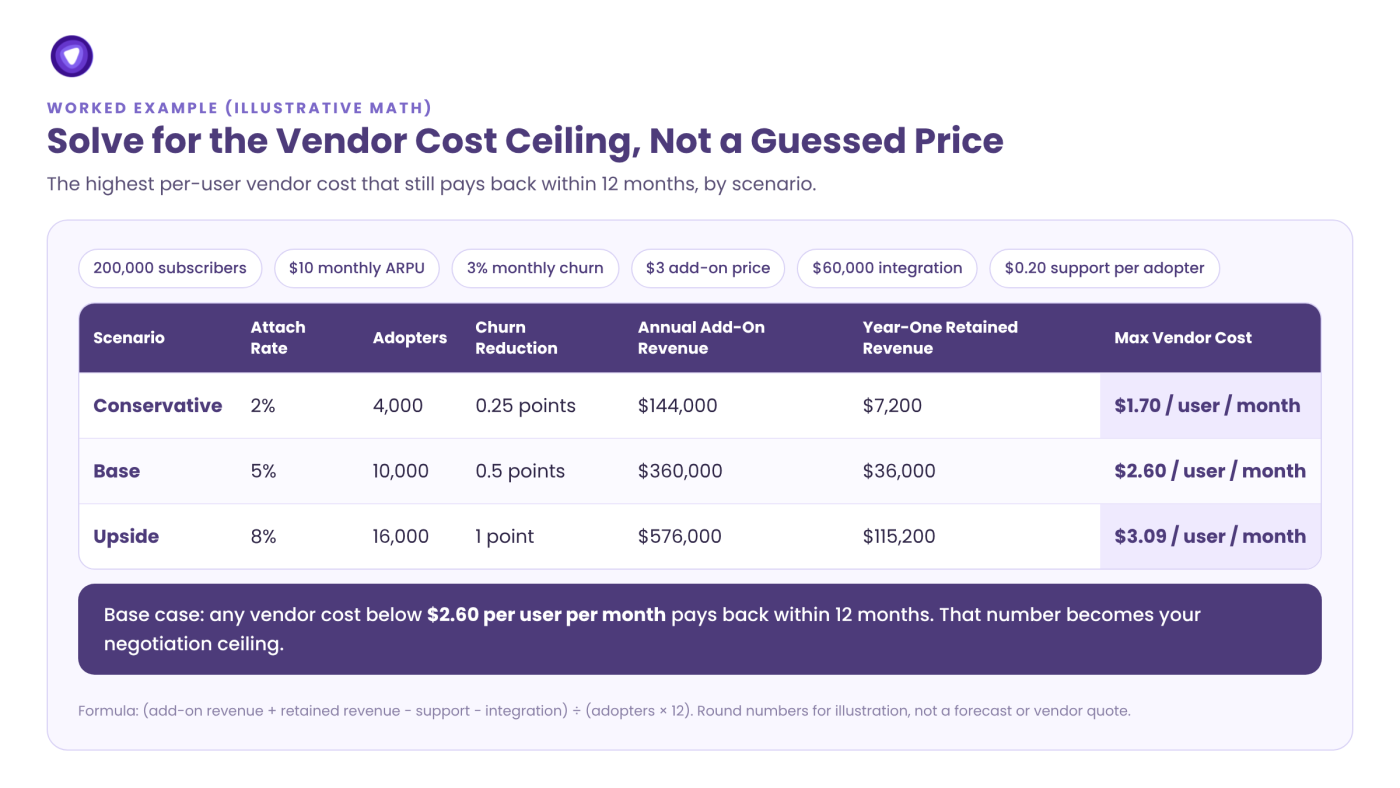
The example below uses round numbers. It is illustrative math, not a forecast and not a vendor quote. Replace each input with your own data before you present it.
The base inputs are:
- 200,000 active subscribers
- $10 existing monthly ARPU
- 3% monthly churn
- $3 monthly price for the privacy add-on
- $60,000 one-time integration cost
- $0.20 per adopter per month for support
Next, the model runs three scenarios. Each one changes only the attach rate and the churn reduction among adopters. Retained revenue assumes each kept subscriber pays base ARPU for an average of six months in year one.
| Scenario | Attach Rate | Adopters | Churn Reduction | Annual Add-On Revenue | Year-One Retained Revenue | Max Vendor Cost for 12-Month Payback |
|---|---|---|---|---|---|---|
| Conservative | 2% | 4,000 | 0.25 points | $144,000 | $7,200 | $1.70 per user per month |
| Base | 5% | 10,000 | 0.5 points | $360,000 | $36,000 | $2.60 per user per month |
| Upside | 8% | 16,000 | 1 point | $576,000 | $115,200 | $3.09 per user per month |
The last column carries the decision. In the base case, any vendor cost below $2.60 per user per month pays back within 12 months. In the upside case, retention lifts the ceiling above the add-on price itself. As a result, the board sees a range, not a single bet.
The formula behind that column is simple. Take add-on revenue plus retained revenue. Subtract support and integration. Then divide by adopters times 12 months. Any finance analyst can rebuild it in a spreadsheet in minutes.
Build In-House vs White-Label vs Refer a Third-Party App
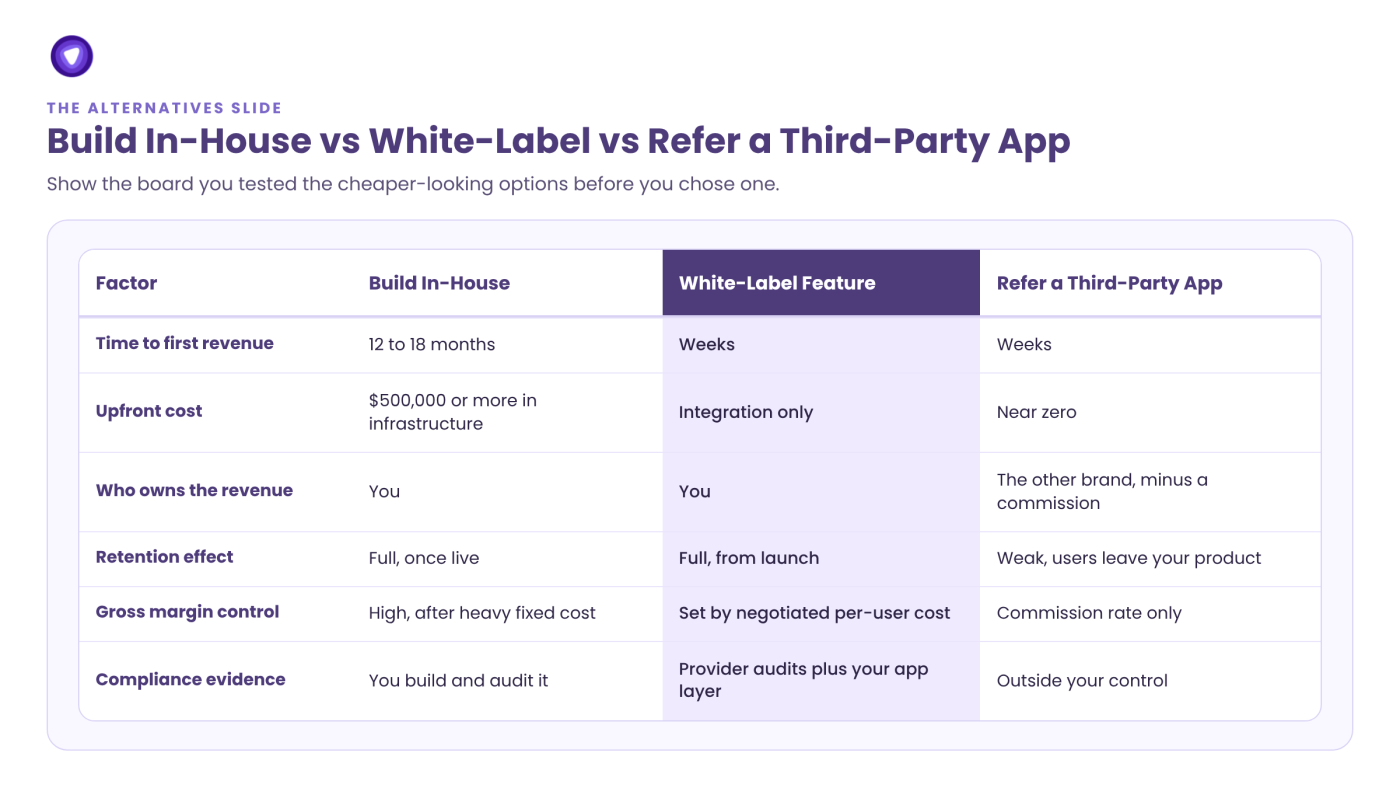
Boards almost always ask about alternatives. So include a side-by-side comparison in the deck. It shows that you tested the cheaper-looking options before you chose one.
| Factor | Build In-House | White-Label Feature | Refer a Third-Party App |
|---|---|---|---|
| Time to first revenue | 12 to 18 months | Weeks | Weeks |
| Upfront cost | $500,000 or more in infrastructure | Integration only | Near zero |
| Who owns the revenue | You | You | The other brand, minus a commission |
| Retention effect | Full, once live | Full, from launch | Weak, users leave your product to use it |
| Gross margin control | High, after heavy fixed cost | Set by negotiated per-user cost | Commission rate only |
| Compliance evidence | You build and audit it | Provider audits plus your app layer | Outside your control |
The build figures reflect a vendor estimate of 12 to 18 months and $500,000 or more. Treat them as a starting point and replace them with your own engineering quote. The referral option looks cheap, but it hands the customer relationship to another brand. That choice removes Line Two from your model entirely.
How to Present the Model So the Board Approves It
A sound privacy features ROI model still fails with a weak presentation. Boards approve plans that limit downside and show when to stop. Build the presentation around four elements.
First, open with a one-line summary that the CEO can repeat. For example: “At a 5% attach rate, the integration pays back within 12 months below $2.60 per user.”
Second, show the three scenarios side by side. Lead with the conservative case. If the conservative case still pays back inside 36 months, say so clearly.
Third, add stage gates with kill criteria. A simple structure works well:
- 90 days: attach rate above 2% among users who see the offer
- 6 months: support tickets per adopter at or below the model allowance
- 12 months: measured churn gap between adopters and non-adopters
Finally, attach vendor due diligence. A board member will ask about audits, data handling, and exit terms. Answer with the provider’s audit scope and contract terms. A procurement checklist helps you cover those questions before the meeting.
Proof From a White-Label Router Partner
Models persuade, but outcomes close the case. One hardware partner shows how an embedded privacy feature changes the revenue model itself.
A router maker wanted to move from one-time hardware sales toward recurring subscription revenue. It embedded a white-label VPN layer directly into its WiFi routers through documented APIs. According to the partner’s own reported results in the router case study, it saw 9x growth in ARPU. It also reached more than 110,000 monthly active users and saved about one year of development.
These figures are partner-reported results, not independently audited data. Still, they map cleanly onto the privacy features ROI model above. The ARPU growth sits in Line One, and the saved development year sits in Line Three.
How PureVPN White Label VPN Solution Fits the Model
PureVPN White Label VPN Solution supplies the VPN layer inside the model. It covers 6,500+ servers across 88+ countries, eight platforms, and SDK and API access. The no-log network carries a Big Four audit. Pricing runs per active subscriber, and the company quotes it per partner rather than publishing rates. Infrastructure figures are the company’s own reported data.
For a product that already sells security, the same platform also connects to identity protection and data broker removal. Those lines sit in a broader privacy suite, and each one needs its own model line. Keep the VPN case clean first, then add the others as separate scenarios with their own bundle pricing.
Conclusion
Privacy features ROI wins approval when it looks like any other investment case. Separate the value into new revenue, retention, and cost avoidance. Model vendor cost as a variable, and solve for the ceiling that meets your payback target. Then show the board three scenarios and clear stage gates.
That structure turns privacy features ROI from a compliance argument into a product decision. It also gives product and finance leaders one shared model to defend. Build it before the FY2027 budget locks, while the retention benefit can still land in next year’s numbers.
Request a 20-minute ROI model review built around your subscriber base.
Frequently Asked Questions
How do you calculate privacy features ROI?
Add attach revenue and retained revenue, subtract vendor, support, and integration costs, then divide by total cost.
What payback period do CFOs expect from a new feature?
In one CFO poll, 26% wanted positive ROI within 12 months and 60% within three years.
Should a privacy feature be a paid add-on or part of a premium tier?
Add-ons give a cleaner revenue line, while tiers raise retention but need a revenue allocation decision from auditors.
Is it cheaper to build a VPN feature or white-label one?
White-labeling swaps a 12 to 18 month, $500,000+ build for a one-time integration plus per-user fees.
What does a board need to approve a privacy business case?
A board needs three scenarios, a one-line ROI summary, stage gates with kill criteria, and vendor audit evidence.