


- VPN Benchmarking Definition: It is the process of evaluating VPN speed, latency, packet stability, and throughput under real-world traffic conditions.
- Core Focus: Latency, jitter, packet loss, throughput, session stability, and routing efficiency define real VPN performance.
- Performance Reality: Latency and jitter impact user experience more than raw speed because they affect responsiveness and real-time communication.
- Protocol Impact: WireGuard, OpenVPN, and IKEv2 deliver different performance profiles, so testing must remain consistent across conditions.
- White-Label Infrastructure: Long-term stability, scalable architecture, and global routing consistency matter more than peak speed results in enterprise use cases.
A VPN connection rarely fails in a single obvious moment. It degrades gradually, first in latency spikes, then in unstable sessions, and eventually in inconsistent application performance that users start reporting as “slow network” issues.
For businesses evaluating a white-label VPN infrastructure, these failures matter more than any peak speed result because they directly affect how secure access behaves under real operational conditions.
This blog breaks down what actually matters when benchmarking VPN performance in enterprise environments. It focuses on the technical metrics that reflect real usage conditions, including latency behavior, packet stability, protocol performance, routing efficiency, and infrastructure consistency across sustained traffic loads.
Why VPN Benchmarking Matters Before Deployment
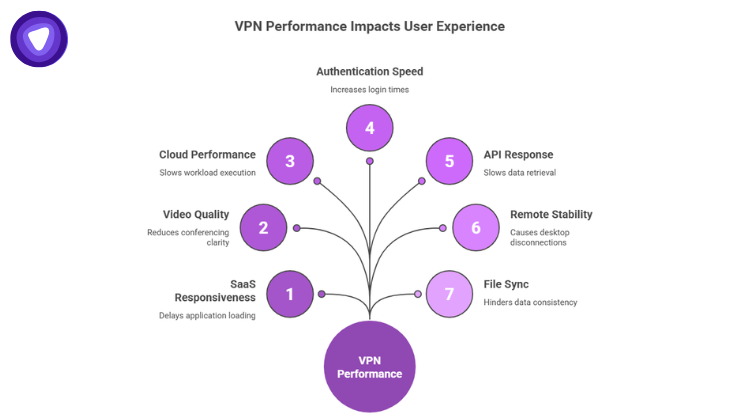
VPN infrastructure becomes part of the organization’s production network the moment employees or customers begin routing traffic through it.
Every delay introduced by the VPN affects the user experience downstream.
That includes:
- SaaS application responsiveness
- Video conferencing quality
- Cloud workload performance
- Authentication speed
- API response times
- Remote desktop stability
- File synchronization consistency
A weak VPN infrastructure creates friction across the entire operational environment.
The global average cost of a data breach reached $4.88 million. Operational disruption remains one of the most expensive components of modern incidents.
Performance benchmarking helps businesses validate whether a VPN provider can support production-scale encrypted traffic before customers or internal teams experience degradation.
What Real-World Research Shows About Ignoring VPN Performance Benchmarking
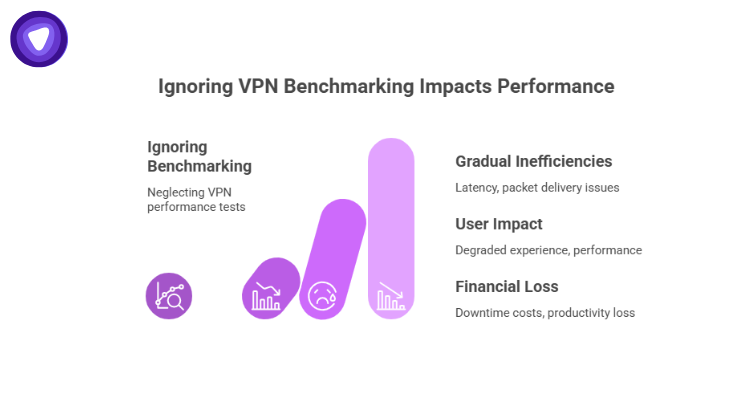
Real-world network performance issues rarely appear as sudden failures. They build up gradually through small inefficiencies in latency, packet delivery, and routing under sustained load.
This is why many enterprises only recognize the impact after user experience and application performance start degrading.
- 1 in 5 organizations has experienced a major outage in the last 3 years, with many incidents costing $100,000 to over $1 million depending on severity and duration.
- Enterprise downtime studies show that 91% of organizations report hourly downtime costs above $300,000, driven by productivity loss, service disruption, and recovery effort.
- Industry SLAs and network standards typically target 99.5% to 99.9% packet delivery reliability, because even small drops in performance create cascading issues in distributed systems.
Most operational impact comes from slow degradation under load, which is why sustained VPN benchmarking is more reliable than short speed tests.
What Businesses Should Actually Measure During VPN Benchmarking
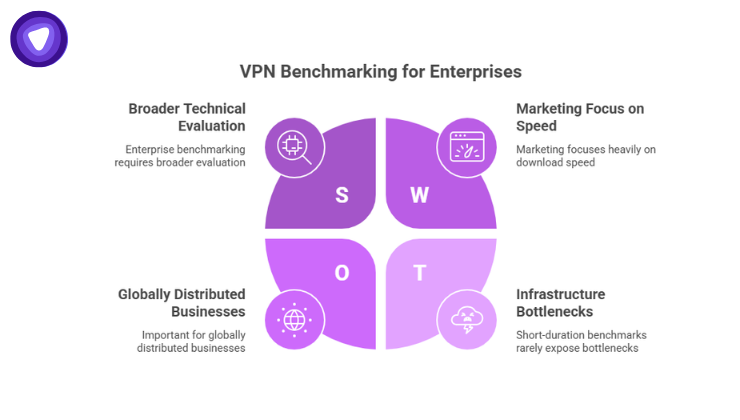
Most VPN marketing focuses heavily on download speed. Enterprise benchmarking requires a broader technical evaluation.
1. Latency Consistency
Latency measures packet travel time between endpoints. For enterprise environments, latency directly affects how responsive applications feel during continuous usage.
High latency introduces:
- Delayed remote desktop sessions
- Slow cloud application response
- Lag during SSH sessions
- Reduced VoIP quality
- Delayed API transactions
Low latency alone is not enough. Consistency matters more.
A VPN delivering 25 ms latency consistently performs better than one fluctuating between 20 ms and 120 ms depending on server load.
Several factors influence latency performance:
- Geographic distance
- Routing efficiency
- ISP peering quality
- VPN gateway congestion
- Encryption overhead
- Protocol architecture
This becomes increasingly important for globally distributed businesses operating across multiple cloud regions.
2. Jitter Stability
Jitter measures latency fluctuation over time. A VPN may show acceptable average latency while still producing unstable communication sessions because packet timing remains inconsistent.
High jitter commonly causes:
- Choppy voice calls
- Video freezing
- Audio synchronization issues
- Delayed packet delivery
- Session instability
Real-time collaboration platforms depend heavily on stable packet timing.
Recent VPN testing environments continue to use jitter consistency as a major indicator of network quality.
3. Packet Loss Rates
Packet loss occurs when packets fail to reach the destination endpoint.
Inside encrypted tunnels, packet loss creates compounding performance problems because retransmissions increase congestion and latency simultaneously.
Even small packet loss rates affect:
- Cloud synchronization
- File transfers
- Video conferencing
- Remote management sessions
- Persistent SaaS connections
Packet loss becomes more common during:
- Congested traffic periods
- Weak international routing
- Oversubscribed VPN gateways
- Mobile network transitions
Enterprise benchmarking should always include sustained packet stability testing across multiple regions.
4. Sustained Throughput
Throughput measures usable bandwidth after encryption overhead and routing conditions are applied. This differs significantly from theoretical bandwidth numbers advertised in speed tests.
Throughput benchmarking should include:
- Upload consistency
- Download consistency
- Multi-user traffic loads
- Cross-region transfers
- Sustained encrypted sessions
- Peak-hour traffic conditions
Short-duration benchmarks rarely expose infrastructure bottlenecks.
Many VPN providers perform well during isolated burst traffic while degrading significantly during continuous enterprise usage.
The Most Important VPN Performance Metrics at a Glance
VPN benchmarking becomes meaningful only when these metrics are evaluated together under sustained traffic conditions, as real performance depends on how they interact rather than how they behave in isolation.
| Metric | Why It Matters | Business Impact |
| Latency | Measures packet response time | Application responsiveness |
| Jitter | Measures latency fluctuation | VoIP and video stability |
| Packet Loss | Measures failed packet delivery | Tunnel reliability |
| Throughput | Measures usable encrypted bandwidth | Transfer performance |
| Session Stability | Measures tunnel persistence | Reduced interruptions |
| Routing Efficiency | Measures network path quality | Lower congestion |
| Protocol Efficiency | Measures encryption overhead | Better scalability |
Why VPN Protocol Selection Changes Performance Results
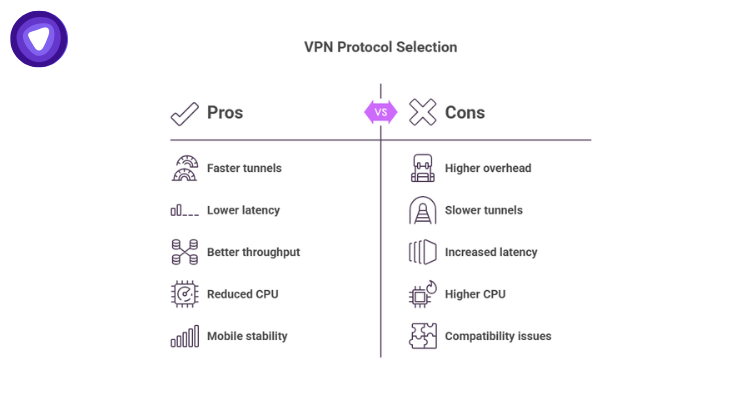
VPN protocols directly influence how efficiently encrypted traffic moves across the network.
Different protocols prioritize different operational characteristics.
1. WireGuard and Lightweight Encryption Performance
WireGuard has gained significant enterprise adoption because of its lightweight architecture and lower processing overhead.
Compared to legacy VPN protocols, WireGuard generally delivers:
- Faster tunnel establishment
- Lower latency
- Better throughput efficiency
- Reduced CPU utilization
- Improved mobile performance
Its smaller codebase also improves operational efficiency under sustained encrypted traffic loads.
For businesses supporting cloud-native environments or distributed remote teams, protocol efficiency becomes a major scalability factor.
2. OpenVPN and Compatibility-Focused Deployments
OpenVPN remains widely used because of its deployment flexibility and broad compatibility.
However, OpenVPN typically introduces higher overhead because of:
- Larger encryption handling requirements
- Additional TLS negotiation
- Increased CPU processing
- Higher packet encapsulation overhead
Performance varies depending on:
- TCP versus UDP configuration
- Cipher selection
- MTU optimization
- Hardware acceleration availability
OpenVPN deployments remain highly effective for many enterprise use cases, but benchmarking usually reveals higher latency compared to lightweight protocols under identical traffic conditions.
3. IKEv2/IPsec for Mobile Workforce Stability
IKEv2/IPsec performs particularly well in mobile enterprise environments.
Its major strengths include:
- Fast reconnection handling
- Stable roaming support
- Better network transition reliability
- Reduced interruption during connectivity changes
Businesses supporting hybrid workforces often benchmark IKEv2 favorably because of its mobility-focused stability.
Read more on VPN protocols used in white label platforms.
Infrastructure Quality Determines Long-Term VPN Performance
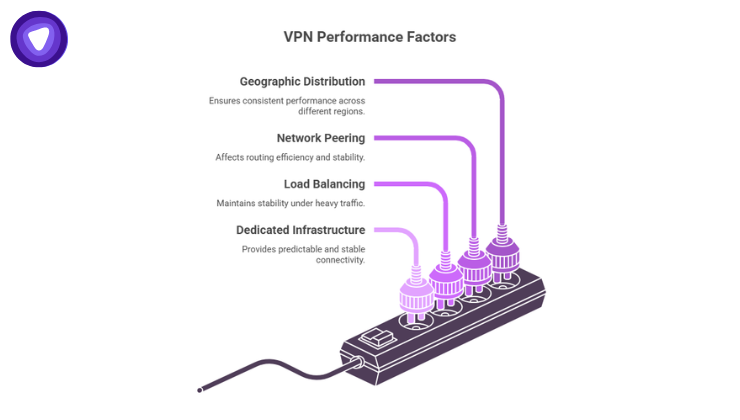
VPN performance depends heavily on the provider’s backend infrastructure architecture.
A large server count does not automatically translate into stable enterprise-grade performance.
Infrastructure benchmarking should evaluate several operational areas.
1. Geographic Server Distribution
Regional server availability reduces routing distance and improves latency consistency.
Businesses operating internationally require optimized routing coverage across multiple regions instead of isolated high-performance locations.
2. Network Peering Relationships
ISP peering quality has a direct effect on routing efficiency.
Weak peering arrangements increase:
- Latency
- Congestion exposure
- Packet instability
- Routing inefficiencies
Networking professionals consistently identify routing quality as one of the largest contributors to poor VPN usability across long-distance deployments.
3. Load Balancing Efficiency
Traffic distribution systems determine whether VPN gateways remain stable under heavy concurrency.
Poor load balancing creates inconsistent regional performance even when sufficient infrastructure capacity exists.
4. Dedicated Infrastructure Availability
Dedicated servers and Dedicated IP environments improve predictability because resources remain isolated instead of shared across large public traffic pools.
This becomes especially important for businesses launching branded VPN services with enterprise customers expecting stable connectivity behavior.
Why Real-World Benchmarking Matters More Than Synthetic Tests
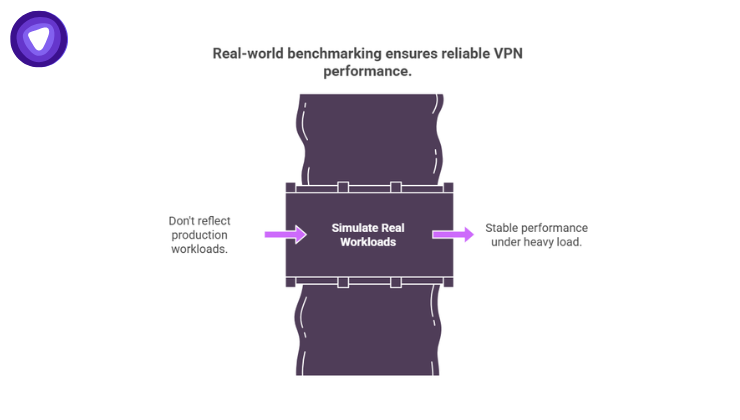
Synthetic testing environments rarely represent production conditions accurately. Enterprise benchmarking should simulate real operational workloads.
That includes testing:
- Concurrent user sessions
- Cloud application traffic
- Video conferencing
- Cross-region API communication
- Authentication systems
- File synchronization
- Long-duration encrypted sessions
Single-user speed tests do not expose infrastructure scaling limitations.
A VPN infrastructure capable of maintaining stable performance across thousands of simultaneous encrypted sessions provides far greater operational reliability than one optimized for isolated benchmark bursts.
Read more on VPN encryption here. Encryption Overhead Still Affects Scalability
Encryption Overhead Still Affects Scalability
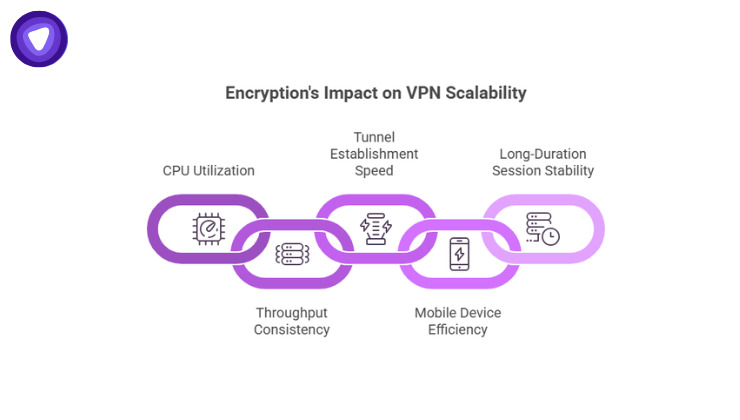
Encryption consumes computational resources during packet processing.
Modern VPN environments commonly use AES-256 or ChaCha20 encryption standards.
AES-256 performs efficiently on enterprise hardware supporting AES-NI acceleration, while ChaCha20 often delivers better performance on lower-power and mobile devices.
Benchmarking should evaluate how encryption affects:
- CPU utilization
- Throughput consistency
- Tunnel establishment speed
- Mobile device efficiency
- Long-duration session stability
Testing encryption overhead on actual deployment hardware is critical because performance characteristics vary heavily across environments.
Common VPN Benchmarking Mistakes Businesses Still Make
Common VPN Benchmarking Mistakes Businesses Still Make
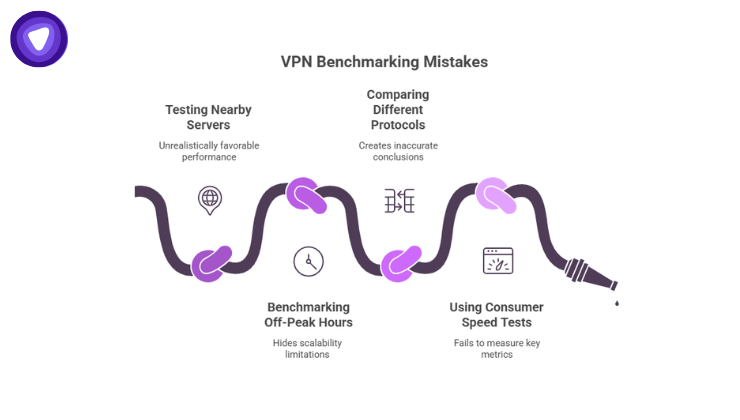
Several benchmarking mistakes continue to produce misleading evaluation results.
Testing Only Nearby Servers
Nearby VPN gateways create unrealistically favorable performance conditions.
Enterprise environments require international routing validation.
Benchmarking During Off-Peak Hours
Low-congestion conditions hide scalability limitations.
Benchmarking should include peak traffic periods.
Comparing Different Protocols
Testing WireGuard against OpenVPN creates inaccurate conclusions.
Protocols must remain identical across benchmark environments.
Using Consumer Speed-Test Platforms
Browser-based speed tests fail to measure:
- Tunnel persistence
- Session stability
- Packet consistency
- Concurrent encrypted traffic
- Authentication performance
Enterprise VPN benchmarking requires workload-focused validation instead of simplified throughput measurements.
What Businesses Should Look for in a White-Label VPN Infrastructure Partner
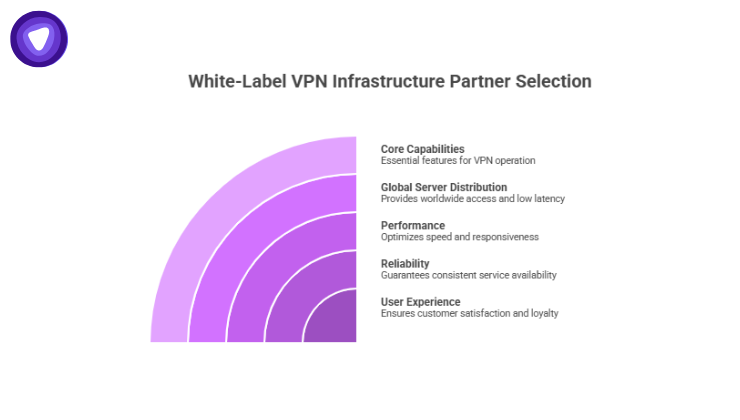
For businesses launching branded VPN services, backend infrastructure quality directly affects performance, reliability, and user experience at scale.
Key capabilities include:
- Global server distribution
- WireGuard, OpenVPN, and IKEv2 support
- Dedicated servers and Dedicated IP options
- Centralized management controls
- Stable international routing
- Scalable backend infrastructure
- Performance monitoring and reporting
Operational visibility is equally important. Businesses should have access to regional performance data, session behavior, usage patterns, and traffic distribution insights to manage scale effectively.
Where PureVPN’s White Label VPN Solution Fits
PureVPN’s White label VPN Solution fits into this stack as the backend layer that handles routing, encryption, and session management at scale. Instead of businesses building and maintaining their own global VPN infrastructure, it provides pre-built access to distributed server networks, multiple protocol support, and centralized control systems.
This allows organizations to focus on branding, customer experience, and distribution while relying on established infrastructure for traffic handling and performance consistency.
In practice, it is positioned for businesses that need to launch or scale VPN services without managing low-level networking complexity. It supports requirements such as Dedicated IP provisioning, protocol flexibility across WireGuard, OpenVPN, and IKEv2, and performance visibility across regions.
For teams benchmarking VPN performance, this type of infrastructure becomes relevant when the goal is to validate whether backend systems can maintain stable encrypted connectivity under real-world load rather than isolated test conditions.
Final Thoughts
VPN benchmarking is ultimately about consistency under real operational load, not isolated performance peaks. Latency stability, routing efficiency, packet reliability, and sustained throughput determine whether an infrastructure can support secure access across distributed users and cloud environments without disruption.
For businesses building or scaling a white-label VPN service, performance is not a secondary consideration. It is a core dependency that shapes user experience, support load, and long-term scalability. Infrastructure that holds steady under continuous traffic delivers predictable outcomes. That predictability is what separates usable VPN systems from unstable ones.