

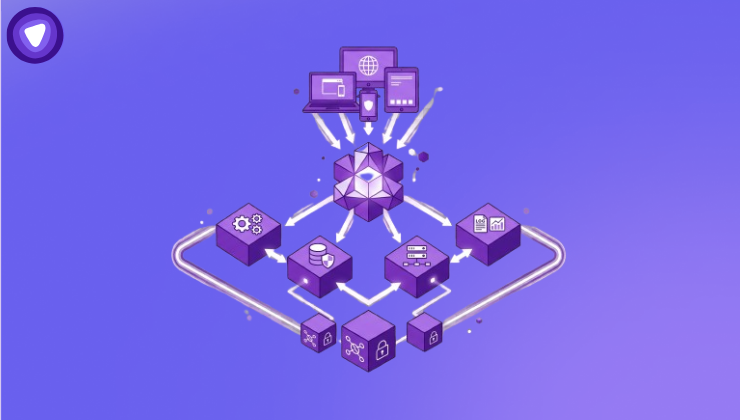
- A white label VPN API covers three tightly coupled layers: authentication, tunneling, and session management. Weakness in any one layer compromises the entire product.
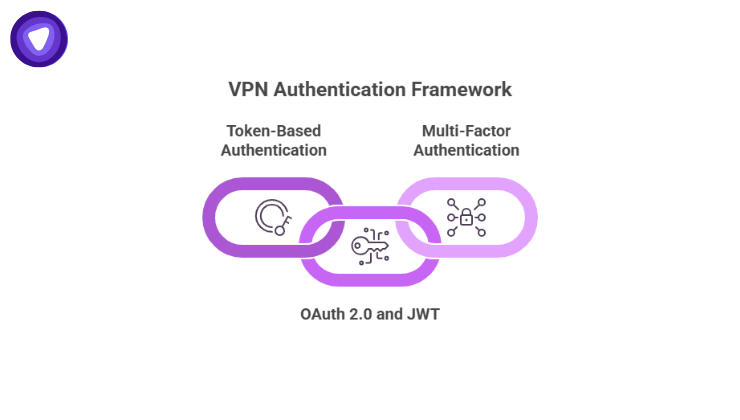
- Token-based authentication using OAuth 2.0 and JWT is the standard for VPN APIs because it allows tunnel servers to verify identity locally without a round-trip to the auth server, keeping reconnections fast.
- WireGuard has replaced OpenVPN as the performance baseline, delivering over 75% faster speeds and 15% less data overhead, making protocol selection a direct factor in product quality.
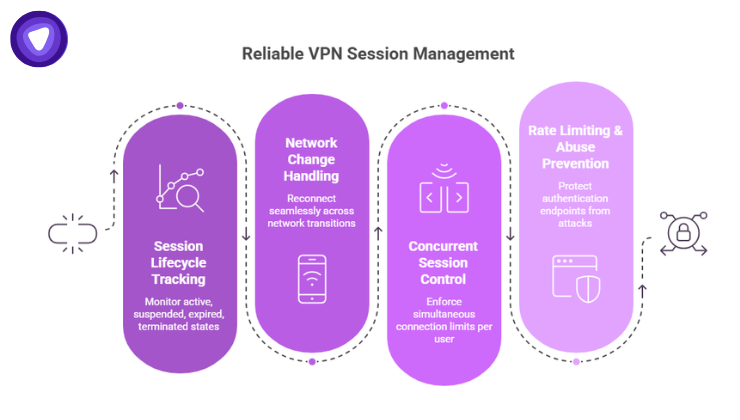
- Session management handles far more than connection state. It governs reconnection across network changes, concurrent device limits, and the difference between a suspended session and one that forces full re-authentication.
- Stolen credentials are behind nearly one in three breaches recorded over the past decade, making rate limiting, MFA, and anomaly detection at the authentication endpoint non-negotiable for any VPN API exposed to the public internet.
Most businesses that want to offer VPN services do not build from scratch. Instead, they rely on a white label VPN API to handle the infrastructure underneath. The real complexity lives in those layers: how users get authenticated, how traffic gets tunneled securely, and how sessions stay stable across networks, devices, and reconnection events. Get any one of these wrong, and the product fails regardless of how polished the front end looks.
This is a technical breakdown of how white label VPN API architecture actually works across these three pillars.
What a White Label VPN API Actually Does
A white label VPN API is not just a protocol wrapper. It is a full backend stack that handles identity, encryption, connection state, and traffic routing, exposed through a set of API endpoints that your application calls.
Your application handles the brand, the UI, and the user experience. The API handles everything that keeps traffic secure and sessions alive.
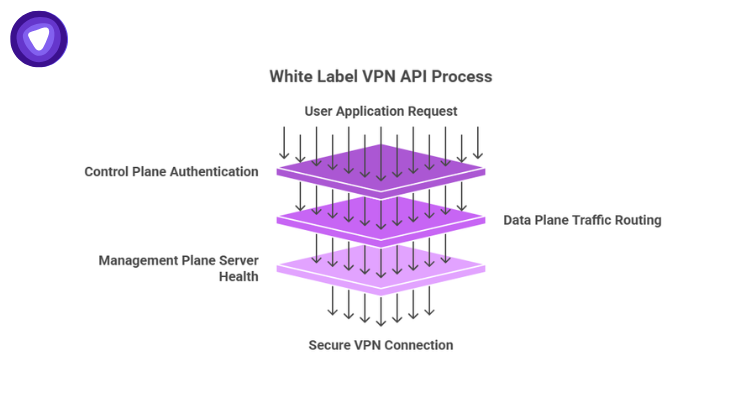
The architecture typically sits across three layers:
- Control plane handles authentication, session tokens, and configuration delivery
- Data plane handles tunneled traffic between the client and VPN servers
- Management plane handles server health, load balancing, and geographic routing
All three must work in tight coordination. A session token issued by the control plane must be accepted by the data plane within milliseconds, or the connection fails.
Authentication: The First Gate
Authentication is where every VPN session begins, and where most security failures originate. The API design here determines both the security baseline and the user experience at login and reconnection.
How Token-Based Auth Works in VPN APIs
VPN APIs use token-based authentication rather than credential-per-request models. The reason is simple: passing usernames and passwords repeatedly across tunnel negotiations is slow and creates unnecessary exposure surface.
The standard flow:
- Client sends credentials (username + password or OAuth token) to the authentication endpoint
- API validates against the identity backend (internal user database or federated identity provider)
- API returns a short-lived access token and a longer-lived refresh token
- Client uses the access token for all subsequent API calls and tunnel negotiations
- When the access token expires, the client exchanges the refresh token for a new pair without re-entering credentials
Access tokens in VPN systems are typically valid for 15 to 60 minutes. Refresh tokens can be valid for days or weeks, depending on the product’s security policy.
OAuth 2.0 and JWT in VPN Contexts
Most modern white label VPN APIs use OAuth 2.0 as the authorization framework, with JSON Web Tokens (JWT) as the token format. JWTs are self-contained: the token itself encodes the user’s identity, permission scopes, and expiration time, signed with the API’s private key.
This matters for VPN architecture because tunnel servers can verify a JWT locally without calling back to the authentication server every time. The server checks the signature, reads the claims, and either accepts or rejects the connection. This eliminates a round-trip that would otherwise add latency to every reconnection event.
Multi-Factor Authentication at the API Layer
Enterprise white label deployments often require MFA. At the API level, this is handled as a second authentication step before the access token is issued. The client completes the first factor, receives a temporary challenge token, submits the second factor (TOTP code, push notification confirmation, or hardware key response), and only then receives the full access token.
This flow is entirely contained within the control plane and does not touch the tunnel negotiation process.
Tunneling Protocols: What the API Exposes
Protocol selection is not just a technical checkbox. It directly affects throughput, latency, mobile reconnection behavior, and how cleanly the API hands off configuration to the client.
Protocol Options and Their API Implications
The tunneling protocol determines how traffic is encapsulated and encrypted between the client and the VPN server. White label VPN APIs typically expose protocol selection as a configurable parameter, not a hardcoded choice.
| Protocol | Transport | Primary Use Case | API Overhead |
| OpenVPN | TCP or UDP | Broad compatibility | Medium |
| WireGuard | UDP | High performance, low latency | Low |
| IKEv2/IPSec | UDP | Mobile, fast reconnect | Low |
| L2TP/IPSec | UDP | Legacy enterprise systems | Medium |
| SSTP | TCP (443) | Firewall traversal | Low |
WireGuard has become the performance baseline in modern deployments. Independent testing shows WireGuard is consistently over 75% faster than OpenVPN regardless of server location, and uses 15% less data due to its lighter codebase and UDP transport layer. Its kernel-level implementation also reduces CPU overhead on the server side, which matters at scale.
How the API Manages Tunnel Negotiation
Tunnel establishment is a multi-step handshake managed through the API:
- Client requests a server assignment from the API (passing region preference, protocol, and load constraints)
- API returns a server endpoint, port, and pre-shared configuration parameters
- Client initiates the protocol handshake directly with the assigned server
- Server validates the session token from the handshake against the access token issued during authentication
- Tunnel is established; the API records the session start
The API does not sit in the data path during active tunneling. Once the tunnel is up, traffic flows directly between the client and the VPN server. The API only re-enters the picture for session events: renewal, reconnection, or termination.
Kill Switch Implementation at the API Level
A kill switch blocks all traffic if the VPN tunnel drops unexpectedly. At the API level, this is implemented by:
- Maintaining a heartbeat signal between client and server (typically every 10 to 30 seconds)
- Detecting missed heartbeats as a tunnel failure event
- Triggering a client-side firewall rule that blocks all non-VPN traffic
- Initiating a reconnection flow through the API
The kill switch logic lives primarily on the client SDK, but the API provides the health-check endpoints and reconnection orchestration that make it functional.
Session Management: Keeping Connections Alive
A tunnel that drops and does not recover cleanly is a failed product, regardless of how well the authentication or protocol layers performed. Session management is where the API proves its reliability under real-world conditions.
Session Lifecycle in a White Label VPN API
A VPN session has a defined lifecycle that the API must track at every stage.
Active: Tunnel is established, traffic is flowing, heartbeats are passing.
Suspended: Client has moved to background or lost network briefly. The session token is preserved for a configurable period (typically 60 to 300 seconds) to allow reconnection without full re-authentication.
Expired: Session token has exceeded its valid window. The client must re-authenticate or use the refresh token to obtain a new session.
Terminated: Client explicitly closed the connection, or the server closed it due to a policy violation, billing event, or server maintenance.
The API must handle transitions between these states reliably. A session that incorrectly transitions from Suspended to Expired causes an unnecessary re-authentication cycle, which degrades the user experience.
Handling Reconnections Across Network Changes
Mobile devices change networks constantly. A user moving from Wi-Fi to cellular, or switching between two Wi-Fi networks, will trigger a network change event that interrupts the tunnel.
IKEv2 handles this natively through MOBIKE (RFC 4555), which allows the tunnel to survive IP address changes without re-establishing the full handshake. WireGuard handles it differently: the protocol is stateless on the server side, so a client that reconnects from a new IP simply sends packets and the server updates its endpoint record automatically.
At the API layer, session management during reconnection involves:
- Detecting the network change via client-side monitoring
- Sending a session refresh request to the API with the current refresh token
- Receiving updated server parameters if the original server is no longer optimal
- Re-establishing the tunnel with the new parameters
Global mobile data traffic is projected to grow threefold between 2023 and 2029, driven by improved device capabilities and the rise of data-intensive applications. VPN architectures that cannot handle rapid network transitions cleanly will face increasing reliability issues as mobile usage dominates.
Concurrent Session Control
Most VPN products limit simultaneous connections per account. The API enforces this at the session layer by tracking active sessions per user ID and rejecting new connection requests once the limit is reached.
The implementation typically works as follows:
- Each session start writes a record to a distributed session store (Redis is common for this)
- Each new connection request checks the session count before proceeding
- If the limit is reached, the API returns an error code that the client can translate into a user-facing message
- When a session ends (either cleanly or via timeout), the record is removed, freeing the slot
This requires the session store to be consistent across all API nodes. A distributed lock or a centralized session arbiter prevents race conditions where two connection requests arrive simultaneously and both pass the limit check.
API Rate Limiting and Abuse Prevention
VPN APIs are targets for credential stuffing and brute-force attacks. Rate limiting at the authentication endpoint is standard, typically enforced with a sliding window algorithm:
- First layer: IP-based rate limiting (e.g., 10 authentication attempts per minute per IP)
- Second layer: Account-based rate limiting (e.g., 5 failed attempts per account per hour before lockout)
- Third layer: Anomaly detection for distributed attacks (many IPs attempting the same account)
Stolen credentials have played a role in nearly one-third of all breaches recorded over the past ten years, making authentication endpoints a persistent and high-value target. VPN API authentication endpoints are a direct target because they are publicly accessible and control access to the entire service.
PureVPN White Label: What the Infrastructure Looks Like in Practice
For teams that need this architecture without building it from scratch, the practical question is whether a white label provider’s API actually covers all three layers at production quality.
PureVPN’s white label VPN solution delivers this architecture as a ready-to-integrate package. The API covers authentication (with OAuth 2.0 and JWT support), protocol selection across WireGuard, OpenVPN, and IKEv2, and full session lifecycle management including concurrent session control and reconnection handling.
The infrastructure spans a global server network across 70+ countries, which the white label API exposes through a server selection endpoint that accounts for load, latency, and geographic policy. Partners get full control over branding, user management, and pricing while the underlying tunneling and session layer runs on PureVPN’s production infrastructure.
For businesses building VPN products for enterprise clients or consumer markets, this removes the need to manage protocol implementation, server infrastructure, and security patching. The API handles the technical layer; the partner owns the product.
The Architecture Reflects the Product’s Reliability
When these three layers work together correctly, the end user never thinks about them. When they do not, the product fails in ways that are hard to diagnose and harder to recover from commercially.
Authentication, tunneling, and session management are not independent concerns. They are tightly coupled: a weak authentication layer exposes the tunnel, a poorly designed tunneling layer breaks sessions, and unreliable session management makes the product unusable on mobile.
White label VPN APIs that get these three layers right give partners a foundation they can build on confidently. The ones that cut corners in any layer eventually show it, in dropped connections, authentication failures, or security incidents.
Understanding how the architecture works is the first step to evaluating whether a white label partner can actually deliver what they promise.