

- Digital privacy protection for SaaS combines three functions: identity exposure checks, continuous dark web monitoring, and data broker opt-out requests running on one account.
- Enterprise buyers now ask about sub-processors by name: licensing a third-party engine for this feature creates a sub-processor relationship that must be disclosed in the SaaS company’s own data processing agreement.
- Building it in-house rarely pays off: it typically takes two to four quarters and ongoing broker maintenance, while an API integration compresses that to days or weeks.
- It moves the needle on retention: products bundling privacy protection see roughly 50 percent lower churn among users who activate it.
- Billing and ownership need to be decided upfront: most products meter it per seat, and incident response should split cleanly between the infrastructure partner and the SaaS company.
A security review used to stop at encryption standards and access logs. Now it asks a harder question. Which third parties touch user data once it leaves your servers. What happens to that data if it turns up somewhere it should not.
That question is why digital privacy protection for SaaS has moved from a customer perk to a line item in enterprise procurement. SaaS vendors are not adding it because competitors have it. They are adding it because buyers now ask for it by name. The operational math behind building it in-house rarely closes either.
Procurement teams now ask about this at the questionnaire stage, not after a deal closes. A vendor that cannot answer the sub-processor question cleanly loses time in the review cycle. A vendor that already has an answer moves straight to contract. That answer starts with the engineering decision behind the feature, then extends into how it gets billed and supported.
What Digital Privacy Protection For SaaS Actually Covers
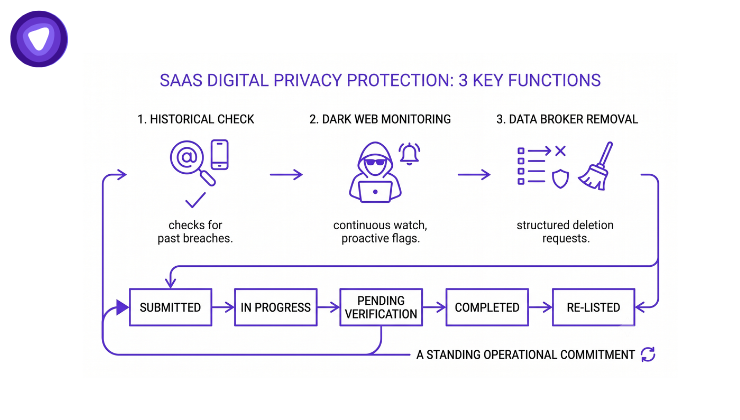
Inside a product, digital privacy protection is not one feature. It runs as three connected functions on the same account. The first checks whether a user’s email, phone number, or username has already surfaced in a known breach. The second keeps that identifier under continuous watch across dark web marketplaces, forums, and paste sites.
New appearances get flagged through a webhook instead of a manual rescan. The third submits structured removal requests to data broker and people-search sites. Each request moves through a status lifecycle. Submitted, in progress, pending verification, completed, and re-listed if the data reappears.
That last stage matters more than most product teams expect. Broker listings do not stay deleted. A completed opt-out can re-list within months. Digital privacy protection for SaaS is not a one-time cleanup task. It is a standing operational commitment, and that commitment drives the build versus buy decision below.
Why Enterprise Buyers Are Asking About This Now
Third-party vendors now account for more than 60% of enterprise cyber risk. Procurement teams have adjusted their questionnaires to match. A SOC 2 report used to close most of the conversation. It no longer does. A SOC 2 report describes your own controls. It says nothing about the sub-processor you embedded to run digital privacy protection for SaaS.
The Sub-Processor Disclosure Problem
A SaaS company that licenses a third-party engine for identity exposure checks or broker opt-outs creates a new sub-processor relationship. That provider now sits inside the SaaS company’s own data processing agreement. Enterprise buyers increasingly want that sub-processor named, not just categorized.
- Named disclosure: Some state privacy laws now require listing specific White Label VPN Solution sub-processor entities, not vague categories.
- Audit alignment: Buyers compare sub-processor answers across renewal cycles and flag inconsistencies.
- Certification pass-through: A partner’s SOC 2 Type II status becomes part of your own answer, not a separate footnote.
A manual response to a full enterprise security assessment still runs two to four weeks without a prepared answer library. That baseline holds for standard SOC 2 questionnaires today. Adding digital privacy protection without a documented sub-processor answer turns a simple feature into a deal delay.
The Build Versus Buy Math Engineering Teams Actually Run
Product teams often assume digital privacy protection for SaaS is a database lookup against breach dumps. It is not. It runs as three separate operational systems, and each one carries its own maintenance load.
What Building In-House Actually Requires
A team building this internally needs breach data ingestion pipelines. It needs relationships or scraping access across hundreds of broker sites. A verification workflow for broker responses is also needed. It needs a monitoring system that runs continuously, not on a fixed schedule. None of that is a one-quarter build. Broker sites change their opt-out forms without notice. A pipeline built against last year’s form structure breaks silently, often without anyone noticing until a customer complains.
What An API Partner Compresses
An account management API changes the math. One that already handles account creation, status checks, and subscribed feature scopes turns a multi-quarter engineering project into an integration measured in days.
White Label VPN Solution
| Factor | Build In-House | API-Based Partner |
| Time to launch | Two to four quarters | Days to a few weeks |
| Broker coverage at launch | Small, manually sourced list | 400 or more brokers already mapped |
| Ongoing maintenance | Full engineering ownership | Handled by the infrastructure partner |
| Compliance certification | Must be built and audited separately | SOC 2 Type II already in place |
| Re-listing monitoring | Custom rebuild required | Native status lifecycle tracking |
Where This Feature Lands In Retention Economics
Digital privacy protection for SaaS earns its place on a roadmap when it changes a renewal conversation. Not just a feature list. A productivity SaaS application added a built-in privacy feature and saw an 18 percent reduction in churn after launch. Users treated the feature as a reason to stay. Not a reason to try a competitor next renewal cycle.
The pattern holds across bundled services more broadly. Products that bundle privacy protection see roughly 50 percent lower churn among users who activate the feature. That gap is not a rounding error for a SaaS company fighting for net revenue retention. It is a direct answer to a question every board asks about expansion revenue.
Multi-Tenant Billing And Admin Visibility Questions
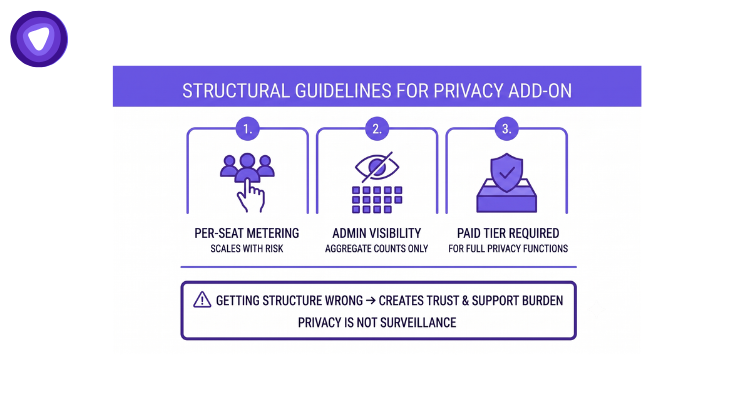
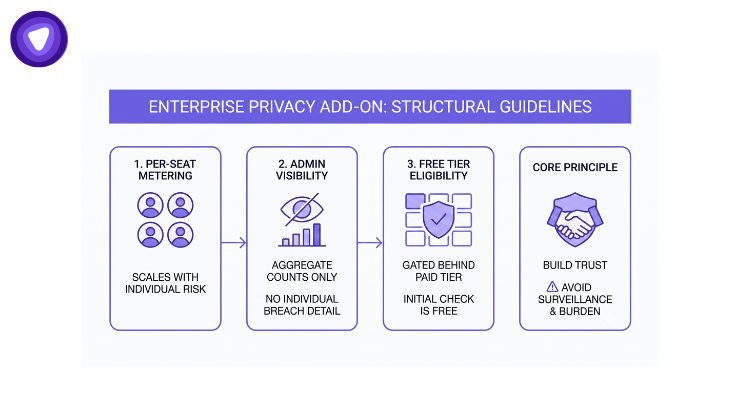
Once a SaaS company decides to add digital privacy protection, the next questions turn structural rather than technical.
- Per-seat or per-workspace: Most B2B SaaS products meter this as a per-seat add-on rather than a flat workspace fee. Exposure risk scales with individual users, not accounts.
- Admin visibility: Workspace admins typically see aggregate exposure counts. Not individual breach detail. This keeps a privacy feature from turning into a surveillance tool.
- Free tier eligibility: Most vendors gate opt-out and monitoring functions behind a paid tier. The initial exposure check often stays free as a trust signal.
Getting this structure wrong creates its own support burden. A privacy feature that exposes too much to an admin becomes a trust problem instead of a trust builder.
Who Owns The Incident When Something Goes Wrong
Digital privacy protection for SaaS introduces a question most teams have not answered before adding the feature. If a user’s data shows up exposed, who owns the response. The product team building the feature, the security team handling breach disclosure, or the infrastructure partner running the underlying checks.
The cleanest answer splits the responsibility along a clear line. The infrastructure partner owns detection and the mechanics of the opt-out request. The SaaS company owns user communication and how the exposure gets surfaced inside the product. Blurring that line creates confusion during an actual incident, which is the worst time to be deciding who sends the notification email.
The Compliance Clock Is Also Moving
State enforcement around data broker obligations is no longer theoretical. California’s Privacy Protection Agency closed a settlement with a streaming company for 2.75 million dollars in February 2026. That figure marked the agency’s largest settlement to date. California’s DROP platform adds direct pressure on the broker side. Penalties run 200 dollars per day per unfulfilled deletion request starting in August 2026.
For a SaaS company whose users are themselves data subjects under these laws, digital privacy protection for SaaS stops being a nice-to-have. It starts functioning as downstream compliance cover. The average breach still goes undetected for 194 days. That window is long enough for exposed data to circulate across dozens of broker listings before anyone acts. A product that surfaces exposure earlier closes a real gap. Not a marketing one.
Making The Decision Without Overbuilding
Most SaaS teams do not need to choose between a full privacy suite and doing nothing. The realistic choice sits between three tiers. Each tier fits a different stage of product maturity. A single exposure check at signup covers the earliest stage. A fully monitored, brandable privacy dashboard inside the product covers the most mature one. Most teams land somewhere in between. They add monitoring first, then layer in opt-out coverage once retention data justifies the spend.
PureVPN White Label’s Digital Privacy Protection gives SaaS teams a path into this category without the multi-quarter build. The infrastructure runs through a documented account management API. It covers identity exposure checks, continuous dark web monitoring, and data broker opt-out requests, all under a partner’s own brand. Partners are not asked to trust a black box. The same infrastructure already serves 150 or more partners worldwide and holds a SOC 2 Type II, BigFour no-log certification.
Final Thoughts
For a SaaS company weighing whether digital privacy protection for SaaS belongs on the next roadmap, the practical test stays simple. Compare the engineering cost of building continuous broker monitoring in-house. Weigh it against the cost of integrating infrastructure that already handles it at scale. Under a partner’s own brand. With the compliance paperwork already finished.
Digital privacy protection for SaaS is becoming a standard line in enterprise procurement, not an optional add-on. It shows up in the sub-processor section of a security questionnaire. It shows up again in the churn dashboard six months after launch. SaaS companies that treat it as a retention lever and a compliance answer close deals faster. The ones still explaining why they do not have one keep losing that window.