

- DPP API integration shares the VPN account’s authentication layer: both surfaces exchange the same Secret Key for a bearer access token under one partner account, so no second auth model or security review is needed.
- The two products track different lifecycles: VPN accounts move through create, enable, and renew states, while data privacy protection follows a five stage opt-out lifecycle from submitted to re-listed.
- Provisioning stays independent: a VPN account and an identity exposure record are created separately, since no single endpoint combines both objects.
- It moves the economics for MSPs: bundled privacy and VPN products see roughly 78 percent renewal and 50 percent lower churn compared to single-product accounts, and billing runs on the same per-seat model already used for VPN.
- Integration timeline is short for teams with an existing VPN build: most partners add identity exposure and monitoring endpoints in one to two sprints, since the authentication work is already done.
MSPs already reselling a white label VPN often lose expansion revenue. A client asks for breach monitoring or data removal, and the MSP has nothing to offer. Adding it usually means a second vendor, a second billing relationship, and a separate provisioning flow for every client account. DPP API integration removes that requirement when the MSP already runs the underlying VPN account API.
One infrastructure provider runs both product lines under a single partner account. VPN account management and data privacy protection sit on separate endpoint groups. But the two surfaces connect underneath. Understanding how they connect changes how an MSP scopes the work and prices the add-on.
What Staying on Two Roadmaps Costs an MSP
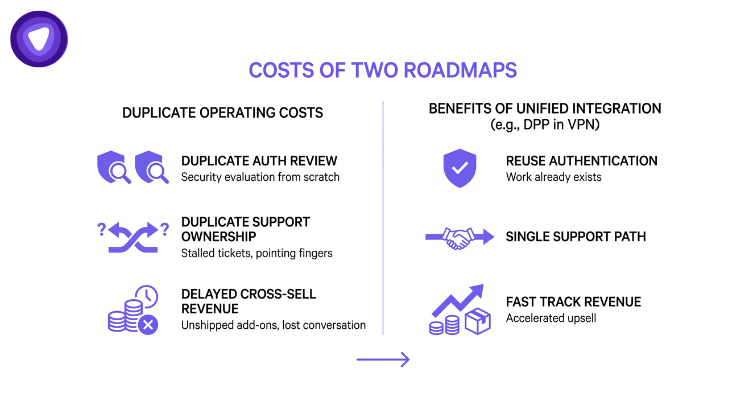
For MSPs, every separately managed privacy integration adds another provisioning workflow and another support queue. A second vendor means a second security review before anything ships to clients. It also means a second contract, a second SLA to track, and a second escalation path when something breaks.
That cost shows up in three places:
- Duplicate authentication review: security teams evaluate a new vendor’s auth model from scratch, instead of reusing an approval already on file.
- Duplicate support ownership: two vendors means two places a ticket can stall while each side points at the other.
- Delayed cross-sell revenue: the longer the add-on stays unshipped, the longer it stays out of the upsell conversation.
Integrating DPP into an existing VPN account avoids that duplicate operating cost. The authentication work and the partner relationship already exist.
Why This Cannot Wait
A 2025 survey on API security found that 57 percent of organizations suffered an API-related breach in two years. The same survey found organizations run 10 to 20 percent more active APIs than their security teams track. Every new integration a partner builds separately adds to that exposure.
The revenue case moves just as fast. MSPs that already cross-sell privacy services alongside their core offering see a 78 percent renewal rate, well above single-product accounts. Bundled users also churn roughly 50 percent less than clients on one product alone. Waiting on a second integration project means missing that renewal pattern while competitors already package privacy at checkout.
What DPP API Integration Actually Adds to an Existing VPN Stack
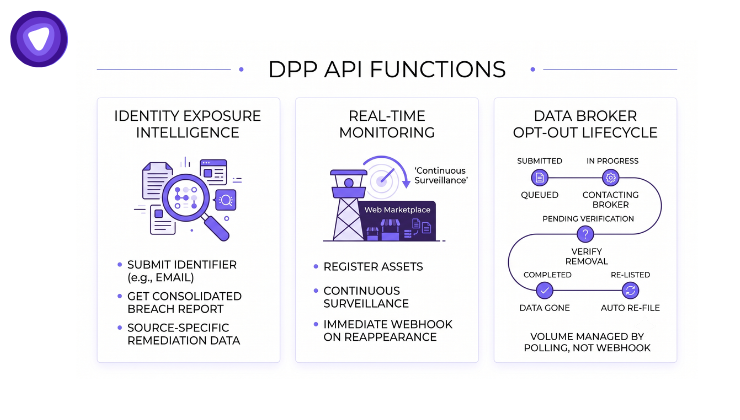
A data privacy protection layer covers three distinct functions. Each one maps to its own endpoint group, not one general purpose call.
Identity Exposure Intelligence
The identity exposure endpoint accepts an email, phone number, or username. It returns a consolidated report of where that identifier surfaced in known breaches. A partner submits one identifier per call and gets breach sources back, not a simple yes or no flag. That detail matters for remediation. A password from an old breach needs different guidance than a card number from a recent leak.
Real Time Monitoring Versus Manual Rechecking
Once exposure is confirmed, a partner can register the same asset for continuous dark web monitoring. That replaces re-scanning it by hand. The monitoring service watches marketplaces, forums, and paste sites. It pushes a webhook the moment the asset reappears. A partner that skips this step ends up polling on a fixed schedule instead. That delays detection and adds unnecessary call volume against rate limits.
Data Broker Opt-Out Lifecycle
A partner submits a user’s name and email to start an opt-out request. From there, it moves through five defined states:
- Submitted: the request is created and queued for processing.
- In progress: the service is actively contacting the broker.
- Pending verification: the broker requires confirmation before removal.
- Completed: the broker confirms the data is gone.
- Re-listed: the data reappears, and a new request files automatically.
A single user can carry multiple opt-out requests in flight at once. Brokers do not process removals on the same schedule. More than 400 brokers fall under this coverage today. A partner is not filing one request per user, but potentially dozens across the broker landscape. DPP API integration handles that volume through status polling on the opt-out endpoint, not a webhook. Broker responses do not arrive the way breach alerts do.
How the Account Layer Works Across Both APIs
VPN account management and data privacy protection sit on different endpoint groups. But they share the same partner account structure underneath.
| Layer | Primary Object | Auth Pattern | Lifecycle Model | Delivery Method |
| VPN Account Management | VPN account, tied to subscription type | Secret Key to bearer access token | Create, generate, extend, renew, enable, disable, delete | Request and response, status polling |
| Data Privacy Protection | Identity record, tied to email or phone | Secret Key to access token via auth endpoint | Submitted, in progress, pending verification, completed, re-listed | Webhook for monitoring, polling for opt-out |
Both API surfaces authenticate the same way. A Secret Key exchanges for a bearer access token, tied to a single partner or reseller ID. A partner that already integrated VPN account management does not need a new authentication model to add DPP API integration. It needs a second set of endpoints, evaluated on their own merits rather than a second security review.
The Provisioning Sequence Question
Partners often ask whether DPP API integration needs to run before or after VPN account creation. The two are independent. A VPN account grants network access, tied to a subscription type, a country inventory, and a protocol list. An identity record tracks exposure instead, tied to an email or phone number, not a subscription.
A partner can provision a VPN account first. Identity monitoring can get added weeks later without breaking either object. Sequencing only matters for one case: onboarding flow design. Consider an MSP adding a privacy add-on to an existing client’s VPN plan. The VPN account already exists at signup. Adding identity exposure intelligence at that point means one additional call. It uses the client’s email as the identifier, fired right after account confirmation returns. The two calls do not depend on each other. A failure in one does not roll back the other.
Billing and Margin Impact for MSPs
DPP API integration bills per user rather than per feature, the same model VPN accounts already use. An MSP adding privacy monitoring to an existing base of client seats can model margin before committing to it. The same per-seat math already applies to VPN pricing.
That consistency matters for how the add-on gets sold. A separate vendor usually means a separate pricing model. That forces a new margin calculation and a new line item on every client invoice. Running both products through one partner account keeps the pricing structure the client already understands. The MSP’s own margin math stays in one place, not two.
What a Technical Evaluation Actually Needs to Confirm
A handful of details decide most technical evaluations, and generic VPN content rarely covers them. A second Secret Key is not part of the picture. Both surfaces authenticate against the same partner account. Each session simply issues its own access token from that one key.
Rate limits stay separate as well. Each API surface tracks its own call volume. A spike in opt-out status checks does not throttle VPN account calls on the other surface. Reporting works the same way, since usage dashboards break volume out by product line rather than showing one blended number.
A partner with an existing VPN integration typically adds identity exposure and monitoring endpoints in one to two sprints. The auth layer already exists and does not need rebuilding. Most of that time goes into mapping opt-out lifecycle states into the partner’s own support tooling. Authentication work takes little of it.
Incident ownership splits cleanly between the two parties. The infrastructure partner owns detection and opt-out mechanics. The MSP owns client communication and in-product alerting. A partner that skips defining this split up front usually builds duplicate alerting logic. Both sides end up assuming the other handles client notification.
Compliance scope does shift once both products run together. Identity data processing adds a sub-processor relationship. That relationship needs to appear in the partner’s own data processing agreement. It sits alongside any VPN sub-processor language already on file.
What Happens When a Call Fails
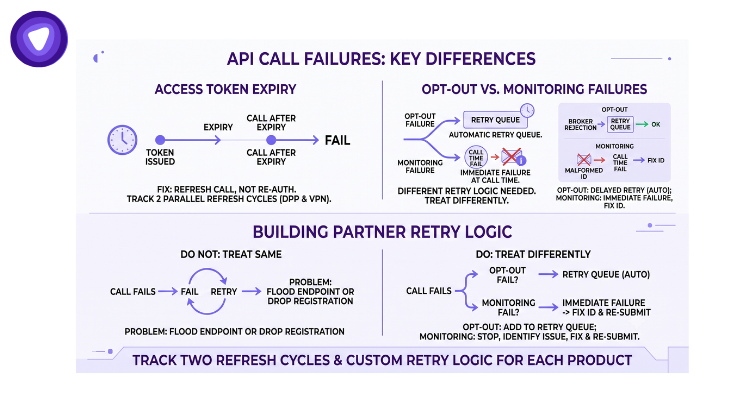
Generic API guides cover error codes in the abstract. A partner building DPP API integration alongside a VPN account needs to know what happens when a call fails. The failure modes do not always overlap.
Access Token Expiry
Both API surfaces issue access tokens with a defined expiry, returned in seconds at the time of the token exchange. A call made after expiry fails authentication on that surface only. The fix is a refresh token call, not a full re-authentication. A partner running both products needs two refresh cycles tracked in parallel. Each surface issues its own token, even though both trace back to one Secret Key.
Opt-Out Failures Versus Monitoring Failures
A failed opt-out submission and a failed monitoring registration behave differently. An opt-out request that fails at the broker level moves to a retry queue automatically. Brokers reject malformed submissions for reasons outside the partner’s control. A monitoring registration failure is usually immediate and tied to a malformed identifier. It surfaces back to the partner at call time, not during a background retry.
This distinction matters for how a partner builds its own retry logic. Treating both failure types the same way causes problems. It either floods the opt-out endpoint with retries, or drops a monitoring registration that needed an immediate fix.
Compliance and Data Handling Across Both Layers
Running VPN and data privacy protection under one integration does not merge their compliance obligations. It adds them together instead. VPN traffic falls under standard no-log commitments. Identity exposure checks and broker opt-out requests involve personally identifiable information, which carries separate handling requirements.
The underlying infrastructure is SOC 2 Type II certified. Its no-log policy is verified through a KPMG audit. That certification covers the VPN layer directly. Partners adding DPP API integration still need to confirm their own downstream handling of exposure reports and opt-out records. That data passes through their product surface too.
Where This Fits for MSPs Already Running VPN Infrastructure
PureVPN White Label VPN Solution’s data privacy protection layer covers identity exposure intelligence, dark web monitoring, and broker opt-out tracking. Coverage spans more than 400 brokers today, with over 150 partners already running it in production. MSPs access all three through documented endpoints and a shared partner account. Coverage and SLA terms get confirmed during technical review.
MSPs already running PureVPN White Label VPN Solution’s VPN infrastructure add DPP API integration onto the same account. That avoids a second vendor relationship, a second contract, and a second support queue. Start with the API reference to confirm whether an existing VPN account can support DPP API integration without rebuilding authentication.
Final Thoughts
Two privacy products do not need two integration timelines. The account layer, the authentication model, and the partner relationship stay the same. This holds whether an MSP calls one surface or both. What changes is the endpoint set and the lifecycle each one tracks. MSPs that treat DPP API integration as an extension of an existing VPN account keep the evaluation scoped and simple.