


Key Takeaways
- Employee dark web monitoring matters because 46 percent of infostealer-hit systems with corporate logins sit on unmanaged personal devices.
- Set scope before price: corporate domains, leadership identities, and opt-in personal addresses each need a different basis and alert owner.
- Bill per seat for corporate domains and per protected identity for leadership tiers.
- An infostealer alert needs session revocation, not just a password reset.
- Triage labor, not license cost, decides whether the line is profitable, so build the runbook first.
A small business client rarely asks for employee dark web monitoring by name. The request arrives after the damage instead. A payroll login gets used from another country. A fake invoice goes out from the owner’s real mailbox. By then, the MSP is the one answering for it.
The cost of that call is not small. The Identity Theft Resource Center tracked this in its 2025 Business Impact Report. It found 81 percent of small businesses suffered a breach in the past year. Among those breached, 62.5 percent reported a total impact above $250,000. For a client with 25 staff, that figure can wipe out a full year of profit.
Employee dark web monitoring gives MSPs an early signal on that risk. However, packaging decides whether it becomes a margin line or a support burden. This guide covers scope, billing units, the alert runbook, and how to prove value at renewal.
Why Employee Exposure Lands on the MSP’s Desk
Most employee credentials leak from places the MSP does not manage. That is the core problem. Dark web monitoring only reports what has already leaked, so the source of a leak shapes the response.
Verizon’s 2025 Data Breach Investigations Report studied infostealer malware logs. It found that 46 percent of systems holding corporate logins were unmanaged personal devices. An endpoint agent on the office laptop never sees a family PC at home. Yet that home PC may store the same email password and session cookies.
The 2026 edition of the same report adds pressure from another side. Small organizations made up 96 percent of ransomware victims. Software exploits also overtook stolen credentials as the top first entry point. Even so, exposed logins still help attackers move once they are inside.
Meanwhile, basic controls are slipping at the client level. Separate ITRC findings show MFA adoption fell from 33.6 percent in 2024 to 27.2 percent in 2025. Fewer accounts behind MFA means each leaked password carries more weight.
Four Packaging Decisions Before You Set a Price
Pricing comes last in a sound employee dark web monitoring offer. Four scope choices come first, and each one shapes margin and liability.
Decide Whose Identities Are in Scope
Corporate domain addresses are the easy part. The client owns those accounts, so monitoring them fits normal security duties. Even so, staff should receive written notice that the domain is watched.
Personal email addresses are a different matter. In Europe, regulators view workplace consent with suspicion because of the power gap. EDPB guidance holds that employees often cannot refuse consent freely. Therefore, MSPs should sell personal address monitoring as an opt-in benefit the employee controls. Alerts for a personal address should go to the employee, not the employer.
Executives sit in between. Owners and finance staff are common targets for invoice fraud. Many clients will pay more to cover their personal emails and phone numbers, with consent.
Pick the Billing Unit
Three billing units cover most SMB deals. Each one suits a different client profile.
- Per domain: simple for micro clients with fewer than 10 staff and one domain.
- Per seat: matches how most MSPs already bill for email, backup, and endpoint tools.
- Per protected identity: fits leadership tiers, where one person may have several emails and a phone number.
Decide Who Owns Triage
An alert with no owner becomes a liability. If the MSP sees an exposure and nobody acts, the client will ask why later. So the contract should name who reviews each alert type and how fast.
Define What a Closed Alert Means
A closed alert needs a written definition. For a corporate login, it means a password reset, MFA confirmed, and sessions revoked. For a personal address, it means the employee received the alert. Clear definitions keep quarterly reporting honest and repeatable.
Three Employee Tiers That Match How SMBs Buy
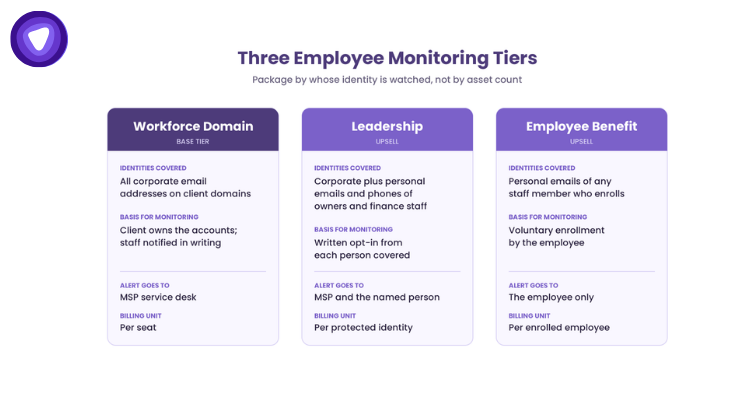
These tiers follow the scope decisions above rather than asset counts. The first tier fits almost every client. The other two are upsells for clients with higher exposure.
| Tier | Identities Covered | Basis for Monitoring | Who Gets the Alert | Billing Unit |
| Workforce Domain | All corporate email addresses on client domains | Client owns the accounts; staff notified in writing | MSP service desk | Per seat |
| Leadership | Corporate plus personal emails and phones of owners and finance staff | Written opt-in from each person covered | MSP and the named person | Per protected identity |
| Employee Benefit | Personal emails of any staff member who enrolls | Voluntary enrollment by the employee | The employee only | Per enrolled employee |
The Alert Runbook That Makes It a Managed Service
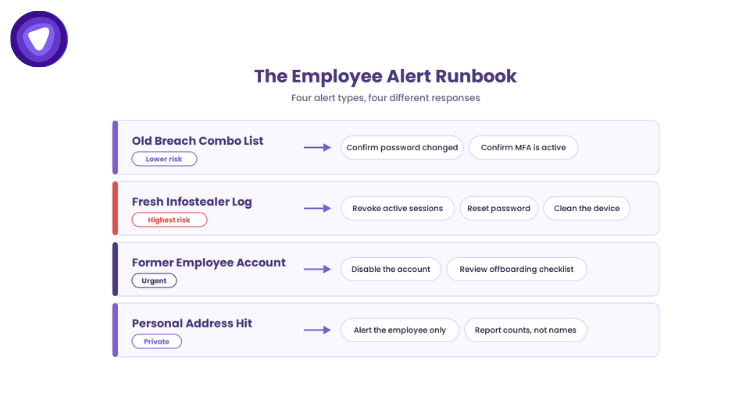
Raw alerts do not justify a monthly fee. A repeatable response does. Most employee dark web monitoring alerts fall into four types, and each needs its own steps.
First, alerts should flow into the ticket queue on their own. Providers that support webhook delivery push each finding the moment it is confirmed. That removes the gap between detection and a technician seeing it.
Old Breach Combo Lists
Many alerts come from old breaches recycled into new lists. The password may already be retired. Still, the technician should confirm the password changed and MFA is active. This alert type closes fast and suits junior staff.
Fresh Infostealer Logs
This alert type carries the highest risk. An infostealer log often holds live session cookies, not just a password. A reset alone does not end an active session. The response should include session revocation, a password reset, and a check of the infected device. If the device is personal, the employee needs clear steps to clean it.
Former Employee Accounts
An alert on a departed staff member points to an offboarding gap. If that account still works, the exposure is real and urgent. The fix is to disable the account and review the offboarding checklist. Over time, these alerts show where client processes need tightening.
Personal Address Hits
For opt-in personal addresses, the MSP should see only what it needs. The employee gets a private alert with plain steps to secure the account. The MSP report then counts these alerts without naming the person.
Illustrative Margin Math for a 20-Client Book
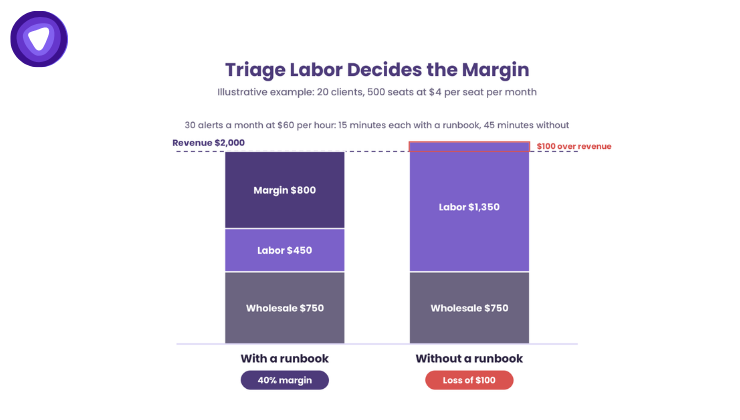
The numbers below are illustrative, not benchmarks. They show how triage labor shapes margin more than wholesale cost does.
Assume an MSP with 20 SMB clients averaging 25 seats each. That makes 500 seats on the Workforce Domain tier.
- Price: $4 per seat per month, or $2,000 in monthly revenue.
- Assumed wholesale cost: $1.50 per seat, or $750 per month.
- Assumed volume: 30 alerts per month across all clients.
- With a runbook: 15 minutes per alert at $60 per hour, or $450 in labor.
- Without a runbook: 45 minutes per alert, or $1,350 in labor.
With a runbook, monthly margin lands at $800, or 40 percent. Without one, the line drops to a loss of $100. The runbook, not the license price, decides whether this product pays.
Selling It at Insurance Renewal and the QBR
Cyber insurance renewals give MSPs a natural opening. Many 2026 applications ask what share of accounts has MFA, not just yes or no. Old contractor and shared accounts often make up that gap. An employee dark web monitoring report shows which exposed identities still lack MFA. That list gives the client a concrete fix before the form is due.
Quarterly business reviews are the second opening. Four numbers tell the story clearly:
- Exposed employee identities found this quarter
- Median time from alert to closed
- Former employee accounts found still active
- Identities exposed again after an earlier fix
These figures show the client what the fee bought. They also give the MSP evidence for a price review later.
What MSP Partners Report
The closest published evidence comes from the VPN side of the same white label program. On the MSP program page, one MSP head of business operations describes selling VPN under their own brand. They report a double-digit gain in client retention after that launch. That result is the partner’s own account, not an audited figure. It also covers VPN rather than monitoring. Still, the pattern carries over to employee dark web monitoring. Branded security layers keep SMB clients from shopping around.
PureVPN White Label Dark Web Monitoring
PureVPN White Label Dark Web Monitoring scans breach data and infostealer logs around the clock. Its infostealer coverage reaches credentials, cookies, and device context. A historical scan returns a total exposure count within seconds, which suits prospect assessments. MSPs can launch it as a full branded platform. They can also add it to their own stack through an API and SDK.
The platform holds SOC 2 Type II and ISO 27001 certification. It also reports more than 150 partners worldwide, a company figure rather than an audited one. For clients who want more, the same engine runs data broker removal as a separate line. Together, the two lines form the Digital Privacy Protection bundle.
Conclusion
Employee dark web monitoring sells best when scope, billing, and response are set before the first alert fires. Corporate domains cover the base tier. Leadership and benefit tiers add revenue with consent built in. The runbook protects the margin, and the QBR report proves the value. For the remaining build steps, the launch guide covers the full rollout.
Request a 20-minute margin and audit-scrutiny review.
Frequently Asked Questions
Is employee dark web monitoring worth it for small businesses?
Yes. Nearly half of infostealer-infected systems with corporate logins are personal devices no endpoint tool covers.
Can an employer monitor employees’ personal email addresses on the dark web?
Only through opt-in enrollment, with alerts for personal addresses going to the employee alone.
Does dark web monitoring replace MFA?
No. Monitoring finds leaked logins, MFA blocks password reuse, and session revocation stops stolen cookies.
How do MSPs price employee dark web monitoring?
Per seat for corporate domains, and per protected identity for leadership tiers covering personal accounts.
What should happen when an employee’s credentials appear in an infostealer log?
Revoke active sessions, reset the password, confirm MFA, then clean or replace the infected device.