

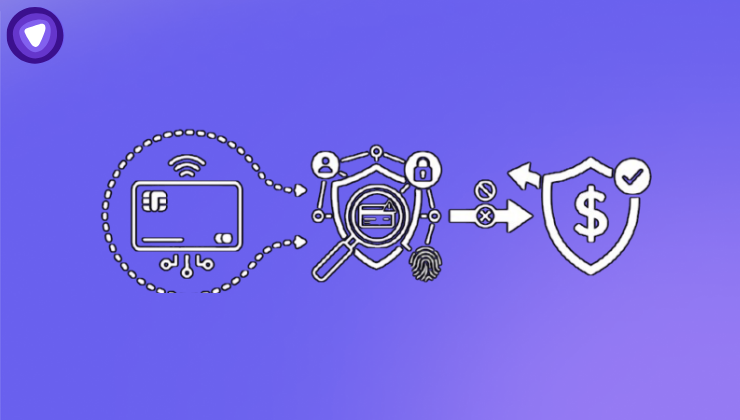
- Liability: Card-not-present fraud shifts chargeback liability to the merchant, not the issuing bank, since there is no signature or chip read to catch a stolen card number.
- Source of Exposure: Stolen card data gets sorted and listed within hours of a breach, coming from sources like POS malware, e-commerce skimming, and compromised payment processors.
- Two Monitoring Layers: Credential monitoring card fraud prevention works through two separate layers. One watches employee and admin logins tied to payment systems, the other watches card numbers and BIN ranges directly on the dark web.
- Alert to Action: A monitoring alert only stops fraud if it triggers a fast action, freezing or reissuing a card through a webhook before a fraudulent charge posts.
- Build vs Embed: Building this detection layer in-house can take months of engineering work, while embedding it through an existing API can get a platform live in weeks under its own brand.
A stolen card number rarely gets used the moment it is stolen. It gets sorted, priced, and listed for sale first, and that gap is where credential monitoring card fraud prevention does its actual work. The moment a card number or a payment system login appears on a dark web listing, a monitoring layer can flag it before a fraudster ever runs a transaction.
That distinction matters because two separate exposures create card not present fraud. One is the card number itself showing up for sale. The other is an employee or admin credential tied to the payment system getting stolen first. Most platforms only budget for one of these layers, and it is rarely the one that catches the breach at its source.
What Is Card-Not-Present Fraud and Why It Is Hard to Stop at the Point of Sale
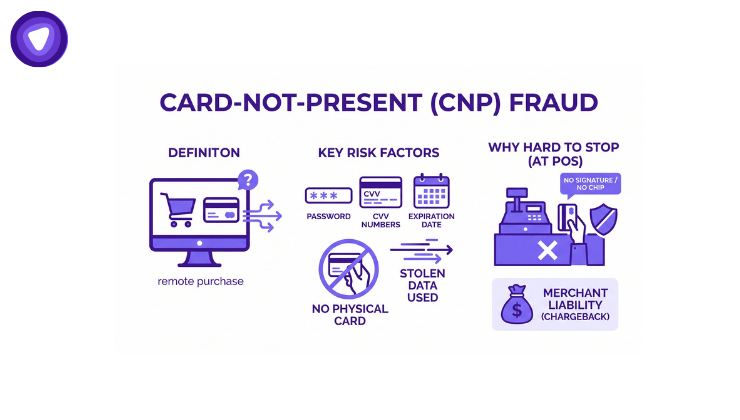
Card-not-present fraud happens when a stolen card number gets used for a purchase without the physical card ever being shown. Online checkouts, phone orders, and subscription sign-ups all fall into this category. There is no signature, no chip read, and no cashier to notice a mismatched name. The merchant absorbs the chargeback in almost every CNP case, not the issuing bank, which is the opposite of how liability works for a physical in-store fraud attempt.
That liability shift is why CNP fraud carries higher processing risk and higher fraud rates than in-person transactions. A fraudster only needs the card number, expiration date, and sometimes the CVV, all of which travel easily once stolen. None of that requires physical access to anything. For a payment platform running its own merchant base, this is not an abstract risk. It shows up as chargeback fees, reserve requirements from acquiring banks, and merchant churn once a fraud wave hits their checkout.
How Stolen Card Data Actually Reaches the Dark Web
Card data rarely gets stolen one record at a time. Most of it comes from bulk sources. Point-of-sale malware captures card details during a swipe or tap and can run undetected for months. E-commerce skimming injects malicious code into a checkout page and copies card details as customers type them in. A single compromised payment processor can expose card data across every merchant that processor touches.
Once stolen, card data gets sorted, priced, and listed within hours. Basic card numbers with a CVV sell for a few dollars each, while a full identity package built around the card sells for far more. Payment data consistently makes up the largest single share of what gets listed on dark web marketplaces. That volume is exactly why waiting for a chargeback report is the slowest possible way to find out a breach happened.
Two Different Monitoring Layers: Employee Credentials Versus Direct Card and BIN Data
Most fraud teams think of dark web monitoring as one thing. It is actually two separate layers that catch different exposures, and a platform needs both budgeted and integrated on purpose rather than assuming one covers the other.
| Layer | What It Watches | What It Catches | Where It Fits in a Fraud Stack |
| Employee Credential Monitoring | Admin and staff logins tied to payment systems, gateways, and dashboards | A stolen password that gives an attacker a direct path into the payment system itself | Upstream, before any card data is even touched |
| Direct Card and BIN Monitoring | Card numbers and bank identification number ranges appearing on dark web markets | Card data already stolen and listed for sale, whether the source was an employee credential or something else | Downstream, the last checkpoint before a chargeback |
Attackers frequently breach a payment system by using a stolen employee password, not a technical exploit. A compromised admin login for a payment gateway is a direct route to the card data behind it. Monitoring only for exposed card numbers misses that earlier warning sign entirely.
From Alert to Action: How Monitoring Actually Prevents a Chargeback
An alert only prevents fraud if it triggers a fast, specific response. The sequence looks like this in a working fraud stack:
- A monitored card number, BIN range, or employee credential appears in a new dark web listing.
- The monitoring system generates an alert through a webhook rather than waiting for a manual review cycle.
- The fraud team or an automated rule flags the affected card or account for step-up authentication.
- The card gets frozen or reissued before a fraudulent charge can post.
- The merchant is notified if the exposure traces back to their checkout specifically, closing the loop before repeat fraud hits the same source.
The speed of that sequence is the entire value. A compromised card costs an issuer an average of $2,500 once fraud actually occurs, and that number climbs fast once support tickets, reissuance costs, and merchant disputes get added on top.
Building This In-House Versus Embedding It Through an API
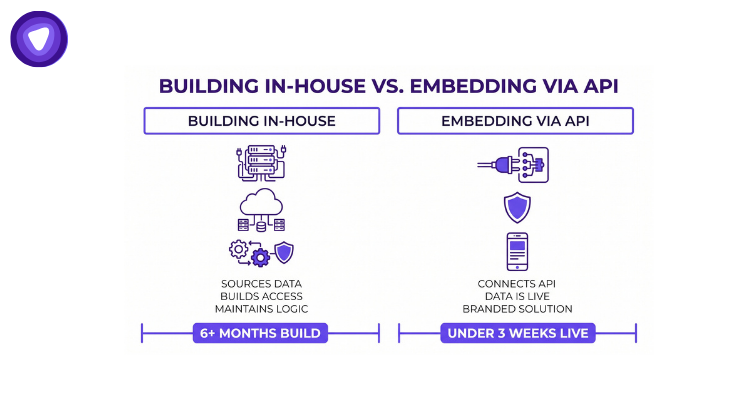
A payment platform weighing whether to build this capability faces a real cost decision, not a feature checklist. Building dark web scanning infrastructure means sourcing breach data feeds. It means building marketplace access, and maintaining match logic against sources that shift daily. That is a multi-month engineering commitment before a single alert ever fires.
One partner that evaluated building data exposure monitoring in-house found the broker and dark web integrations alone would have taken its engineering team more than six months. Working through an existing API instead had the same partner live under three weeks, fully branded under its own product and pricing. That gap between a six-month build and a three-week integration is the actual decision point for most product teams, not a comparison of feature lists.
What a White-Label Version Looks Like for a Payment Platform’s Own Merchant Base
Every card issuer-facing tool on the market today is built for a bank fraud team monitoring its own portfolio directly. A payment platform, PSP, or embedded-finance product sits in a different position. It wants this capability inside its own dashboard, under its own brand, covering its own merchant base, not a separate login its merchants have to visit.
A white-label version of credential monitoring card fraud prevention works through an API rather than a standalone console. A partner submits an identifier, whether a BIN range, a card token, or an employee credential tied to its payment infrastructure. And the service returns exposure data through the partner’s own dashboard.
New exposures trigger the partner’s own alerting, not a third-party notification that undercuts the platform’s relationship with its merchants. That structure keeps the fraud-prevention feature, and the revenue tied to it. Inside the platform’s own product rather than sending merchants to an outside tool. Before committing to any vendor for this, it is worth verifying the vendor’s own audit and certification claims rather than taking a marketing page at face value.
The same infrastructure decision that applies to VPN or data broker removal applies here too: building the detection layer from scratch rarely pencils out compared to plugging into an existing one, a distinction covered in more depth in this account’s dark web monitoring guide.
PureVPN White Label Dark Web Monitoring
PureVPN White Label Dark Web Monitoring gives a payment platform the credential and card exposure detection layer described above without building the scanning infrastructure in-house. Coverage spans 400+ data brokers and 150+ partners worldwide, and the same infrastructure tracks leaked email and password combinations, session tokens, and payment credentials across dark web forums and marketplaces.
A partner integrates through a single API and manages every alert from its own dashboard under its own brand. This keeps the fraud-prevention relationship, and the margin tied to it, with the partner rather than a third-party monitoring tool.
Final Thoughts
The decision in front of most payment platforms is not whether credential monitoring card fraud prevention works. It is whether to build it, license it as a standalone tool, or white-label it into a product merchants already use. Building costs months of engineering time before the first alert fires. Licensing a standalone tool sends merchants to a separate login. White-labeling keeps the detection layer, the branding, and the recurring revenue inside the platform’s own product.
Request a 20-minute partnership and margin review call.