


Key Takeaways
- Valid logins: Credential stuffing uses real leaked passwords, so every attempt looks valid to login defenses.
- Scale: Credential stuffing made up a median 19% of daily authentication attempts in Verizon’s 2025 research.
- Blind spot: Rate limits, bot detection, CAPTCHA, and MFA judge the attempt. Exposure data judges the password.
- Triggers: Exposure flags work best on five events: admin changes, bulk exports, API keys, billing changes, and contact changes.
- Ownership: Embedding exposure data through an API keeps the signal, the revenue, and the customer relationship in-house.
Quick Answer
Credential stuffing is an automated attack that tests leaked username and password pairs against your login page. When a pair works, the attacker owns a real customer account. That is account takeover. SaaS platforms stop it best by pairing login controls with exposure data. Exposure data shows which users already have leaked passwords or stolen sessions. The platform then forces a reset or step-up check before the attacker signs in. Rate limits and bot detection only act once the attack arrives. Exposure data acts earlier, so credential stuffing meets a closed door instead of an open account.
Your login page never sees where a credential stuffing attack begins. The theft happens somewhere else, weeks or months earlier. Malware on a customer laptop copies saved passwords. A breach at an unrelated site leaks more. Criminals bundle both into lists and test them against every SaaS login they find. Your logs show a real email and a correct password. Nothing looks wrong, because the login layer did nothing wrong. The failure sits upstream, in data your team never sees.
Why Credential Stuffing Hits SaaS Platforms Harder
Credential stuffing pays off on SaaS platforms because one stolen login opens a workspace, not a single profile. An admin login in a B2B product usually controls member invites, billing, and data exports.
The scale is larger than most security teams assume. Verizon researchers analyzed single sign-on logs and found credential stuffing made up a median 19% of daily authentication attempts. The share reached 25% at enterprise-sized organizations and 12% at small ones. The worst single day hit 44%.
Customers carry the risk too. A customer who reuses a password can lose an account at your company after a breach somewhere else. The same research shows why. In the median case, only 49% of a user’s saved passwords differ from each other on infostealer-infected devices.
A successful takeover costs a SaaS platform in four ways:
- Data theft: The attacker reads private files, payment details, and communications.
- API abuse: Taken accounts drain credits, exhaust quotas, and resell access.
- Blame: Customers often blame your platform, even when the password leaked elsewhere.
- Support load: Resets, disputes, and recovery requests consume engineering and support hours.
How a Credential Stuffing Attack Reaches Your Platform
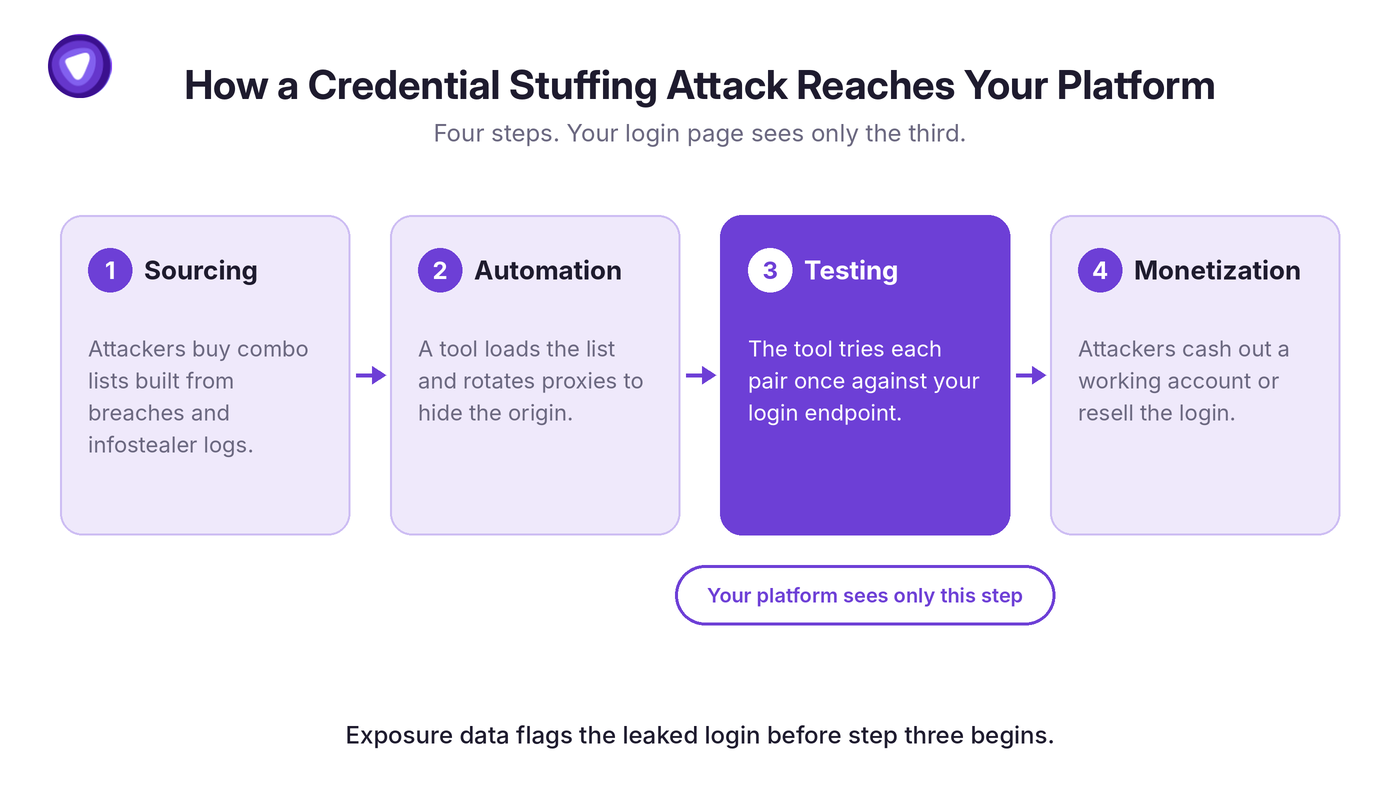
A credential stuffing attack follows four steps, and your platform sees only the third.
- Sourcing: Attackers collect combo lists, which are bundles of leaked username and password pairs. Marketplaces and cybercrime channels sell them.
- Automation: Attackers load the list into a tool configured for your login endpoint. The tool adds proxies to hide the origin.
- Testing: The tool tries each pair once and flags every success. Single attempts per account blend into regular traffic.
- Monetization: Attackers cash out a working account at once or resell the login on criminal forums.
Early warning signs appear as a slow buildup, not a spike. A failed login rate that jumps from a 2% to 5% baseline to 15% to 20% deserves investigation. So do surges of IP addresses your platform has never seen. Repeated user-agent strings across thousands of requests point to the same tool.
These signals confirm an attack after it starts. They do not tell you which accounts the attacker already holds a working password for.
Why Login Defenses Alone Miss Credential Stuffing
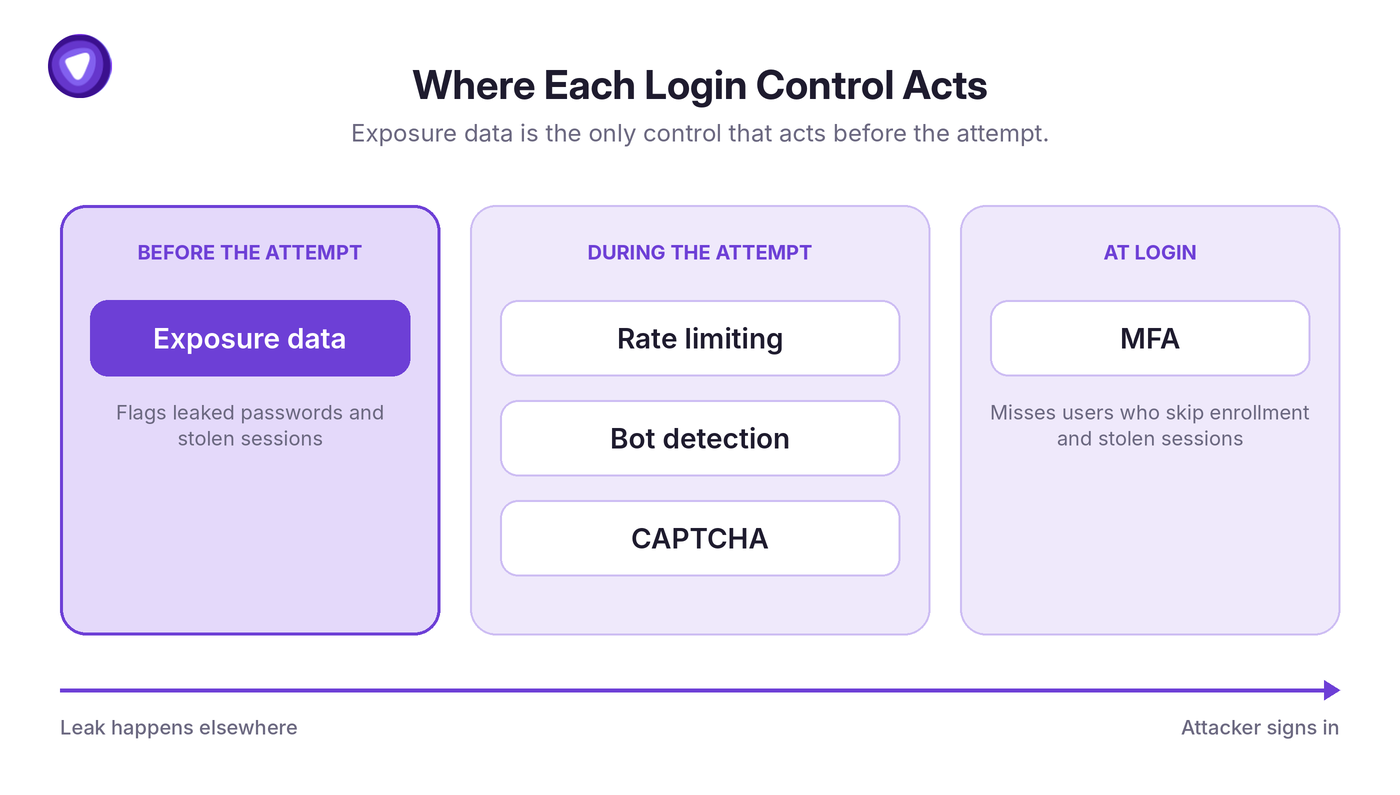
Login defenses miss credential stuffing because the attacker arrives holding a correct password. Attack tools rotate through proxy addresses and solve CAPTCHAs. Each request tries a single account once, which keeps per-account lockouts quiet.
| Control | What It Sees | Blind Spot |
|---|---|---|
| Rate limiting | Request volume per IP or account | Attackers spread requests across many proxy addresses |
| Bot detection | Automation signals in traffic | Residential proxy traffic that resembles real users |
| CAPTCHA | Whether a human solves a challenge | Tools that bypass or solve challenges |
| MFA | A second factor at login | Users who skip enrollment and attackers holding stolen sessions |
| Exposure data | Leaked passwords and stolen sessions before login | Logins that never leaked anywhere |
The first four controls judge the attempt. Only the last one judges the password itself.
What Exposure Data Adds to Credential Stuffing Defense
Exposure data tells you which of your users already appear in breach dumps or infostealer logs. Credential monitoring matches each registered login against those sources.
Providers scan breach databases and infostealer malware logs, both live and historic. Infostealer logs matter most for SaaS. They hold saved logins, session cookies, and device details.
Verizon’s 2026 report shows why this signal matters. Credential abuse appears in 39% of breaches when you count the full attack chain. It fell to 13% as the first recorded step.
Three things change once you hold that signal:
- Timing: You act on a leaked login before the first stuffing attempt, not after an alert fires.
- Targeting: Only exposed accounts meet extra friction. Clean accounts keep a fast login.
- Evidence: Good feeds attach a source and timeline to every alert, so teams act on facts.
Your team cannot patch another company’s breach. It can only decide what happens when that breach reaches your login.
Turning Exposure Signals Into Login Decisions
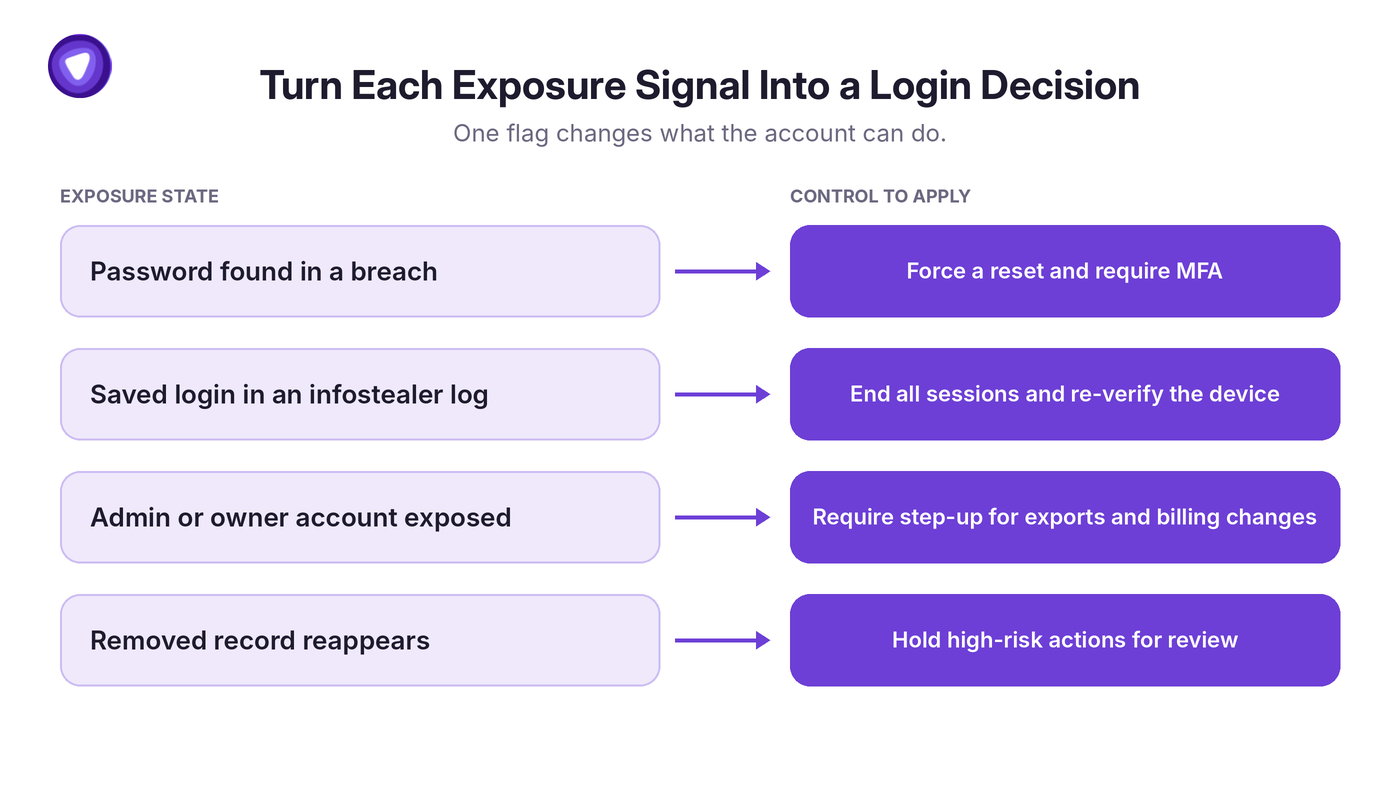
An exposure alert has no value until it changes what an account can do. The table below maps each exposure state to one practical control.
| Exposure State | Attack It Signals | Control to Apply |
|---|---|---|
| No known exposure | Baseline risk | Keep the normal login |
| Password found in a breach | Credential stuffing with a valid pair | Force a reset and require MFA |
| Saved login in an infostealer log | Stolen session and device | End all sessions and re-verify the device |
| Admin or owner account exposed | Workspace-wide takeover | Require step-up for exports and billing changes |
| Removed record reappears | Renewed targeting | Hold high-risk actions for review |
Five SaaS events carry most takeover risk:
- Admin role or ownership changes
- Bulk data exports
- New API key creation
- Billing or payout detail changes
- Email or phone changes
Gate those events behind a fresh step-up check whenever the account carries an exposure flag. Webhook alerts let your risk engine update each user’s state the moment a new leak appears. Crypto platforms apply the same logic to withdrawals, where a settled transfer cannot reverse.
Credential Stuffing Beyond the Login Page
Credential stuffing also targets sign-up forms, free tiers, and API endpoints. Attackers who confirm a platform holds value start creating fraudulent accounts. Free trials, sign-up bonuses, and API access tied to new accounts become targets.
AI platforms feel this directly. Every free API call and inference credit costs the platform money.
Three controls close most of that gap:
- Password screening: Block any new or reset password that already sits in a breach dump.
- Session revocation: Revoke API tokens and sessions on every exposure alert, since linked tools stay logged in.
- Shared signals: Feed exposure flags into login, sign-up, and API checks together.
Four Numbers to Track From Day One
Credential stuffing defense needs a scorecard, or the exposure signal turns into a dashboard nobody reads. Track four numbers:
- Exposure rate: The share of active users with a fresh leaked login or stolen session.
- Pre-attempt resets: Accounts reset or re-verified before the first stuffing attempt reached them.
- Step-up volume: Checks triggered by exposure flags, and how many users completed them.
- Re-exposure rate: Users whose cleaned logins leaked again within a quarter.
The first number sizes the problem. The second proves the signal works. The third shows the friction cost. The fourth shows whether your reset flow holds. Security leads can take all four to a customer security review as evidence.
Build, Refer, or Embed Exposure Data
SaaS teams have three ways to add this layer. Each option decides who owns the signal.
| Option | Owns the Signal | Keeps the Revenue | Alert Reaches Login Logic |
|---|---|---|---|
| Build in-house | Your team | Your team | Yes |
| Refer to a third-party consumer service | The third party | The third party | No |
| Embed through an API | Your team | Your team | Yes |
Building in-house means sourcing breach feeds and infostealer logs, matching identifiers, and hashing every stored login. The pipeline then runs around the clock. That is a standing cost, not a one-time project.
Referring users to a third-party consumer service costs less at first. It also hands away the exposure signal, the subscription revenue, and the customer relationship. The alert never reaches your reset or step-up logic.
Embedding through an API keeps all three in-house. Your backend registers each user’s identifier, receives alerts, and runs its own response. You can also package the feature as a paid protection tier.
What to Ask an Exposure Data Provider
Ask for six answers in writing before you sign:
- Stealer log depth: The feed should include session cookies and device context, not only email and password pairs.
- Alert context: Each alert should show a source and timeline.
- Delivery: The provider should push webhooks instead of forcing your team to poll.
- Registration model: The API should register each end user by identifier, not only by company domain.
- Storage: Registered identifiers should arrive encrypted and sit in hashed form.
- Audit evidence: The provider should share SOC 2 Type II and ISO 27001 reports under NDA.
A feed without cookie data cannot trigger session resets. A feed keyed only to domains cannot protect individual end users.
How PureVPN White Label Digital Privacy Protection Supports SaaS Platforms
PureVPN White Label Digital Privacy Protection gives SaaS partners dark web monitoring and data broker removal. Partners sell both under their own brand. Monitoring scans breaches and infostealer malware around the clock, live and historic, down to credentials, cookies, and device context. A historical scan returns a user’s total exposure count within seconds. Each alert carries its source and timeline.
Partners keep the brand, the pricing, and the customer relationship. SaaS teams embed monitoring or removal alone through the API and SDK, or launch the full hosted platform. Removal covers 400+ people-search sites, and no service can promise every trace disappears. The service holds SOC 2 Type II and ISO 27001 certification, with audit reports shared under NDA. PureVPN reports 150+ partners, which is its own figure and not an audited one.
Final Thoughts
Credential stuffing succeeds because the stolen password is correct. Login controls judge the attempt, so they judge it late. Exposure data judges the password before the attempt arrives. SaaS teams that wire that signal into login, admin actions, and API key creation close the gap. The leak and the takeover no longer happen back to back. They also gain a protection feature customers can see.
FAQ
What is credential stuffing?
It is an automated attack that tests leaked username and password pairs against login pages.
How does credential stuffing differ from brute force?
Brute force guesses passwords for one account, while credential stuffing replays real leaked pairs across many accounts.
What is the difference between credential stuffing and account takeover?
Credential stuffing is the method, and account takeover is the result when a stolen login works.
What are the early warning signs of credential stuffing?
Watch for a failed login rate that jumps across many accounts, new IP addresses, and repeated user-agent strings.
Does MFA stop credential stuffing?
No. Users who skip enrollment and attackers holding stolen sessions both bypass MFA.
How does exposure data help prevent account takeover?
It flags users with leaked passwords or stolen sessions, so the platform acts before the attacker logs in.
Why is credential stuffing dangerous for SaaS platforms?
One taken account exposes private files, payment details, and API access, and users blame the platform.