


Quick Answer
Crypto account takeover happens when an attacker controls a real user’s exchange, wallet, or trading account. Exposure data shows which users already have leaked passwords, stolen session cookies, or public broker profiles. Platforms use those signals to tighten withdrawal controls before an attacker ever logs in.
Key Takeaways
- Crypto transfers settle as final, so the fraud decision has to happen before the withdrawal.
- Attackers prepare with three kinds of exposure data: leaked logins and cookies, broker profiles, and home addresses.
- Exposure signals work best as triggers on five account events, such as allowlist changes and new trading keys.
- FINRA, SEC Regulation S-P, and NYDFS rules now push platforms toward earlier detection, tighter access, and faster notice.
- Embedding monitoring and broker removal keeps the signal, the revenue, and the customer relationship in-house.
A crypto account takeover rarely ends with a refund. Once coins leave for an attacker’s wallet, no chargeback process pulls them back. The platform absorbs the support load, the reimbursement debate, and the trust damage.
The scale keeps growing. The FBI’s Internet Crime Complaint Center logged 181,565 crypto-related complaints in 2025, with losses of $11.366 billion. The average reported loss reached $62,604 per complaint.
Most crypto and trading platforms defend at the login screen. Attackers prepare much earlier. They buy leaked passwords, stolen session cookies, and personal profiles before they touch the app. Exposure data reveals that preparation while there is still time to act. This guide explains how crypto and trading platforms turn exposure data into withdrawal decisions.
Why Crypto Account Takeover Costs More Than Other Fraud
Card fraud has a safety net. Banks reverse charges, and card networks spread the loss. Crypto transfers settle in minutes and stay final. That turns every successful crypto account takeover into a permanent loss.
Individual holders now sit at the center of the problem. Chainalysis counted 158,000 incidents of personal wallet compromise in 2025. That figure has roughly tripled since 2022.
Trading apps face the same clock. An attacker who controls a brokerage account can swap the linked bank account. Next, the attacker pushes an outbound transfer to another firm. Each step looks like normal customer activity.
Japan showed how fast this scales. From January to October 2025, the Financial Services Agency counted 9,348 fraudulent trades through hijacked brokerage accounts. Those trades totaled about 711 billion yen in volume. Police said the attackers used stolen IDs and passwords, with phishing behind some cases. That figure reflects trade volume, not net customer losses.
Illustrative math helps size the risk:
- A platform holds 250,000 funded accounts.
- In a given year, 0.2% of them suffer a successful takeover, which equals 500 accounts.
- At an average loss of $5,000, direct exposure reaches $2.5 million.
- Support hours, legal review, and lost deposits then sit on top of that figure.
These are round numbers for illustration, not industry benchmarks.
The Three Kinds of Exposure Data Behind Crypto Account Takeover
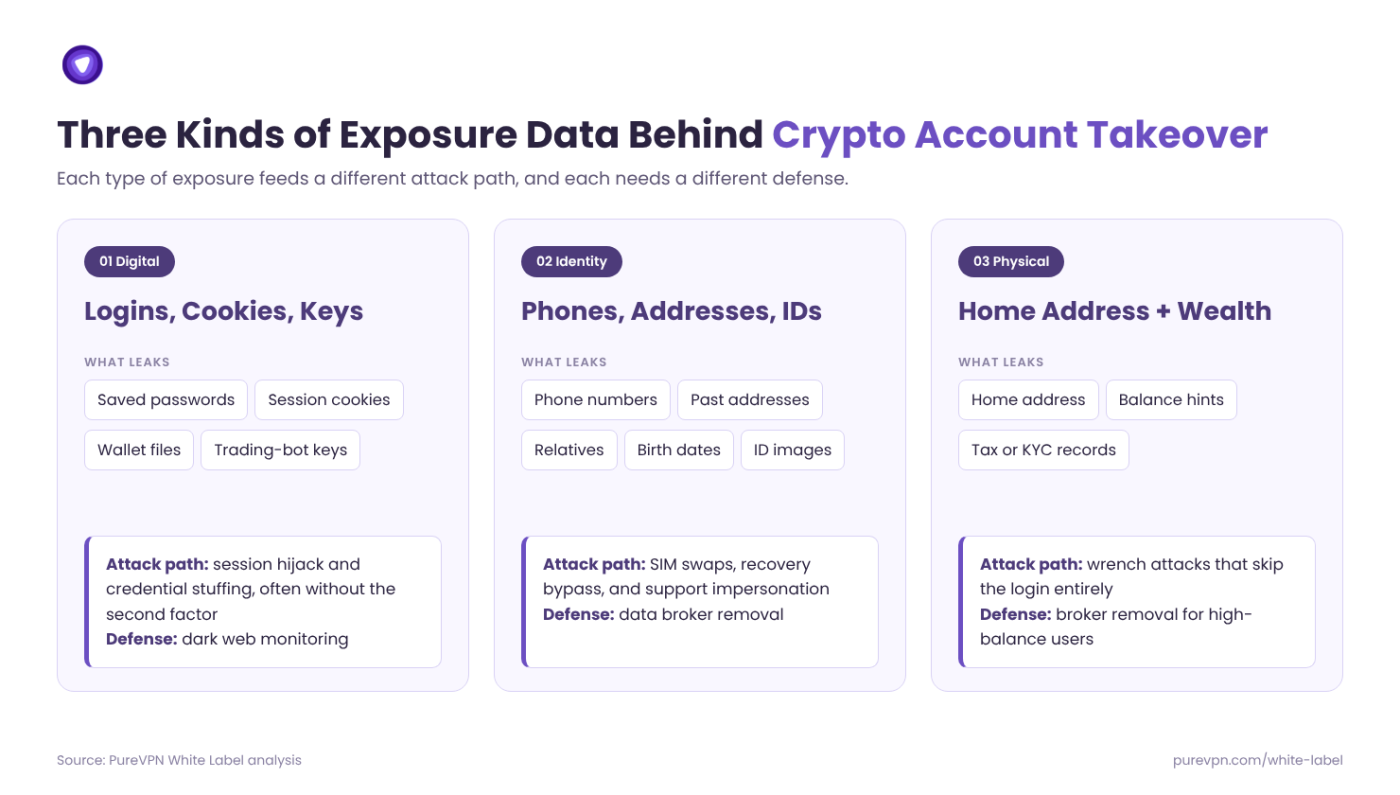
Attackers do not start with a guess. They start with data that already sits outside the platform. That data falls into three groups, and each group feeds a different attack path.
Digital Exposure: Passwords, Cookies, and Trading Keys
Infostealer malware copies saved passwords, browser cookies, and wallet files from an infected device. Criminals then sell those logs in bulk. Microsoft found more than 394,000 Windows computers infected by one stealer, Lumma, in just two months of 2025. Microsoft says Lumma targets passwords, bank accounts, and crypto wallets. A stolen session cookie lets an attacker reuse a live login without the password or the second factor.
Crypto users face targeted lures. Check Point Research tracked a campaign that impersonated almost 50 trading apps through paid social media ads. The fake installers stole credentials and wallet data from people who trusted the download.
Trading-bot keys add a further risk. Active traders often connect outside tools through keys with trade or withdrawal rights. Those keys behave like machine keys, with no owner email and no password reset.
Identity Exposure: Phones, Addresses, and ID Images
Data brokers and people-search sites publish phone numbers, past addresses, relatives, and birth dates. Attackers use those details to pass carrier checks and move a victim’s number to a new SIM. The same details help them pass recovery checks at the platform itself.
Insider leaks raise the stakes further. In May 2025, a major US exchange disclosed that bribed support agents had stolen customer data. The leak touched less than 1% of its monthly transacting users. The data included names, addresses, phone numbers, ID images, and balance snapshots. Attackers then posed as support staff and tricked customers into sending funds. The exchange estimated the cleanup cost at $180 million to $400 million.
Physical Exposure: When a Home Address Becomes the Target
Some attackers skip the login entirely. In a wrench attack, criminals use violence or threats to force a holder to transfer funds. CertiK recorded 72 wrench attacks in 2025, a 75% rise over the prior year. Confirmed losses passed $40.9 million. Chainalysis also found a clear correlation between these attacks and the bitcoin price. Rising markets therefore raise physical risk for known holders. In France, prosecutors charged a tax official with passing crypto investors’ personal details to criminal groups.
A home address plus a hint of wealth gives criminals a target list. Removing that address from broker sites will not stop every attack. It does raise the cost of finding the next victim. Offering broker removal by default to the highest-balance tier protects the users attackers want most.
Where Exposure Data Fits in the Crypto Account Takeover Stack
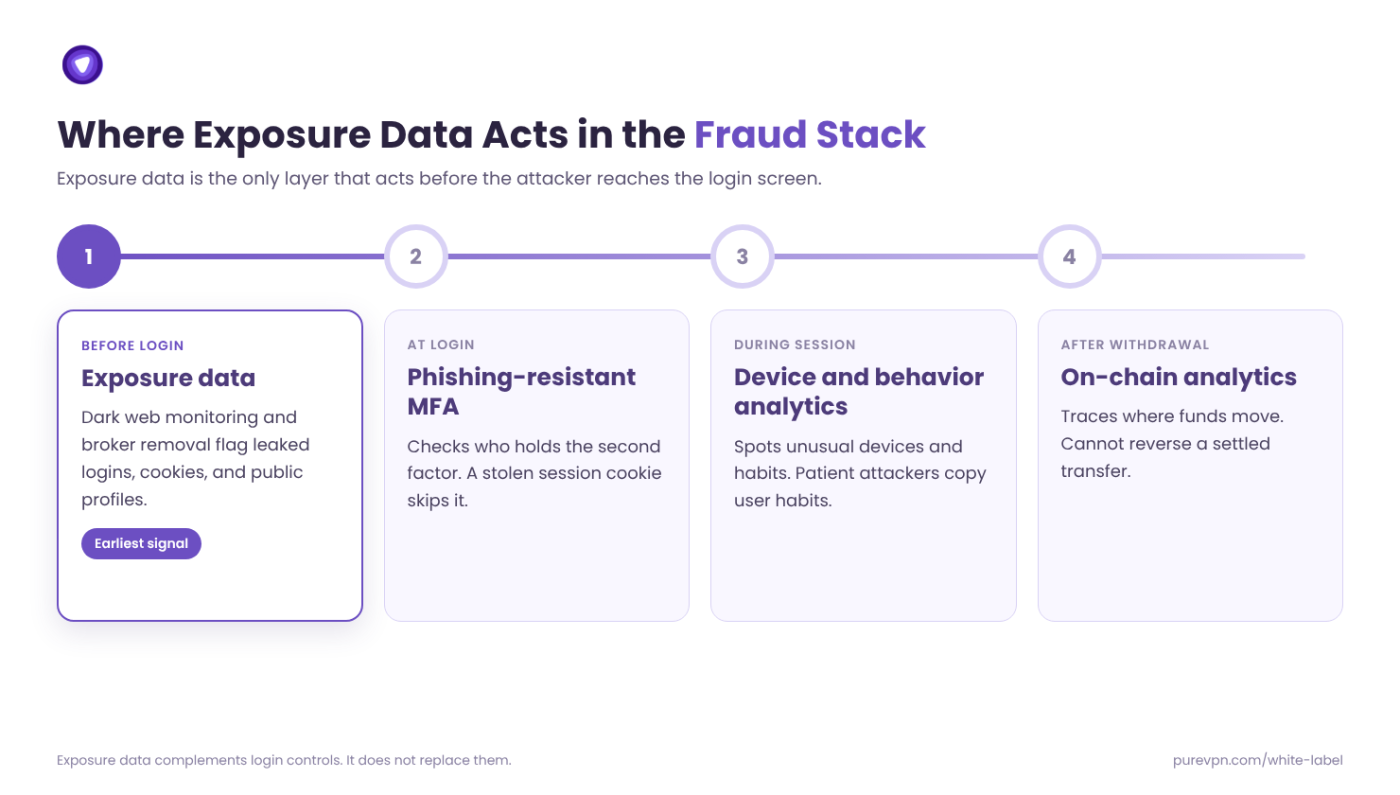
Exposure data does not replace login controls. It fills the gap before them. The table below shows what each layer sees and where each layer goes blind.
| Control | What It Sees | When It Acts | Blind Spot |
| Phishing-resistant MFA | Who holds the second factor | At login | A stolen session cookie skips it |
| Device and behavior analytics | Unusual devices and habits | During the session | Patient attackers who copy user habits |
| On-chain analytics | Where funds move after withdrawal | After funds leave | Cannot reverse a settled transfer |
| Credential monitoring | Leaked passwords and cookies | Before login | Misses phone and address exposure |
| Data broker removal | Public profiles behind SIM swaps and targeting | Before the attack starts | Does not see stolen passwords |
The last two rows form the exposure layer. Dark web monitoring covers the digital side, and broker removal covers the identity side. Together they make up digital privacy protection for the user. Platforms that run credential monitoring alone still miss the phone data behind SIM swaps.
Turning Exposure Signals Into Withdrawal Decisions
An exposure alert has no value if it only lands in an inbox. The signal has to change what the account can do. Five account events carry most crypto account takeover risk:
- New device login: A fresh device plus a known stolen cookie calls for step-up checks.
- Withdrawal allowlist change: Adding a new address is the classic first move after a takeover.
- New trading key with withdrawal rights: Attackers create keys to drain funds through automation.
- Phone or email change: These changes cut the real owner out of recovery.
- Large withdrawal or outbound transfer: This is the final step, so it needs the strictest rules.
Each exposure state then maps to a matching control. The table below shows one practical policy.
| Exposure State | What It Suggests | Control to Apply |
| No known exposure | Standard risk | Keep the normal flow |
| Password found in a breach | Credential stuffing risk | Force a reset and require MFA |
| Session cookie in a stealer log | Live session hijack risk | End all sessions and re-verify the device |
| Phone and address on broker sites | SIM swap and impersonation risk | Block SMS recovery and file opt-outs |
| Removed record listed again | Renewed targeting risk | Hold new allowlist addresses for review |
The point is proportion, because blanket friction frustrates active traders. A user with no exposure keeps a fast experience. A user with a fresh stealer log meets friction at the exact moment it matters. Per-user webhook alerts let the risk engine update that state in real time.
Why Regulators Now Expect Earlier Detection
No single deadline drives this topic. Enforcement pressure already exists, and it keeps tightening across three regulators:
- FINRA: The 2026 oversight report flags new account fraud and account takeovers built on stolen identity information.
- SEC Regulation S-P: Broker-dealers and advisers must notify affected customers within 30 days when attackers compromise their sensitive data. Larger firms complied by December 3, 2025, and smaller firms by June 3, 2026. Firms must also require service providers to report security incidents within 72 hours.
- NYDFS Part 500: Since November 1, 2025, MFA covers every person who accesses a covered firm’s systems. Virtual currency businesses that New York regulates fall under the rule. That reaches support staff and vendors, the same insider path behind the exchange leak above.
The SEC also named Regulation S-P a 2026 examination priority, so examiners now test these programs directly. A platform that adds crypto account takeover controls only after a breach must then explain the gap. Decide before the next exam cycle, not after an incident forces the question.
Build, Refer, or Embed Exposure Protection
Crypto and trading platforms have three ways to add this layer. Each option changes who owns the signal.
Building in-house means sourcing stealer logs, matching identifiers, and filing opt-outs across hundreds of broker sites. Brokers also re-list removed records, so the work needs scheduled re-checks. Most fraud teams would rather spend that time on detection rules. The build versus partner math favors a partner for that reason.
Referring users to a third-party consumer service looks cheaper at first. It hands away the exposure signal, the subscription revenue, and the customer relationship. The platform also loses the re-listing alerts its withdrawal rules depend on.
Embedding through an API keeps all three in-house. The platform runs scans under its own brand and feeds results straight into its risk engine. It can also package the feature as a premium protection tier for high-balance users.
What to Ask an Exposure Data Provider
Not every exposure feed fits crypto account takeover work. A generic breach alert without a source or date gives a risk rule nothing to weigh. Before signing, crypto and trading platforms should confirm seven points in writing:
- Infostealer depth: The feed should include session cookies and device context, not only email and password pairs.
- Alert context: Each alert should show its source and timeline, so risk rules can weigh freshness.
- Delivery method: The provider should push alerts through webhooks instead of forcing your team to poll.
- Broker coverage: The contract should state how many people-search sites removal covers, and in which regions.
- Re-listing tracking: The service should re-scan on a fixed schedule and flag records that come back.
- Audit evidence: The provider should share SOC 2 Type II and ISO 27001 reports under NDA.
- Incident notice: The contract should commit the provider to report its own security incidents within 72 hours.
Each answer maps to a control in the withdrawal policy above. A feed without cookie data cannot trigger session resets. A removal service without re-listing alerts cannot trigger allowlist holds. These checks sound technical, but they decide whether exposure data stops fraud or only fills a dashboard.
A 90-Day Rollout Plan for Crypto and Trading Platforms
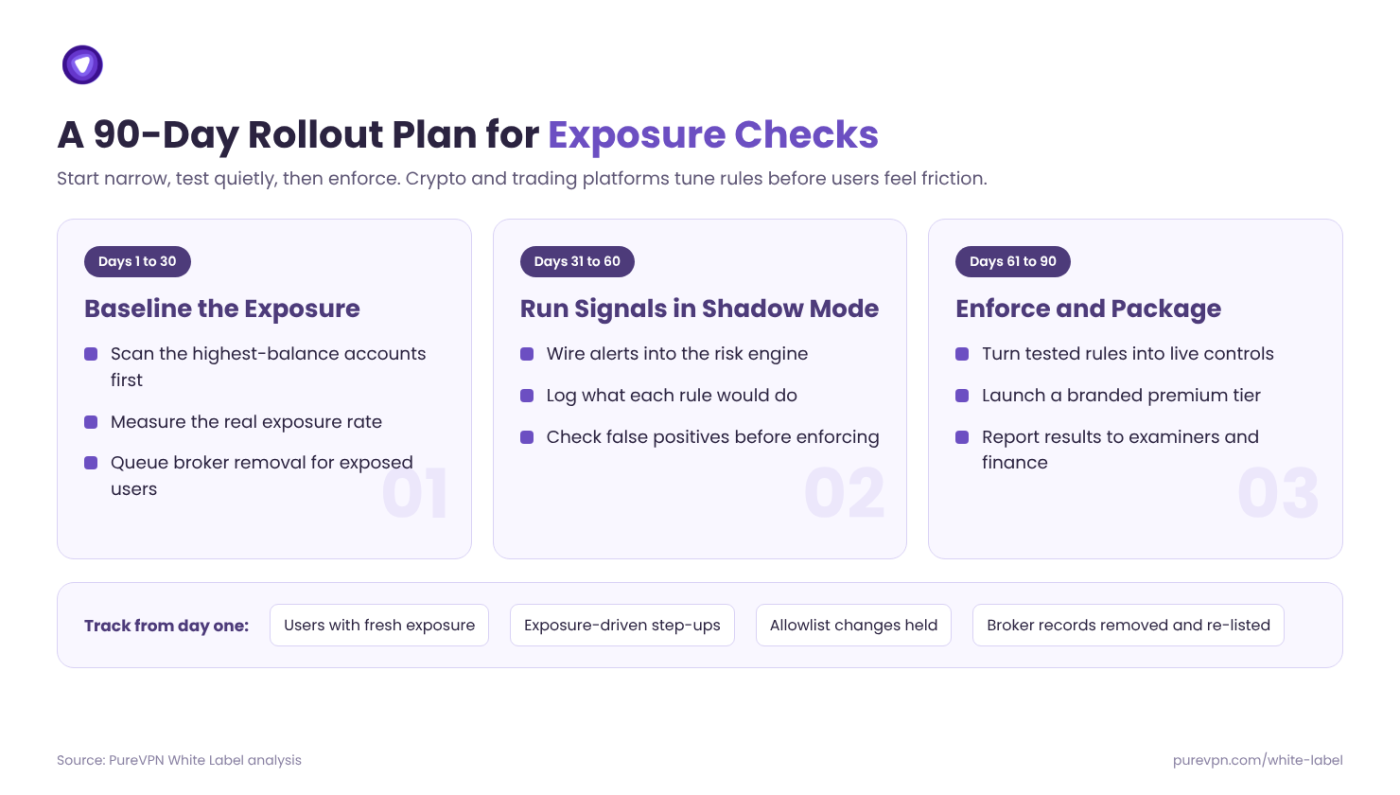
Crypto account takeover checks work best when they start narrow and expand. A phased rollout lets the fraud team tune rules before users feel any friction. The plan below splits the work into three 30-day stages.
Days 1 to 30: Baseline the Exposure
Start with a historical scan of the highest-balance accounts. This shows how many users already carry leaked logins, stolen cookies, or public broker profiles. The result gives the fraud team a real exposure rate instead of a guess. It also tells product teams which users need broker removal first.
Days 31 to 60: Run Signals in Shadow Mode
Next, wire exposure alerts into the risk engine for the five account events. Log what each rule would have done, but do not block users yet. Shadow mode shows false positives before they reach real customers. It also shows how often exposed users trigger allowlist changes or new trading keys.
Days 61 to 90: Enforce and Package
Finally, switch the tested rules from logging to enforcement. At the same time, launch exposure protection as a branded feature or premium tier. Track four numbers from day one:
- Share of active users with fresh exposure
- Step-up checks triggered by exposure signals
- Allowlist changes held, and how many users confirmed them
- Broker records removed, and how many came back
These numbers show examiners a working program. They also show finance whether the premium tier pays for itself.
Proof: Embedding Protection Inside an Existing Subscription
No crypto-specific case study exists yet for this product line. The closest evidence comes from a VPN integration, not from exposure data. An app bundle partner added a branded VPN inside its existing subscription, with no separate checkout. The partner reports 2x subscription sales, a 40% higher conversion rate, and 56% lower acquisition cost. These are the partner’s own figures, not an independent audit.
The pattern still applies here. Protection sold inside an app users already trust removes the second purchase decision. For a trading app, that means exposure alerts inside the existing premium plan.
How PureVPN White Label Data Privacy Protection Supports Crypto and Trading Platforms
PureVPN White Label Data Privacy Protection combines dark web monitoring and data broker removal under your brand. Monitoring covers live and historic breaches plus infostealer logs, including credentials, cookies, and device context. Each alert carries its source and timeline, so risk rules can act on it. Broker removal covers 400+ brokers in the US, the EU, and beyond, with monthly re-scans. Removals re-run when data resurfaces, though no service can promise every trace disappears.
Platforms can launch a hosted branded platform or embed features through the API and SDK. The service holds SOC 2 Type II and ISO 27001 certification, with audit reports shared under NDA. PureVPN reports 150+ partners worldwide, which is its own figure rather than an audited one. Fraud teams gain exposure signals, and product teams gain a premium tier to sell.
Final Thoughts
Crypto account takeover is a race against settlement time. Login controls start that race too late for many users. Exposure data moves the starting line back to the moment credentials leak or a profile goes public. Platforms that wire those signals into withdrawal rules stop more fraud before funds move. They also gain a protection product their highest-value users will pay for.
Request a 20-minute partnership and margin review call.
What is crypto account takeover?
It is fraud where an attacker controls a real user’s exchange, wallet, or trading account and withdraws funds.
How do attackers take over crypto accounts?
They use leaked passwords, infostealer session cookies, SIM swaps, and support impersonation built on leaked personal data.
Does MFA stop crypto account takeover?
No. A stolen session cookie skips MFA, so platforms also need exposure monitoring before login.
Can stolen crypto be recovered after an account takeover?
Recovery is rare because crypto transfers settle as final, so prevention must happen before the withdrawal.
What is a crypto wrench attack?
It is a physical attack where criminals use violence or threats to force a holder to transfer crypto.
Which rules cover account takeover at US trading apps?
SEC Regulation S-P requires 30-day customer notice, and FINRA’s 2026 report flags account takeovers directly.
How does data broker removal reduce crypto fraud?
It removes the phone numbers and home addresses attackers use for SIM swaps, impersonation, and wrench attacks.