

Key Takeaways
- Telco identity protection combines dark web monitoring and data broker removal under the carrier’s own brand.
- Demand exists, but a 2025 survey found 60 percent of consumers unaware of their provider’s security services.
- Carriers package it four ways: a free baseline, premium-tier inclusion, a paid add-on, or a standalone app.
- Enrollment, first-session results, and in-app alerts decide whether subscribers ever see value.
- White labeling keeps the brand, the billing line, and the retention credit with the carrier.
Identity fraud now reaches subscribers through the phone they pay a carrier for. When it lands, many subscribers expect the carrier to have stopped it. Yet most of them have no idea what their carrier already offers.
That gap is where telco identity protection either earns its place or fades out. The tooling is mature. The harder work sits in packaging, enrollment, data handling, and care readiness.
This guide shows how telcos offer identity protection today. It covers what the service holds, how carriers sell it, and where launches lose people.
Why Telco Identity Protection Starts With a Visibility Problem
Demand is not the issue. In 2025, the FTC logged more than 1.35 million identity theft reports, according to Experian’s analysis of FTC data. That total sits roughly 20 percent above the 2024 figure.
Subscribers also know where they want help. In TransUnion’s 2023 telecommunications consumer report, people said mobile carriers hold the most duty to stop phone fraud. In every age group, about half or more wanted free credit and ID checks from their carrier.
However, the offer rarely reaches them. A 2025 F-Secure survey of 1,000 US consumers found 75 percent expect their provider to protect them from scams. Even so, 60 percent did not know about any security service their provider offered. In the same study, 86 percent said scam protection could shape their choice of provider.
So the threat is rising, and people look to the carrier. Still, most subscribers never see the offer. A hidden benefit cannot cut churn, because no one values what they never see.
Consider an illustrative example. An operator has 1,000,000 postpaid lines. Its top tier, held by 200,000 lines, includes identity protection at no extra charge. If only one in five of those lines enrolls, 160,000 subscribers hold a benefit they never use. At renewal, that benefit gives them no reason to stay. These numbers are illustrative and do not come from any real operator.
What Telco Identity Protection Actually Includes
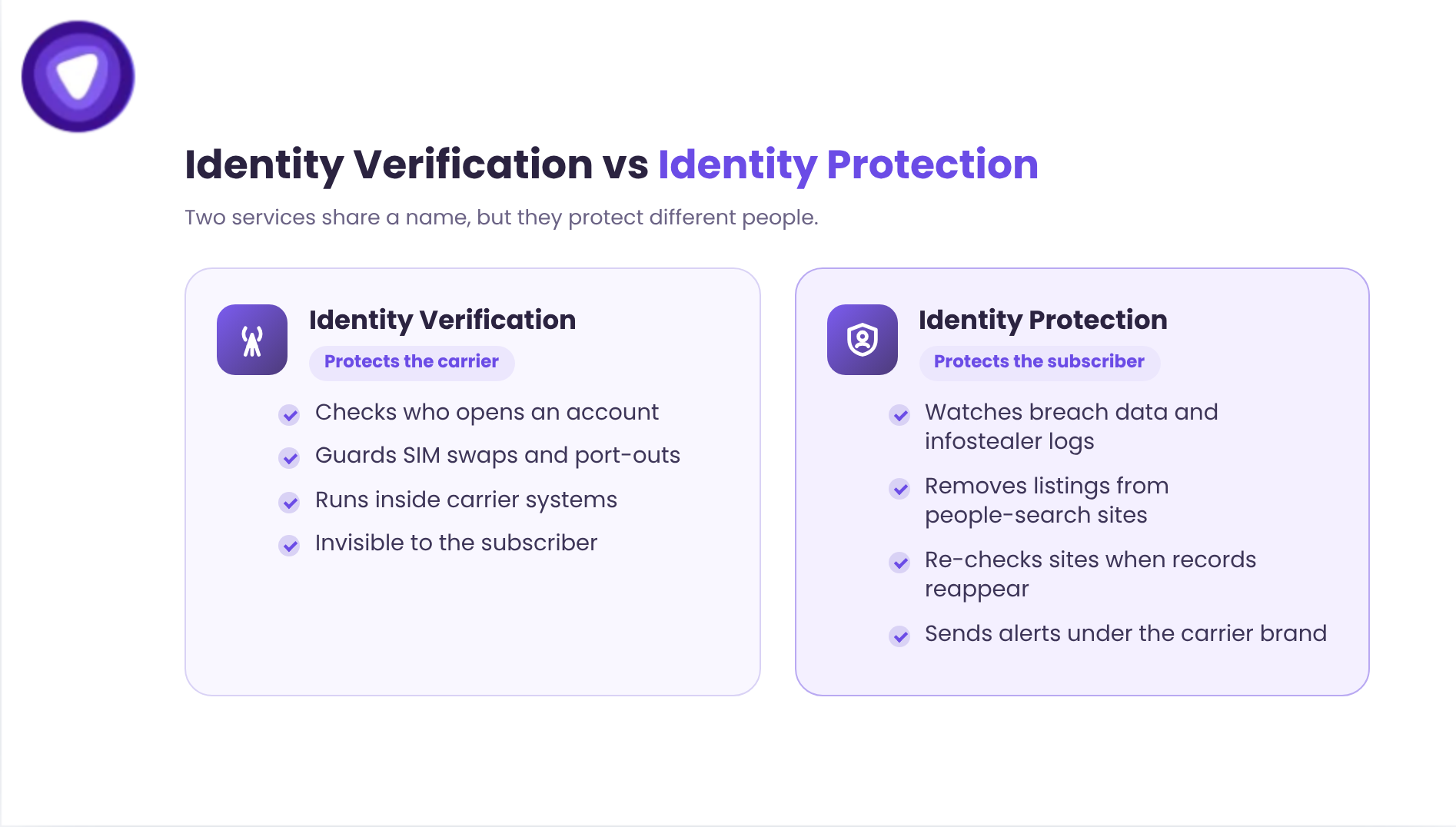
Before packaging, it helps to separate two ideas that share a name. Identity verification protects the carrier. It checks that a person opening an account or swapping a SIM is who they claim to be. Identity protection, by contrast, protects the subscriber. It watches for their personal data in breaches and on broker sites, then helps them respond.
Most subscriber plans pair two tools under one brand. Together they form a digital privacy protection service:
- Dark web monitoring scans breach data and infostealer logs for a subscriber’s email, phone number, passwords, and ID numbers. It is a detection function, so it alerts but does not remove anything.
- Data broker opt-out finds the subscriber on people-search sites and files removal requests. It then re-checks those sites, because records often reappear.
The two tools answer different fears. Monitoring tells a subscriber what has already leaked. Removal, on the other hand, shrinks what a fraudster can buy next. That second point matters to carriers directly. Broker data gives fraudsters enough detail to sound convincing on a support call.
Some carriers also add recovery help, insurance, or credit checks. Those usually come from other firms under other contracts. So scope each extra on its own terms, and do not assume one vendor covers them all.
| Component | What the Subscriber Sees | What the Carrier Runs |
|---|---|---|
| Dark web monitoring | Alerts when an email, password, or ID number appears in breach data | Identifier registration, alert routing, care scripts |
| Data broker opt-out | A report of listings found, removed, and re-checked | Enrollment consent, status display, re-listing follow-up |
| Restoration support (optional) | Hands-on help after an identity theft event | A handoff to a separate restoration provider |
| Identity verification (not subscriber-facing) | Extra checks during account changes | KYC and SIM-swap controls inside carrier systems |
How Carriers Package Telco Identity Protection
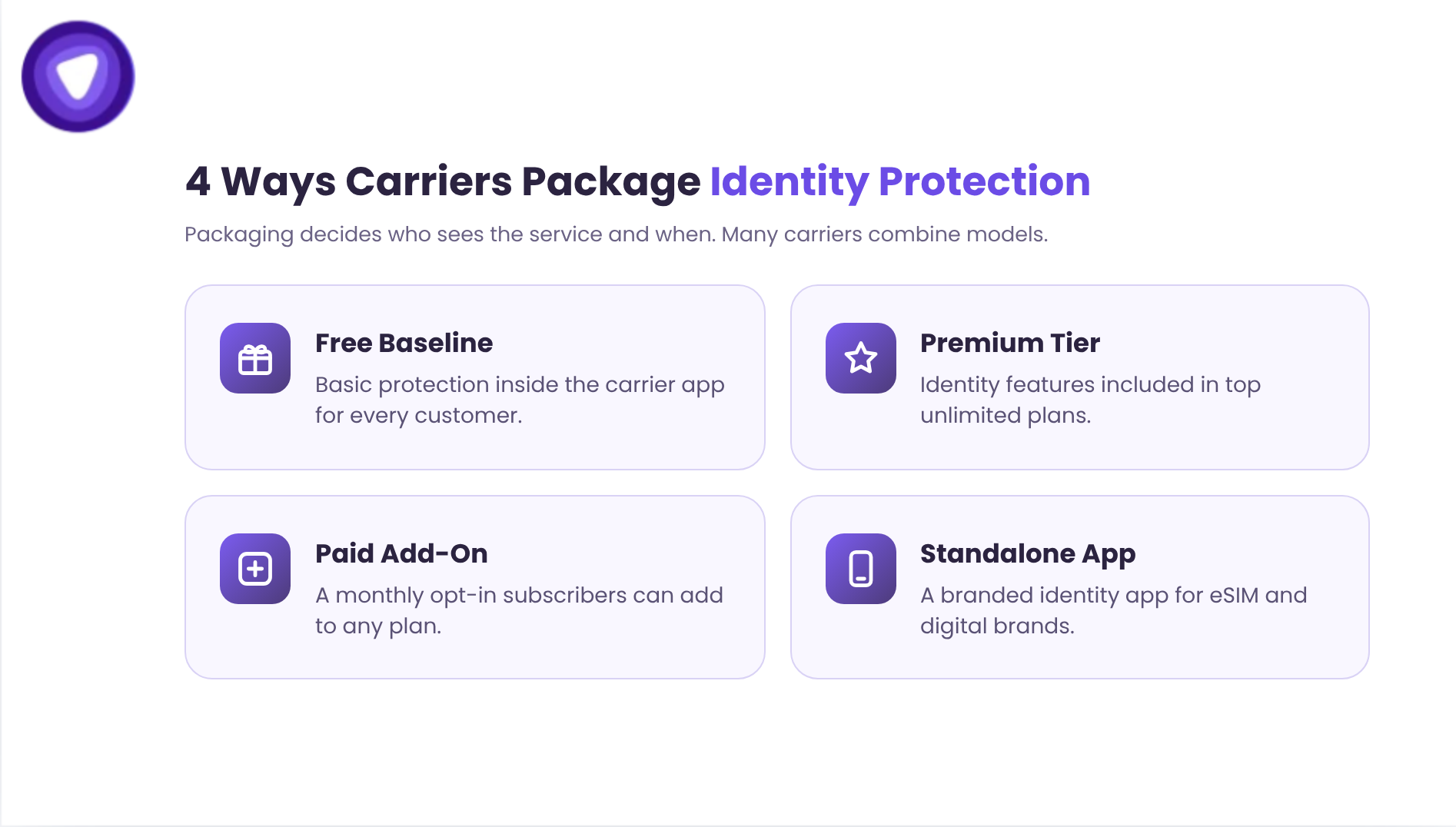
Packaging decides who sees the service and when. In practice, carriers tend to use four models, often in combination.
Free Baseline Inside the Carrier App
Some operators give every customer a free layer of protection inside their main app. For example, one national carrier keeps spam call and text blocking free on any plan. Its identity features, such as dark web monitoring and ID restoration, sit in an advanced tier instead.
Included in Premium Plan Tiers
That same advanced tier comes at no extra cost on the carrier’s top unlimited plans. Inclusion gives the top plan a concrete feature subscribers can point to. However, inclusion only pays off if subscribers switch the feature on.
Paid Opt-In Add-On
Subscribers on other plans can add the advanced tier for a monthly fee. A paid add-on creates clear revenue. At the same time, it sets a higher bar, since subscribers need a visible result each month to keep paying.
Standalone Branded App for Digital Brands
Digital-first brands and travel eSIM providers often run lighter apps. For them, a standalone branded identity app or an in-app module can work better. The same packaging choices apply to MVNOs and eSIM brands.
Where each model sits on the price ladder is a separate decision. The plan ladder approach covers that ARPU side in detail.
The Enrollment Flow Decides Whether Subscribers Ever See Value

In telco identity protection, packaging puts the service in front of subscribers. Enrollment then decides whether they use it. The first session matters most, because a subscriber who sees no result has little reason to return.
The F-Secure finding above makes this concrete. A service that 60 percent of subscribers do not know about will not survive a renewal review. As a result, the enrollment flow deserves as much design time as the product itself.
Start With Identifiers the Carrier Already Holds
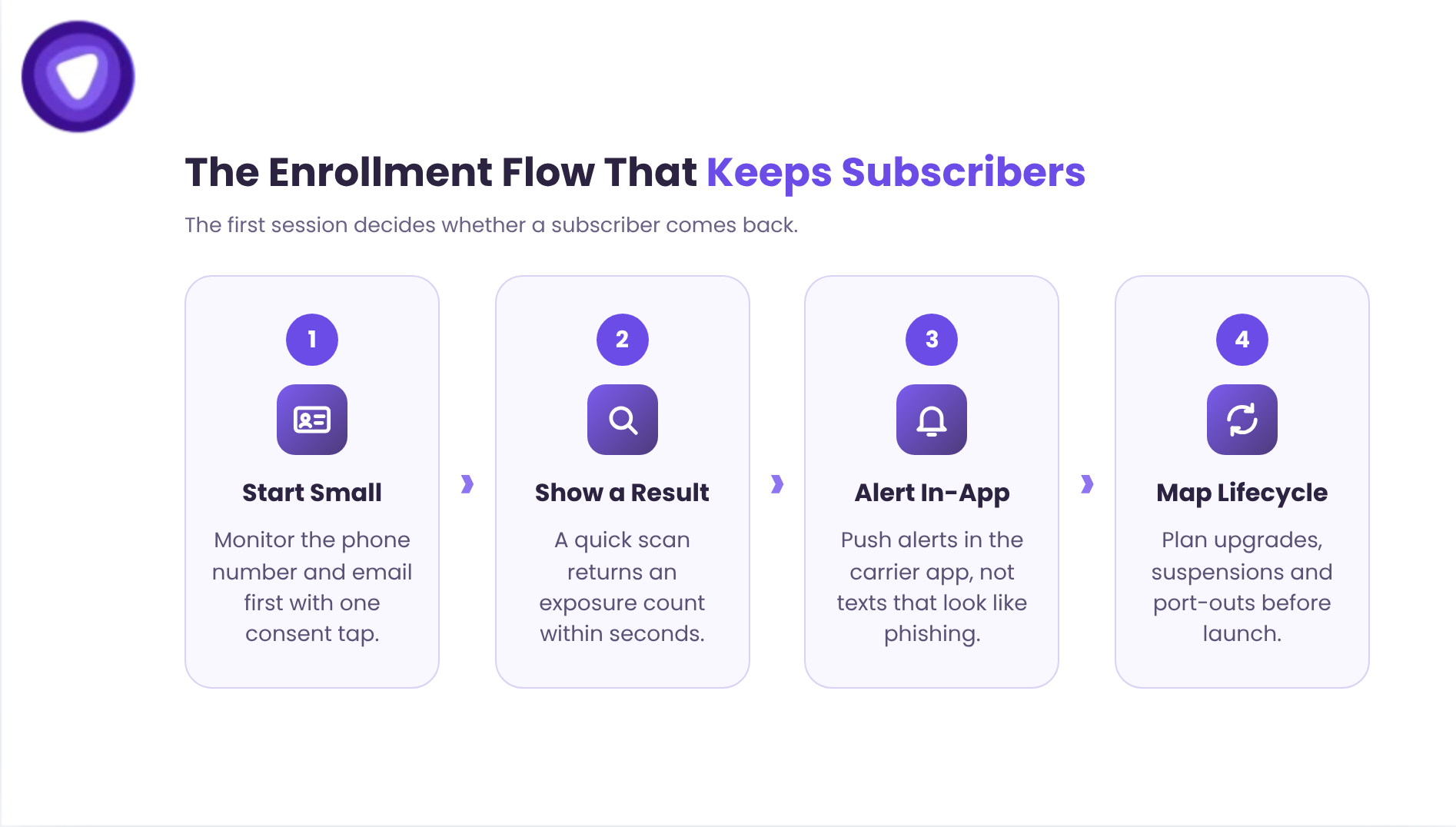
Every carrier already has a subscriber’s phone number and most often an email. Sign-up can start watching those two with one consent tap. Asks for a passport or Social Security number can wait until the service has shown its worth.
Show a First Result in the First Session
A subscriber who sees a finding stays engaged. A quick exposure scan can return a count of breach records within seconds. That number turns an abstract benefit into something personal before the subscriber closes the app.
Deliver Alerts Where Subscribers Already Look
Alerts belong inside the carrier’s own app as push notifications. Text alerts about identity risk look a lot like phishing texts. A subscriber trained to ignore suspicious texts may ignore a real alert too. In addition, in-app alerts keep the carrier brand attached to every warning.
Map Lifecycle Events Before Launch
Plan upgrades, suspensions, cancellations, and port-outs all change what a subscriber should receive. For instance, a subscriber who ports out should not keep receiving alerts under the carrier brand. The entitlement flow for these events belongs in the launch plan, not in a later fix.
Handling Identifiers Carriers Do Not Usually Hold
Telco identity protection asks for data a carrier rarely stores. Think of passport, driver’s license, and Social Security numbers. Most carrier privacy rules center on service and usage records. So these new numbers need their own handling rules.
Three rules keep that exposure contained:
- Collect only what each feature uses. Monitoring an ID number requires that number. Broker removal requires name, address, and date of birth. Neither feature needs the full set at once.
- Keep sensitive identifiers out of carrier systems where possible. Subscribers can enter them directly into the protection service, which encrypts them before storage. The carrier then holds an enrollment status rather than the raw numbers.
- Name the vendor’s role in the privacy notice. Subscribers should see who processes their identifiers and why. Plain wording here also helps when a regulator asks.
This matters because a breach of an identity service does unusual damage. The service exists to protect the exact data it stores. For that reason, ask any vendor for independent audit evidence before launch. ISO 27001 and SOC 2 Type II are good starting points.
Refer, Co-Brand, or White Label
Every carrier chooses how much of the service it owns. There are three common answers, and each one hands away a different amount of value.
- Referral sends subscribers to a third-party consumer removal service. It is the fastest path, but that brand keeps the customer, the bill line, and the credit for keeping them.
- Co-branding keeps the carrier logo on the offer. However, alerts and reports can arrive under the partner’s name, which splits trust at the worst moment.
- White labeling puts the carrier brand on every alert, report, and support conversation. Meanwhile, the vendor runs scanning and removal in the background.
| Factor | Refer to a Third Party | Co-Brand Resale | White Label |
|---|---|---|---|
| Brand on alerts and reports | Third party | Mixed | Carrier |
| Billing relationship | Third party | Usually carrier | Carrier |
| Subscriber data relationship | Third party | Shared | Carrier, with vendor as processor |
| Retention credit at renewal | Third party | Split | Carrier |
| Control over enrollment flow | None | Limited | Full |
The 2026 Iris survey adds a useful signal here. Of 1,015 US adults, 80 percent said they would use identity tools embedded in apps they already use. Respondents also preferred integrated access over standalone apps, 38 percent to 18 percent. Meanwhile, the share with no identity protection at all rose from 18 percent to 22 percent. In short, embedded, carrier-branded delivery matches how subscribers say they want the service.
Preparing Care Teams Before the First Alert
Every telco identity protection alert creates a possible support contact. A subscriber who sees their password in breach data may call the carrier first. So care teams need answers ready before launch.
Prepare four things:
- Alert scripts that say what was found, where it likely came from, and what to do next.
- Status visibility for removal requests, so agents can see submitted, in progress, pending verification, completed, and re-listed states.
- A clear handoff to restoration support when a subscriber reports actual identity theft.
- Fraud-aware verification, since a caller citing an alert may be a fraudster probing for account access.
That last point closes a loop. Identity protection reduces the data fraudsters use against carriers. Care processes should not reopen that door during alert follow-up.
Proof: What a White-Label Partner Reports
No telecom case study on identity protection is public yet. The closest proof comes from a hardware partner that added a VPN, not an identity tool. So read it as proof of the white-label model, not of identity results.
A router maker built a white-label VPN into its WiFi hardware through APIs. The partner reports it saved about one year of build time. It also reports 15 devices per connection, more than 110,000 monthly active users, and 9x ARPU growth. The partner self-reports these figures, and no third party has audited them.
The lesson still holds for telcos. A service sold under the partner’s own brand, inside its own product, turned one-time sales into monthly revenue.
How PureVPN White Label Digital Privacy Protection Supports Telcos
PureVPN White Label Digital Privacy Protection combines dark web monitoring and data broker opt-out under the operator’s brand. Removal covers 400+ people-search sites, with listings re-checked monthly. Monitoring scans breach data and infostealer logs around the clock. A quick scan shows an exposure count within seconds.
Telcos can run the full branded platform or take single modules through one API and SDK. A hybrid option embeds monitoring in the carrier app while the removal dashboard stays hosted. The service holds ISO 27001 and SOC 2 Type II certifications. PureVPN reports more than 150 partners worldwide, a figure from its own records rather than an audit.
Conclusion: Make Telco Identity Protection Visible
Telco identity protection works when subscribers can see it, trust it, and act on it. The engines behind it are mature. Success depends on clear packaging, a quick first result, safe ID handling, and a ready care team.
Carriers that own the brand on every alert also own the retention credit. Start with the enrollment flow, because that is where most programs lose their subscribers.
Request a 20-minute revenue and churn-impact review.
Frequently Asked Questions
What is telco identity protection?
It is dark web monitoring plus data broker removal, sold by a carrier under its own brand.
How is identity protection different from identity verification?
Identity verification protects the carrier at account changes, while identity protection monitors and removes the subscriber’s exposed data.
How do carriers usually package identity protection?
Carriers use a free baseline, premium-tier inclusion, a paid add-on, or a standalone branded app.
Why do carrier identity protection programs struggle with adoption?
In a 2025 survey, 60 percent of US consumers did not know their provider offered any security service.
Should carriers send identity alerts by text message?
In-app push alerts work better, because identity alerts sent by text closely resemble phishing messages.