

- The 30-Day Clock: The GLBA Safeguards Rule gives covered firms 30 days to report a leak to the FTC, but that clock starts at discovery, not the moment the leak actually happened.
- Discovery Trigger: Discovery counts the moment any staff member learns of a leak, even something as informal as a Slack message, which can start the clock earlier than most compliance teams expect.
- Burden of Proof: The rule assumes unauthorized access means data theft, so the burden of proof sits with your firm, not the FTC, unless you can show otherwise.
- Encryption Gap: Encrypted customer data loses its safe harbor if the encryption key also leaked, so API keys and session tokens need monitoring just as much as passwords.
- Penalty Correction: The current fine for a violation is $53,088 per person affected, not the outdated $100,000 figure still circulating in many compliance posts, and GLBA’s vendor oversight duty means your monitoring partner needs the same scrutiny as your own systems.
You need to give customers dark web monitoring without building detection systems from scratch. The GLBA Safeguards Rule gives your bank 30 days from discovery to notify the FTC. Slow detection can make that window hard to manage and easy to miss. Credential leaks on the dark web often start that clock long before your team even knows a breach happened.
This guide is for fintech and digital banking product leaders. It breaks down the GLBA Safeguards Rule steps that catch teams off guard. It also fixes a penalty figure that keeps showing up in old compliance posts. Then it shows how white label dark web monitoring closes the gap between a leak and your report to the FTC. Banks and credit unions face this same clock too. Fintechs feel it fastest since they often lack in-house threat teams.
What the GLBA Safeguards Rule Notification Rule Says
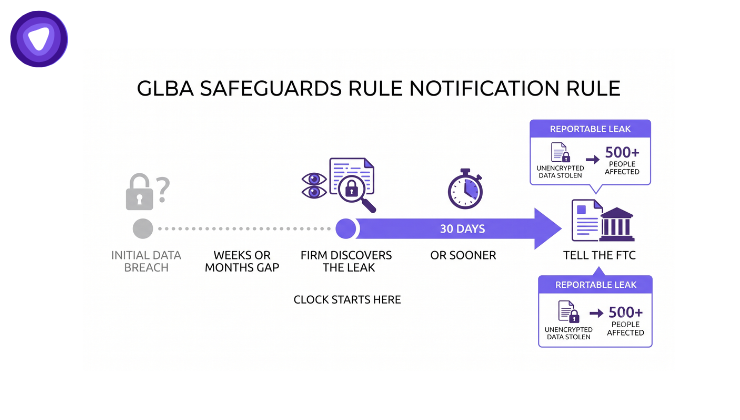
The FTC updated the Safeguards Rule in 2023 to add a report rule. The change took effect in May 2024. Under the rule, your firm must tell the FTC as soon as you can. You must report no later than 30 days after you find out about a leak. A reportable leak means someone took unencrypted customer data from at least 500 people.
That rule sounds narrow until you map it against how stolen data actually shows up. Attackers rarely announce a break-in the day it happens. Stolen logins, API keys, and session tokens tend to show up first on dark web sites and paste pages. That gap often runs weeks or months past the first break-in. The GLBA Safeguards Rule starts its clock the moment your team finds the leak. It does not start the clock when the break-in itself took place.
The report clock starts sooner than your legal team expects
The rule spells out what counts as finding out. It is the first day any staff member or agent at your firm learns of the event. The one exception is the person who caused the leak. That rule creates a real snag for most compliance teams. Say a fraud analyst spots stolen logins on a dark web forum and posts about it in Slack. Your firm has likely already found out, even if no formal case has opened yet.
Firms that rely only on their own tools tend to learn about leaks through angry customers. Card network flags and police calls are the other two common paths. All three routes tend to surface a leak weeks after the data first goes up for sale. By then, stolen logins may have already changed hands many times over. Live dark web monitoring closes that gap by finding stolen data first. That gives your team more of the 30-day window to build the report, not just to find the leak. That gap often decides whether your report goes out on day 25 or day 5.
The Rebuttable Presumption Most Fintechs Miss
The updated rule holds a key idea worth knowing well. The rule assumes data theft took place any time someone gets in without permission. In practice, the FTC treats access as theft unless your firm can prove otherwise. Your firm carries that proof burden, not the FTC.
This one rule shapes how your monitoring setup should work. A firm that can show proof of what data actually left holds a much stronger hand. A firm that only knows someone got in holds a much weaker one. Dark web tools that log the date and match of every stolen credential give your team that proof directly. That proof turns a weak spot into a strong case.
Why the Encryption Shield Breaks When Keys Leak Too
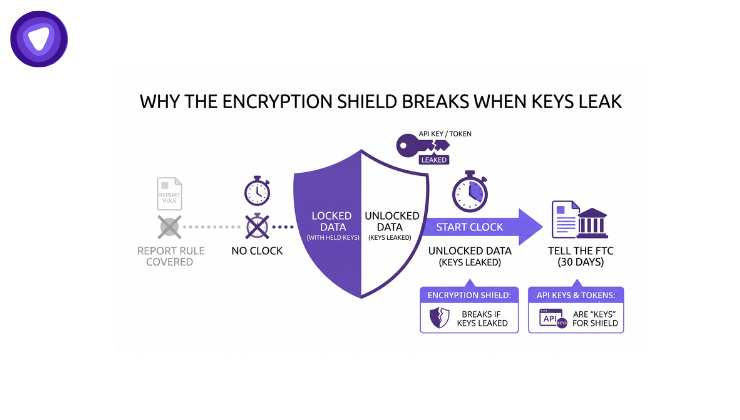
The report rule covers unencrypted customer data. That wording leads many teams to assume locked data sits outside the rule entirely. That shield breaks under one clear condition. The rule says locked data still counts as open if the lock key also got out.
API keys and session tokens are often the exact keys that open your locked data stores. When those keys turn up on the dark web next to locked records, your assumed shield goes away. A monitoring setup built only around customer usernames and passwords misses this gap entirely.
API keys and tokens rarely look like normal logins, so plain monitoring tools tend to skip them. One leaked API key on a paste site can start the same clock as a leaked plain-text password.
The Real Cost of Getting the Timeline Wrong
Financial firms now rank second among all fields for breach cost. The field averages a $5.56 million average per event. Detection speed drives a big share of that cost. Across the field, the average 241-day breach lifecycle runs well past the 30-day window once a firm finds a leak.
Many compliance posts still cite a $100,000 fine tied to GLBA’s separate pretexting rule. That figure has not applied to the Safeguards Rule report duty in years. The current fine for a knowing violation stands at $53,088 per violation under 15 U.S.C. 45(m)(1)(A). The FTC raised that figure for inflation in January 2025. Each affected person can count as its own violation, so the fine grows with the size of the leak.
Build versus Partner: The Real Math on GLBA Safeguards Rule Compliance
Picture a mid-size fintech weighing whether to build dark web monitoring in house. The other path is adding it through an existing partner deal. Building it yourself means buying threat feeds and hiring staff to sort every match.
It also means running scans around the clock on your own servers. A fair estimate puts that first-year cost near 300,000 dollars. That figure sits before you add the ongoing staff needed to review alerts. One analyst working full time on matches adds a further six-figure cost each year after that.
A white label deal folds monitoring into a product you already sell instead. Your firm pays a fee per user or per tier for coverage. The feeds and back-end tools stay with your partner the whole time. Your staff only step in once a real match needs a second look. For firms running lean compliance teams, this math often tips the choice toward a partner deal.
Build versus Partner at a Glance
The table below lines up both paths side by side. Figures are illustrative estimates, not sourced averages.
| Factor | Build in house | White-label partner |
| First-year cost | Around $300,000 | Per-user or per-tier fee |
| Ongoing staff | One analyst, six-figure cost each year | Your team handles triage only |
| Threat feed access | Must license and maintain | Included, partner-managed |
| Timestamped evidence logs | Must build in house | Included by default |
| Time to launch | Several months | A few weeks |
Your Monitoring Partner Needs its Own GLBA Check Too
The GLBA Safeguards Rule does not stop at your own walls. It also covers any outside firm that touches your customer data, and that includes your monitoring partner. The rule expects a real contract with safeguard clauses, not just a signed form. It also expects your firm to check on that partner over time, not just once at signup.
Ask a would-be monitoring partner where it stores the credentials it finds. Ask who else can see a match before your team does. A partner that only hands you a dashboard and skips this proof puts your own compliance at risk too.
A GLBA Safeguards Rule Notification Checklist
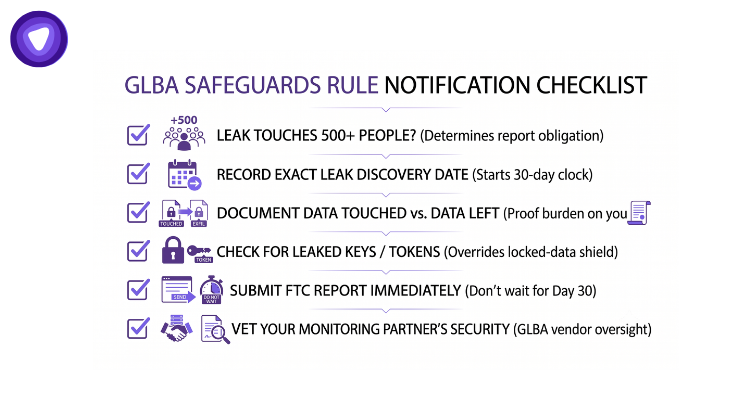
Use the following as a working guide. It does not replace legal counsel or your own compliance review.
- Check whether the leak touches at least 500 people. That mark decides whether you must tell the FTC at all.
- Write down the exact date any staff member first learned of the leak. That date starts the 30-day clock no matter when your formal case opens.
- Keep proof showing exactly what data attackers touched versus what data actually left. The rule puts that proof burden on your firm, not the FTC.
- Check whether any keys or tokens leaked next to locked records. That gap can void your locked-data shield entirely.
- Send your report through the FTC’s online form as soon as you can. Do not wait until the 30-day mark nearly runs out.
- Vet your monitoring partner’s own data handling. GLBA’s vendor oversight duty covers that partner too, not just your internal systems.
Closing the Gap with PureVPN White Label VPN Solution
PureVPN White Label VPN Solution gives fintechs, digital banks, and credit unions live sight into stolen data. Coverage spans login data, API keys, and session tokens the moment they surface anywhere online. Webhook alerts send matches straight into a fraud or compliance queue your team already uses. Partners run the tool under their own name, so customers only ever see your brand.
The setup keeps a dated, matched log built for the exact proof burden the rule places on your firm. Your team gets a clear record of which data showed up, when, and where it surfaced. That record becomes the proof a GLBA Safeguards Rule case actually asks for. Partners get that proof without hiring a threat team of their own.
The program also gives partners a clear answer to the vendor-oversight question above. It shows where scanned data lives and who can access a match. More than 150 partners run on this setup today, spanning fintech, telecom, and managed security firms. Partners who adopt it keep a 78 percent renewal rate each year.
Final Thoughts
Meeting the GLBA Safeguards Rule notification duty comes down to speed and proof, not controls alone. The report clock starts sooner than most compliance calendars assume. The proof burden sits with your firm, not the FTC. The fine for getting the timeline wrong has climbed well past the old figures still floating online.
Live monitoring closes the gap between a leak and the moment your team finds out. See how fast your fintech can launch branded dark web monitoring with dated, audit-ready alerts.