

Key Takeaways
- White-label dark web monitoring providers fall into three types: embedded identity platforms, identity data APIs, and domain monitoring platforms.
- Detection lag is the biggest hidden gap. Only 36.4% of stolen credentials were detected within 24 hours in 2025.
- Infostealer depth matters. 31% of malware-sourced credentials carried active session cookies that survive a password reset.
- Monitoring detects exposure but removes nothing. Broker removal needs its own re-check cadence and broker list.
- Ask every provider for detection data, audit scope, and change-of-control terms in writing before signing.
Identity fraud cost US consumers $27.3 billion in 2025, according to Javelin Research. That figure covers 18 million victims. Each victim was a customer of some bank, carrier, insurer, or software brand. The brand that warned them first keeps the relationship.
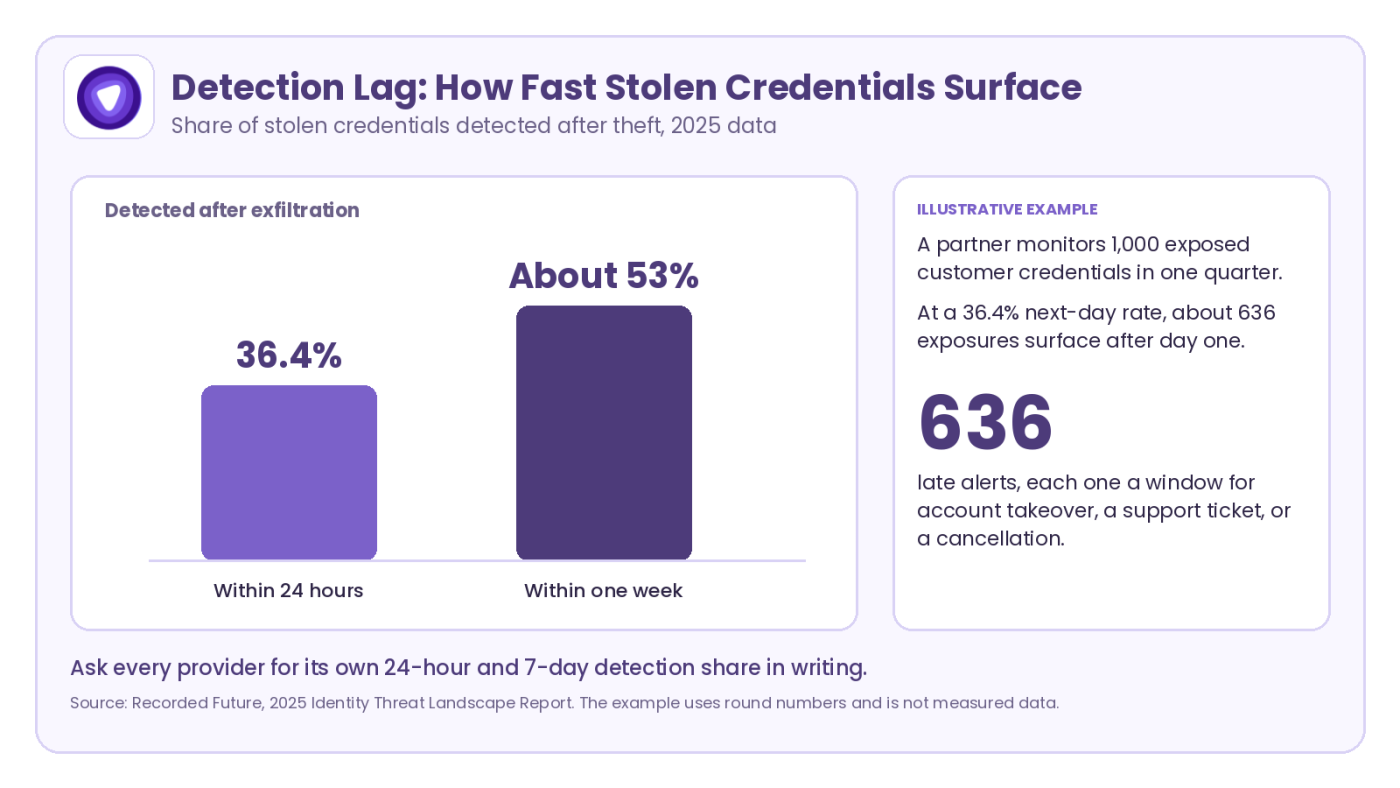
That is why choosing among white label dark web monitoring providers is a margin decision, not a feature decision. Speed is where providers differ most. In its 2025 data, Recorded Future detected only 36.4% of stolen credentials within 24 hours of theft. About 53% surfaced within one week. A provider that publishes “real-time alerts” on its sales page may still sit inside that curve.
This guide sorts white-label dark web monitoring providers into three types. It then compares seven named providers on the same factors. Finally, it gives eight questions that expose the gaps a demo will not show.
Why the Provider Decides Your Cost of Inaction
A dark web alert has one job. It must reach the customer before the attacker uses the data. Every hour of lag shifts the cost back onto the partner.
The supply side keeps growing. Threat actors stole 1.8 billion credentials in the first half of 2025, per Flashpoint’s midyear findings. Flashpoint also reported an 800% rise in infostealer use. In addition, each infected device yielded 87 credentials on average in the Recorded Future data.
Consider an illustrative example with round numbers. A partner monitors 1,000 exposed customer credentials in one quarter. If its provider matches the 36.4% next-day detection rate, about 636 exposures surface after day one. Each late alert is a window for account takeover, a support ticket, or a cancellation.
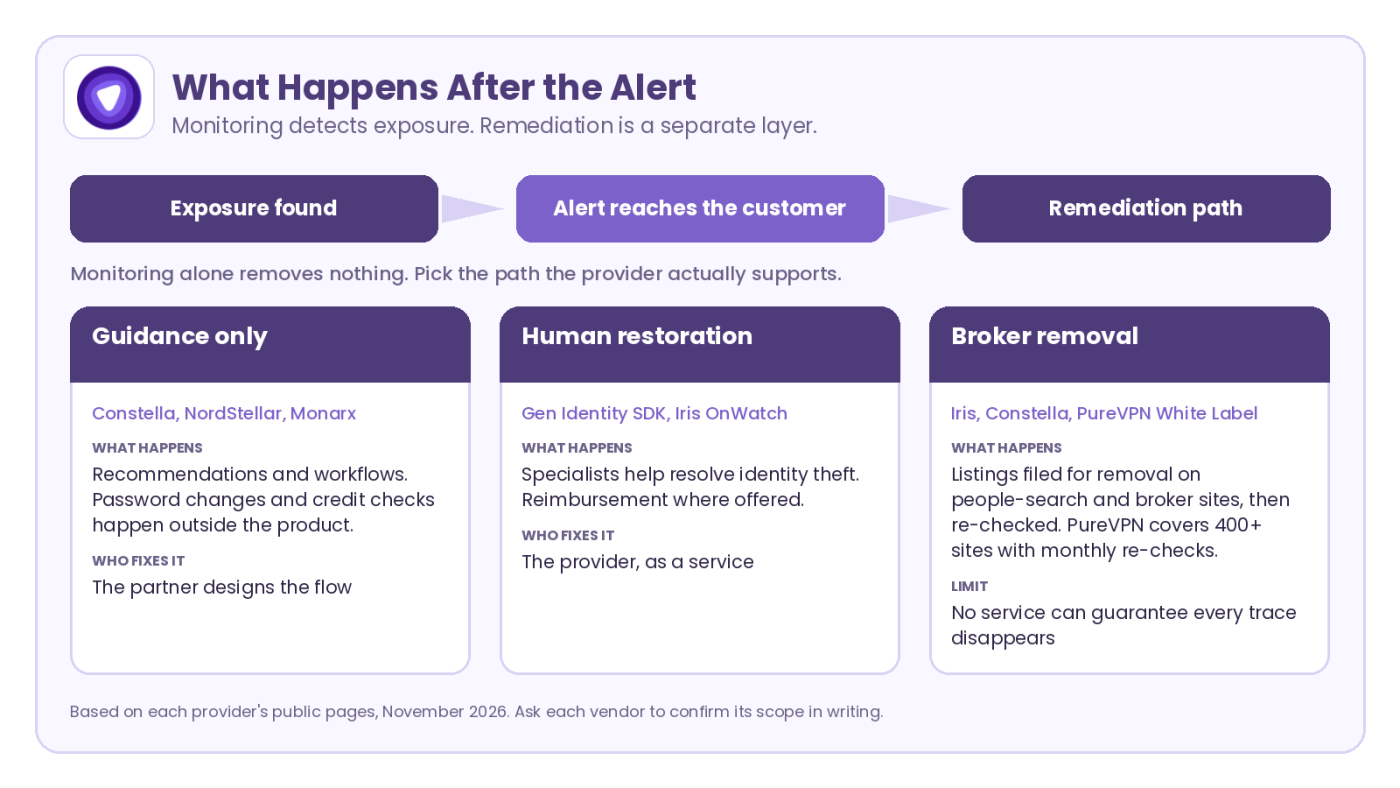
The provider also decides what happens after the alert. Monitoring only detects exposure. It does not delete a leaked record or a broker listing. So the real comparison covers detection speed, depth, and the remediation path that follows.
Three Types of White-Label Dark Web Monitoring Providers
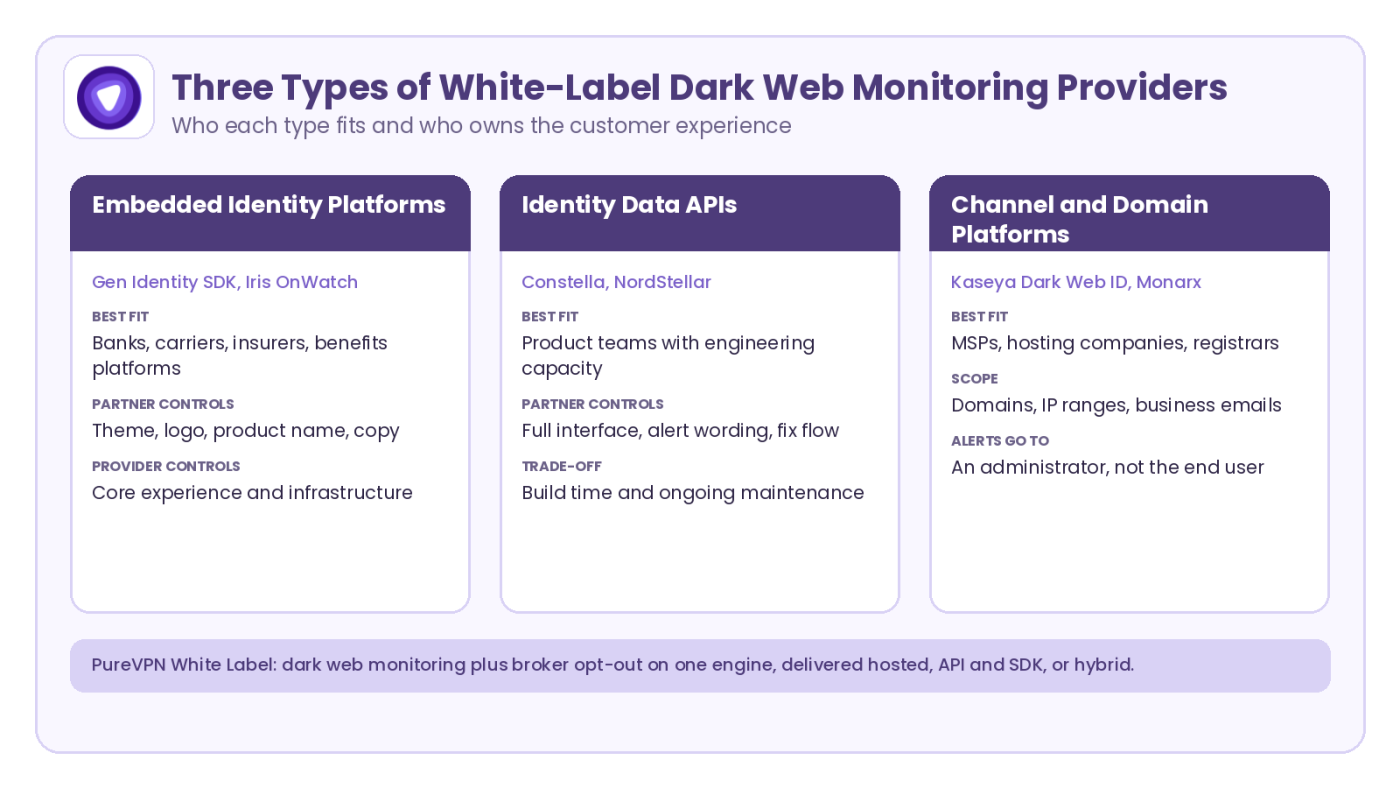
Most buyer confusion comes from comparing providers that were never built for the same job. The market splits into three distinct types. Each one assumes a different partner, a different identity scope, and a different owner for the user experience.
Embedded Identity Protection Platforms
These providers ship a full consumer identity product that a partner places inside its own app or portal. The bundle usually includes dark web monitoring, credit alerts, and human restoration support. Some add insurance. The provider runs the infrastructure and much of the customer journey.
This model suits banks, carriers, insurers, and benefits platforms that want a complete identity product fast. The trade-off is depth of control. Branding stops at themes, logos, and copy, while the provider owns the core experience.
Identity Data APIs
These providers sell the detection layer as an API. The partner sends identifiers and receives exposure events. Everything the customer sees, from alert wording to remediation steps, is the partner’s own build.
This model fits product teams that want full design control and already run engineering capacity. A per-user architecture gives the cleanest fit for apps with individual accounts. The cost is build time and ongoing maintenance.
Channel and Domain Monitoring Platforms
These providers watch business assets such as domains, IP ranges, and company email addresses. They target MSPs, hosting companies, and registrars that resell security to small businesses. Alerts tend to flow to an administrator rather than an individual consumer.
This model works well for employee monitoring at client companies. It fits poorly when the end customer is a single consumer with personal identifiers.
White-Label Dark Web Monitoring Providers Compared
The table below compares seven white-label dark web monitoring providers on the same factors. Every cell reflects public vendor pages or trade coverage checked in November 2026. “Not published” means the detail was absent from public sources, not that the capability is missing.
| Provider | Type | Delivery Model | Identity Scope | Remediation After Alert | Data Broker Removal | Public Pricing |
|---|---|---|---|---|---|---|
| Gen Identity SDK | Embedded identity platform | Hosted web experience inside partner apps, plus subscription APIs | Personal identifiers, credit, social accounts | Restoration specialists; reimbursement where offered | Not published | No |
| Iris OnWatch | Embedded identity platform | API suite, branded portal, single-purpose micro-experiences | Personal identifiers, credit, transactions | 24/7 resolution experts | Yes, Private Data Removal (launched January 2026) | No |
| Constella Intelligence | Identity data API | Intelligence API | Personal identifiers across surface, deep, and dark web | Response recommendations | Yes, broker monitoring and removal | No |
| NordStellar Dark Web API | Identity data API | API with webhook subscriptions | Email, phone, username, address, card data | Guidance and workflows | Not published | No |
| Kaseya Dark Web ID | Channel and domain monitoring | MSP console | Domains, IP addresses, business and personal emails | Admin-led follow-up by the MSP | No | Quote only |
| Monarx Dark Web Monitoring | Channel and domain monitoring | API plus white-label portal for hosts | Every address on a customer domain | Guidance only | No | Suggested retail $1.99 to $9.99 per month |
| PureVPN White Label | DWM plus broker opt-out on one engine | Hosted platform, API and SDK, or hybrid | Personal and work identifiers, infostealer logs | Automated broker opt-outs with monthly re-checks | Yes, 400+ broker and people-search sites | No, wholesale with partner-set retail |
The Providers, Profiled
The table shows the shape of each offer. The profiles below add the details that change an integration plan or a contract. Each profile sticks to what the provider publishes.
Gen Identity SDK
Gen, the company behind Norton and LifeLock, offers an Identity SDK for partner apps. Gen runs the services, data pipelines, and monitoring infrastructure. Partners embed a Gen-hosted web experience in a web portal or mobile app.
Features include dark web monitoring, social media monitoring, restoration help, and credit monitoring. Availability varies by region and commercial agreement. That caveat matters for carriers selling across several countries.
One integration detail stands out. The partner stays the identity provider and must set up single sign-on to obtain a Norton login token. Branding covers colors, fonts, logos, product name, and support contacts.
Iris OnWatch
Iris built its business as a B2B2C identity provider under the Generali name. On September 1, 2026, it completed a management-led buyout from Redion Group. It is now rebranding as Iris OnWatch. The company states that existing programs and service levels remain in place.
Partners can choose an API suite, a fully branded portal, or smaller micro-experiences. In January 2026, Iris launched Private Data Removal through both the API and the portal. In 2025, it added new dark web items. These include crypto wallets and travel visa data.
Constella Intelligence
Constella sells the detection layer as one API. It covers surface, deep, and dark web sources, including infostealer botnets and data brokers. Constella states that six of the top ten global identity theft providers use its API.
Alerts include the last few characters of a leaked password. That small detail helps a customer recognize a reused password without exposing it. Constella also states that it works only with hashed data. Remediation stops at response recommendations, so the partner designs the fix flow.
Kaseya Dark Web ID
Kaseya acquired ID Agent and its Dark Web ID platform, which sells only through the MSP channel. It monitors domains, IP addresses, and email addresses for business and personal credentials. Monitoring combines automated collection with human analysts.
Dark Web ID also sits inside the Kaseya 365 User bundle. New bundle purchases require at least 50 licenses. Its center of gravity is the business client, not the individual consumer.
Monarx Dark Web Monitoring
Monarx launched a white-label service for hosting providers and registrars in September 2026, according to trade coverage. It starts from a customer domain and processes breach data for every address on it. Partners integrate by API and keep billing in their existing systems.
Customers see only the categories of breached data, not the values. Remediation is guidance, with password changes and credit checks handled outside the product. Revenue share starts at 50/50, according to the company.
Eight Questions That Separate White-Label Dark Web Monitoring Providers
A feature checklist makes white-label dark web monitoring providers look alike. The questions below force answers that differ. Ask each one in writing, and ask for evidence rather than a slide.
1. Detection Lag Distribution
“Real-time” describes delivery, not collection. Ask for the share of exposures detected within 24 hours and within seven days of theft. Then compare the answer against the 36.4% and 53% benchmarks above.
2. Infostealer Log Depth
Recorded Future found that 31% of malware-sourced credentials in 2025 carried active session cookies. A stolen cookie can bypass a password reset. A provider that stops at email and password pairs misses that risk.
3. Per-User or Per-Domain Scope
Per-user scope fits consumer apps, banks, and carriers. Per-domain scope fits MSP clients and hosting customers. Choosing the wrong scope creates either noise or blind spots.
4. What the End Customer Sees
Some providers show only data categories. Others show masked values or partial passwords. The display decides whether a customer can act alone or must open a support ticket. Also confirm which scanned sources feed each alert type.
5. What Happens After the Alert
Remediation ranges from a guidance page to human restoration to automated removal. Broker removal deserves separate scrutiny, since listings often reappear after deletion. A removal provider should publish its re-check cadence and its broker list.
6. Who Owns the Interface
Hosted products move fastest but limit design control. API products give full control but need engineering. Also ask how alerts arrive, since webhook delivery suits real-time use better than polling.
7. Audit Evidence for This Product
Ask whether the audit report covers the monitoring service itself, not only the parent company. Request how identifiers are stored, whether data is hashed, and who can view raw records. Financial partners must also map vendor oversight to the Safeguards Rule.
8. Commercial Terms and Change of Control
Confirm who sets retail price, who bills the customer, and how revenue splits. Then check the change-of-control clause. Ownership changes in this market are real, as the 2026 Iris buyout shows.
Matching the Provider Type to the Partner
The right provider depends on who the end customer is and who will own the experience. The pattern below maps common partner types to the best-fit provider type.
- Banks, carriers, and insurers with consumer bases tend to fit embedded platforms or a hybrid model.
- Benefits and HR platforms need restoration support and a hosted portal they can brand quickly.
- Product teams with engineering capacity gain the most from identity data APIs and their own interface.
- MSPs and hosting companies fit domain monitoring, with pricing tied to monitored asset count.
- Privacy and security brands need detection plus broker removal under one brand and one contract.
That last group faces a specific gap. Detection-only APIs leave removal to another vendor. Bundling both on one service removes that second contract.
Where PureVPN White Label Dark Web Monitoring Fits
PureVPN White Label Dark Web Monitoring runs on the same engine as Data Broker Opt-Out. The two are sold together as Digital Privacy Protection. It scans dark web breaches and infostealer logs around the clock, down to credentials, cookies, and device context. Partners choose a fully hosted platform, an API and SDK build, or a hybrid of both.
Broker opt-outs cover 400+ people-search and broker sites, with monthly re-checks and automatic re-removal when data resurfaces. PureVPN states plainly that no removal service can guarantee every trace disappears. Controls are certified under SOC 2 Type II and ISO 27001, with full audit reports shared under NDA. Partners buy at wholesale and set their own retail price.
PureVPN White Label reports 150+ partners and two decades in privacy infrastructure. These are company-reported figures, not third-party audited. No dark web monitoring case study is published yet. The closest proof is an antivirus partner that reported 15% higher retention and 25% more revenue within two months. That result came from bundling VPN, not dark web monitoring.
Conclusion
White-label dark web monitoring providers fall into three types: embedded platforms, data APIs, and domain monitors. Each one fits a different partner. The wrong type costs time in integration, support tickets, or a second removal contract.
Run the eight questions with every one of the white-label dark web monitoring providers on your shortlist. Weight detection lag and remediation most heavily, since they decide whether the customer gets warned and protected. Then match the provider type to your end customer.
Request a 20-minute walkthrough of the dark web monitoring and broker removal API.
Frequently Asked Questions
What are white-label dark web monitoring providers?
They are vendors that scan breach and dark web sources and let partners sell the alerts under their own brand.
How do I compare white-label dark web monitoring providers?
Compare detection lag, infostealer depth, identity scope, remediation, delivery model, audit coverage, and change-of-control terms.
Does dark web monitoring remove exposed data?
No, monitoring only detects exposure; deleting broker listings requires a separate data broker removal service.
How fast should a dark web alert arrive?
Ask for detection within 24 hours, since only 36.4% of stolen credentials surfaced that fast in 2025.
Can MSPs resell dark web monitoring under their own brand?
Yes, domain-based platforms let MSPs brand reports and portals for each client company they manage.