
If you’ve ever logged into your bank account, sent a confidential email, or completed an online payment, RSA encryption has likely protected that interaction.
RSA is one of the most widely used public-key cryptographic algorithms in the world. Despite being introduced in 1977, it still plays a critical role in securing HTTPS websites, VPN connections, digital signatures, email encryption, and enterprise authentication systems.
With global cybercrime damages projected to exceed $10 trillion annually, according to cybersecurity market reports, strong encryption standards are important. RSA encryption remains central to how modern internet security works.
What Is RSA Encryption?
RSA encryption is an asymmetric encryption algorithm used to securely transmit data over the internet. It was developed by Ron Rivest, Adi Shamir, and Leonard Adleman, whose initials form the name “RSA.”
Unlike symmetric encryption, where one key encrypts and decrypts data, RSA uses:
- A public key (shared openly)
- A private key (kept secret)
This key pair system enables secure communication between two parties without previously sharing a secret key.
Why Is RSA Important?
RSA solved a major problem in cryptography: How can two people securely exchange information over an insecure channel without meeting first to exchange a secret key? That breakthrough made secure e-commerce, secure messaging, and secure browsing possible.
Today, RSA is widely used in:
- SSL/TLS certificates (HTTPS websites)
- Secure email protocols
- Digital signatures
- VPN key exchanges
- Secure file transfers
- Enterprise identity systems
How Does RSA Encryption Work?
To understand RSA, you need to understand three core ideas:
- Public and private keys
- Prime numbers
- Modular arithmetic
Let’s simplify this.
Step 1: Generating RSA Keys
RSA key generation involves several mathematical steps:
1. Choose Two Large Prime Numbers
Two large prime numbers (let’s call them p and q) are selected. These primes are typically hundreds of digits long. In modern implementations, RSA keys are usually:
- 2048-bit (standard minimum)
- 3072-bit (stronger security)
- 4096-bit (high security)
2. Multiply the Primes
Multiply: n = p × q
This number n becomes part of the public key. The security of RSA depends on how hard it is to factor n back into p and q.
3. Calculate Euler’s Totient
Compute: φ(n) = (p − 1)(q − 1)
This value is used internally to generate keys.
4. Choose a Public Exponent (e)
Select a number e that:
- Is relatively prime to φ(n)
- Commonly 65537 in modern systems
5. Compute the Private Key (d)
The private key d is calculated such that: (d × e) mod φ(n) = 1
Now you have:
- Public key = (e, n)
- Private key = (d, n)
Step 2: Encryption
When someone wants to send you secure data:
- They take your public key.
- Convert their message into a number.
- Apply this formula:
Ciphertext = (Message^e) mod n
The result is encrypted data.
Step 3: Decryption
To decrypt:
Message = (Ciphertext^d) mod n
Only the private key holder can compute this. That’s the core of RSA encryption.
Why Is RSA Secure?
RSA’s security depends on one hard mathematical problem: Factoring very large numbers into prime factors.
When n is 2048 bits long, factoring it would require astronomical computing power with classical computers.
As of 2026:
- Factoring 2048-bit RSA keys remains computationally infeasible.
- The largest RSA number factored publicly was 829 bits (RSA-250) using massive coordinated computational effort.
- No known practical attacks can break properly implemented 2048-bit RSA.
This is why RSA remains trusted in modern cryptographic systems.
Real-World Applications of RSA Encryption
RSA is not used alone. It typically works alongside other encryption methods.
1. HTTPS (SSL/TLS)
When you visit a secure website:
- RSA helps exchange symmetric keys.
- After the key exchange, faster symmetric encryption (like AES) handles the data transfer.
More than 95% of web traffic globally is now encrypted via HTTPS, and RSA remains a key part of that ecosystem.
2. VPN Key Exchange
Many VPN protocols use RSA during the initial handshake phase.
For example:
- RSA authenticates servers.
- Secure key exchange ensures encrypted tunnels.
- Protects users from MITM (man-in-the-middle) attacks.
Without secure key exchange, VPN encryption would be vulnerable during setup.
3. Digital Signatures
RSA is widely used in:
- Code signing
- Software distribution
- Document authentication
- Government and enterprise digital identity systems
Digital signatures ensure authenticity, integrity and non-repudiation.
4. Secure Email
Protocols such as PGP (Pretty Good Privacy) and S/MIME (Secure/Multipurpose Internet Mail Extensions) rely on RSA encryption to secure email communication. They use public-key cryptography to encrypt messages so only the intended recipient can read them.
RSA also enables digital signatures, which verify the sender’s identity and ensure the message hasn’t been altered. This combination protects email confidentiality, integrity, and authenticity across untrusted networks.
RSA vs Symmetric Encryption
| Feature | RSA (Asymmetric Encryption) | AES (Symmetric Encryption) |
| Key Type | Uses two keys (public + private) | Uses one shared secret key |
| Performance | Slower due to complex math operations | Extremely fast and efficient |
| Primary Purpose | Secure key exchange & authentication | Bulk data encryption |
| Best Used For | Handshakes, digital signatures, identity verification | Encrypting large amounts of data |
| Security Role | Establishes trust between parties | Protects the actual transmitted data |
Why Both Matter
In real-world security systems like HTTPS and VPNs, RSA and AES work together, not against each other.
- RSA secures the key exchange.
- AES encrypts the data.
This hybrid encryption model delivers the best, strong authentication with high-speed performance, making modern online security both robust and scalable.
Is RSA Encryption Still Secure in 2026?
When it comes to RSA encryption security in 2026, experts agree that key length matters, with 2048-bit keys serving as the minimum standard for secure communications and 3072-bit or larger keys recommended for long-term protection due to their stronger security margin against both classical and future quantum threats.
Modern cryptography guidelines, including historical NIST recommendations, discourage using 1024-bit RSA because it’s too weak for today’s threat models and has been essentially deprecated in most secure systems.
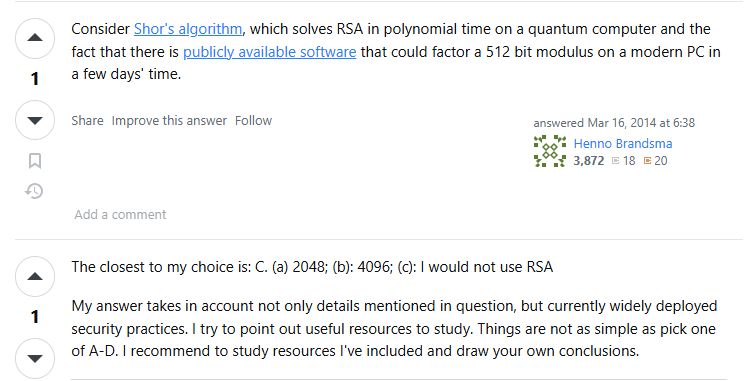
While Shor’s algorithm, a quantum algorithm capable of factoring large integers, poses a theoretical risk to RSA, practical quantum computers with enough qubits to break a 2048-bit key do not yet exist, and current research shows no real-world break of standard RSA key sizes so far.
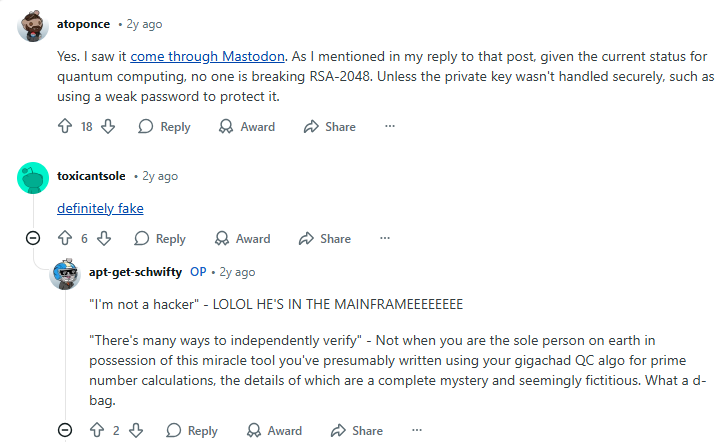
Discussions among cybersecurity communities on Reddit reflect this reality, where scholars point out claims of RSA being broken are either about small toy keys or speculative future threats, and stress that RSA-2048 remains safe for now.
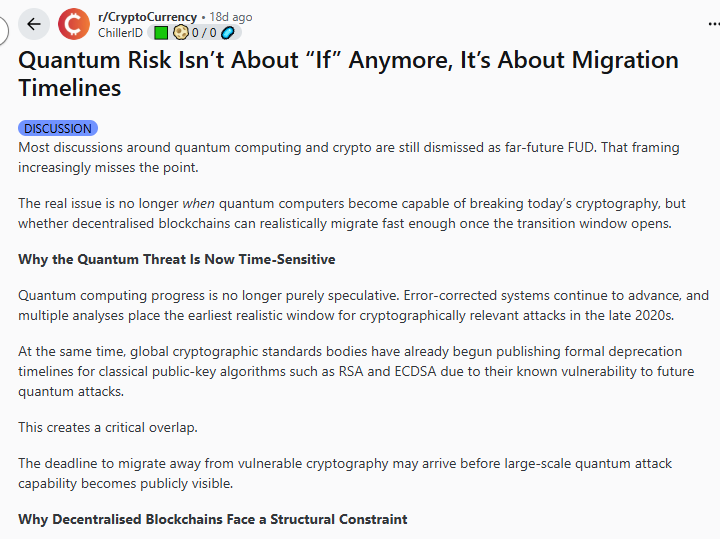
At the same time, cybersecurity practitioners increasingly talk about post-quantum cryptography migration planning and hybrid approaches, combining classical RSA with quantum-resistant schemes, as a responsible strategy for future-proof systems, making broader industry debate on migration timelines and risk management.
Limitations of RSA Encryption
Despite its strength, RSA has limitations.
1. Slower Than Symmetric Encryption
RSA is computationally intensive, which makes it less suitable for encrypting large volumes of data. Instead, it’s primarily used for secure key exchange, server authentication, and creating digital signatures.
These tasks require strong asymmetric cryptography but involve relatively small data sizes. For full data encryption, faster symmetric algorithms like AES are used after the secure connection is established.
2. Key Management Complexity
Private key storage must be secure. If a private key is leaked:
- Encryption is useless.
- Digital signatures can be forged.
This is why enterprises use:
- Hardware Security Modules (HSMs)
- Secure key vaults
- Strict access control policies
3. Vulnerable to Implementation Errors
Even strong encryption like RSA can fail if it’s implemented incorrectly. Poor configurations or outdated padding methods can expose systems to padding oracle attacks, while hardware leaks and power analysis can enable side-channel attacks.
Timing differences in cryptographic operations may also reveal sensitive key information to skilled attackers. That’s why developers must rely on well-maintained, secure cryptographic libraries and follow modern security standards instead of building custom implementations.
RSA and Modern Privacy Concerns
Encryption is a basic requirement for digital privacy. With ISP-level monitoring, government surveillance programs, aggressive data harvesting by online platforms, and a steady rise in cyberattacks, unencrypted communication leaves users exposed.
Strong encryption protocols help shield sensitive information from interception and unauthorized access. RSA, for example, plays an important role in securing encrypted web browsing (HTTPS), protecting VPN handshakes, protecting private communication tools, and enabling secure enterprise remote access for distributed teams.
That said, encryption alone isn’t a complete privacy solution. It protects the content of your data, but not always the surrounding metadata. That’s why secure network practices, encrypted tunnels, are important. Together, these technologies reduce the risk of tracking, traffic analysis, and large-scale data profiling in today’s highly monitored digital environment.
Frequently Asked Questions
RSA stands for Rivest, Shamir, and Adleman, the three cryptographers who invented the algorithm in 1977.
No encryption is permanently unbreakable. However, properly implemented 2048-bit RSA remains secure against classical computing attacks till date.
RSA is mainly used for secure key exchange and authentication. Once a secure connection is established, faster symmetric encryption handles the rest.
Security professionals recommend, minimum 2048-bit, 3072-bit for higher security and avoid 1024-bit.
In theory, yes. In practice, not yet. Current quantum computers cannot break 2048-bit RSA. Post-quantum cryptographic standards are being developed for long-term protection.
Wrap Up
RSA encryption remains one of the foundational pillars of internet security. From HTTPS websites, VPN handshakes, digital signatures and secure email systems, RSA enables secure communication between strangers across untrusted networks.
While quantum computing may reshape cryptography in the future, RSA with modern key lengths continues to provide strong, reliable protection in 2026. Understanding how RSA works helps you appreciate the invisible security layers protecting your data every time you connect, browse, or communicate online.