At 12:01 AM on a warm June night in 2021, millions of Nigerians reached for their phones only to find X (formerly Twitter) had disappeared. No warnings. No countdown. Just gone. Over 200 million people were digitally silenced overnight. The reason? Twitter had removed a tweet by then-President Muhammadu Buhari, citing a violation of its rules.
What followed was a seven-month standoff. The Nigerian government banned Twitter entirely, threatened jail time for anyone accessing it through a VPN, and eventually lifted the ban only after the company agreed to set up a local office, pay taxes, and comply with takedown requests. What once seemed unimaginable, a democratic nation blocking a major global platform, has now become a recognizable pattern.
This was not an isolated case. It marked the beginning of a global trend that has only intensified. From Russia to India, China to the United States, the power struggle between governments and social media platforms is escalating. The dream of an open internet is fracturing, giving way to a fragmented, politicized, and heavily censored digital world.
The Rise of the Digital Blackout
Over the last decade, internet shutdowns and social media blackouts have surged. According to Freedom House, officials in at least 25 countries have blocked access to social platforms, often during elections or mass protests. In 2024 alone, a record 25 of 72 countries studied imposed digital restrictions during politically sensitive periods.
And it is not just the usual authoritarian regimes anymore. Democracies are now joining the censorship club – often in the name of national security or public order.
Let’s take a look at some of the most telling examples of state-led censorship in recent years:
- Russia: In March 2022, as Russian troops rolled into Ukraine, the Kremlin banned Facebook and Instagram for refusing to suppress independent news coverage. Twitter was throttled into near-uselessness. The move effectively erased Meta’s platforms from Russia’s internet and sent a chilling message to tech companies: either fall in line, or get shut down.
- India: In June 2020, amid a violent border standoff with China, India banned TikTok and 58 other Chinese apps overnight. The stated reason? Data privacy and national security. In reality, it was a geopolitical message. And it did not stop there. In 2025, following a deadly terror attack in Kashmir, India launched one of its broadest censorship waves yet, banning thousands of accounts linked to Pakistan, including celebrities, cricketers, and influencers on Instagram, YouTube, and X (formerly Twitter).
- China: The OG of censorship. China’s Great Firewall has blocked Facebook, Twitter, Instagram, and YouTube for over a decade. In 2024, China scored a mere 9 out of 100 in Freedom House’s global internet freedom index – a score it now shares with Myanmar. VPN usage is illegal. Even discussing censorship is, ironically, censored.
- United States: It might seem surprising to see the US on this list. But the tide is shifting. TikTok, with 150 million American users, is now at the heart of a national security firestorm. In 2023, Montana became the first state to outright ban the app, making it illegal for app stores to offer it locally. Federal restrictions are looming. What was once a beacon of free expression now wrestles with surveillance overreach, political pressure, and algorithmic manipulation.
These incidents are not anomalies. They’re the new norm.
Big Tech vs. Big Government
At the center of all this is a fundamental power struggle: who gets to control what billions of people can see, say, and share online?
On one side, you have the Silicon Valley giants – Meta, Google, TikTok, and X – building platforms that span continents, cultures, and politics. On the other hand, you have governments asserting “digital sovereignty” and demanding control over narratives, user data, and speech.
Sometimes it’s blunt force, like Russia labeling Meta an “extremist organization” or Vietnam threatening to shut down Facebook unless it is censored more aggressively. Other times it’s legal sleight-of-hand: India, for instance, used its 2021 IT Rules to compel platforms to remove “anti-national” content, backed by threats of criminal liability for non-compliance.
Platforms find themselves in an impossible spot. Comply, and they compromise on core values. Resist, and they risk losing massive markets. The result? A quiet, steady erosion of online freedom.
Meta’s own transparency reports show a 75% jump in government-ordered content removals in just six months (from 51,000 in late 2021 to nearly 90,000 in early 2022). Twitter, too, received 43,387 legal takedown demands in just half of 2021, with India, Russia, and Turkey leading the charge.
And these numbers likely underrepresent the full scale. Many content takedowns happen quietly, without public notice or user transparency. This is censorship by a thousand cuts.
A Timeline of Escalation
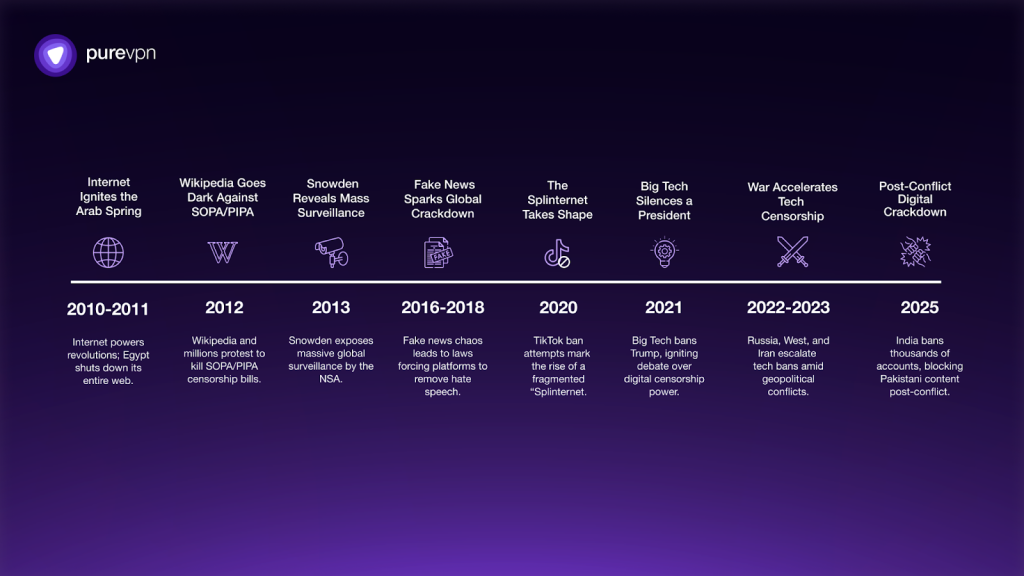
This digital tug-of-war didn’t happen overnight. Let’s rewind the tape:
- 2010-2011: The Arab Spring proves the internet can fuel revolutions. Governments take note. Egypt shut down its entire internet in a panic in a panic for five days.
- 2012: SOPA and PIPA in the US trigger a mass online protest. Wikipedia goes dark. Millions email Congress. The bills are killed. A temporary win for free speech.
- 2013: Snowden drops the surveillance bomb. The NSA’s PRISM and XKeyscore programs show just how deeply the US government has been spying on global digital activity. Trust in the open internet takes a hit.
- 2016-2018: Fake news and algorithmic rabbit holes fuel election chaos. Germany passes a landmark law mandating social platforms to remove illegal hate speech within 24 hours. Other countries follow suit.
- 2020: The US attempts to ban TikTok. India executes the first successful geopolitical app ban. The Splinternet becomes a reality.
- 2021: Big Tech removes Trump after January 6. It sets off global debates: Can private companies silence world leaders? Should they?
- 2022-2023: Russia’s war in Ukraine accelerates the tech-censorship arms race. The West bans Kremlin-controlled media. Russia bans Western platforms. Iran blocks WhatsApp and Instagram amid protests. TikTok CEO gets grilled by Congress.
- 2025: India’s post-conflict crackdown becomes a textbook case of targeted censorship. Over 8,000 social media accounts are banned. Pakistani influencers disappear from Indian Instagram and YouTube. The government tells OTT platforms to stop streaming anything made in Pakistan.
Most Blocked, Most Targeted
So, which platforms are getting the worst of it?
- Facebook is blocked in at least four countries and restricted in many more.
- Twitter (X) has faced nationwide shutdowns or throttling in Nigeria, Turkey, China, and Russia.
- YouTube is banned in China and Iran, with temporary blocks in countries like Pakistan and Sudan.
- Instagram has been blocked in Iran and Russia and selectively censored in India and Turkey.
- TikTok is fully banned in India and Afghanistan, and partially banned or under regulatory siege in the US, UK, and EU.
- LinkedIn was banned in Russia back in 2016. Even the professional world isn’t immune.
And the countries leading the censorship charts? China, Iran, Russia, Turkey, and India.
Even democracies like the US, Germany, and France are increasingly pushing content bans under the guise of moderation or national interest. According to Freedom House, global internet freedom has declined for 12 consecutive years.
A Borderless Internet, Fragmented by Borders
The irony? Social media was supposed to flatten hierarchies. Democratize discourse. Allow anyone, anywhere, to speak and be heard.
Instead, what we’re getting is a fragmented internet, where your digital experience depends entirely on your geography. A user in Berlin sees a different TikTok than a user in Delhi. A post visible in New York might be banned in Jakarta.
And for billions of users, especially in the Global South, the future looks even more uncertain. When state propaganda becomes the only allowed voice, dissent dies. When foreign platforms are banned, local surveillance-friendly clones take over.
Yes, misinformation and hate speech are real. But so is overreach. When censorship becomes the default tool to manage online speech, we don’t get safer communities – we get silent ones.
Who Holds the Kill Switch?
The central question is not whether platforms should moderate content. It’s who gets to decide what’s allowed. Right now, that power is increasingly concentrated in the hands of governments with a political agenda and corporations with opaque policies.
And the user? The everyday citizen? They’re left with a curated feed, a muffled voice, and a shrinking sense of agency.
We’re at a fork in the road. Either we fight for a truly open, global internet – with transparency, accountability, and user rights at its core – or we settle for digital fiefdoms controlled by whoever shouts loudest or pays the most.
What happens next will define more than just tech policy. It will define the nature of speech, democracy, and power in the digital age.The battle for the internet is here – and it’s only just begun. Fortunately, PureVPN doesn’t just equip its users with the tools needed to tailor their online experience, it also empowers them to fight the kill switch and censorship that filter out the information meant for them. With PureVPN, users can freely access unfiltered information without the fear of being flagged.

Arsalan Rashid

February 19, 2026

7 days ago


