
In today’s online world, ads follow you around. They track what you search, what you click, what you buy. That tracking helps advertisers measure what works, but it erodes privacy. That’s where privacy-preserving ad measurement comes in. This approach allows advertisers to understand if a campaign was effective, for example, whether a click on an ad led to a purchase, without tracking you individually or building a profile of your browsing behavior.
Instead of cookies and third-party trackers that collect personal data across sites, privacy-preserving measurement relies on anonymized, aggregated, or on-device data processing. Reported results are stripped of identifying details, so advertisers get the information they need, but you stay anonymous.
In the rest of this post, we’ll dig into how this works technically, which browsers support it, what advantages and drawbacks it has, and how you can control it for your own privacy.
Why Privacy-Preserving Ad Measurement Became Necessary
For years, digital advertising relied heavily on intrusive tracking mechanisms:
- Third-party cookies following users across websites
- Pixel tracking embedded invisibly in pages
- Device fingerprinting identifying users based on browser/device characteristics
- Ad IDs stored on mobile devices
- Behavioural profiling across multiple apps and platforms
Users became increasingly uncomfortable with this level of surveillance. Governments also stepped in:
- GDPR restricts personal data collection
- CCPA gives users opt-out rights from cross-site tracking
- ePrivacy regulations limit use of cookies
- Apple’s App Tracking Transparency (ATT) blocks app-to-app tracking unless users consent
At the same time, all major browsers are phasing out third-party cookies.
This forced the ad industry to evolve toward a solution that preserves measurement but eliminates tracking, leading to privacy-preserving ad measurement.
How It Works: From Click to Conversion — Without Spying on You
One of the most well-known implementations of privacy-preserving ad measurement is Private Click Measurement (PCM), originally developed for web browsers.
Here’s a simplified breakdown:
- Click Recording (On-Device): When you click an ad, the browser stores limited data about that click (which ad campaign, which advertiser). This data stays on your device.
- Conversion Detection: If you later perform a conversion (e.g., purchase, signup) on the advertiser’s site, the browser checks if that conversion corresponds to a stored ad click.
- Anonymous Report Generation: After a delay (often 24–48 hours), the browser sends an anonymized, aggregated report to the advertiser, without cookies or personal identifiers, and often with added “noise” to preserve privacy.
Because the processing happens inside the browser (or device), and because reports are aggregated and anonymized, no third-party ad network or tracker learns who you are or what you browsed.
This model balances two needs: advertisers get useful metrics (how many clicks led to conversions), while users retain privacy, no personal or cross-site tracking, and no behavioral profiling.
Why This Matters: The Shift in Ad Tech & User Privacy
Traditional ad tracking, with cookies, device IDs, fingerprints has raised growing privacy concerns. Users feel exposed, regulators act, and browsers push back. Under pressure from laws like GDPR and evolving browser standards, the ad industry has started searching for privacy-respecting alternatives.
Privacy-preserving ad measurement is part of that shift: it addresses the tension between the business need for measurable ad performance and users’ right to data privacy. With methods like PCM, or more broadly via the developing spec Privacy‑Preserving Attribution API (PPA), the industry aims for a future where ads can still work, but tracking you individually becomes optional.
For you as a user, this should mean fewer invasive trackers and more control over what’s shared, while still getting relevant ads.
Which Browsers & Platforms Offer Privacy-Preserving Ad Measurement
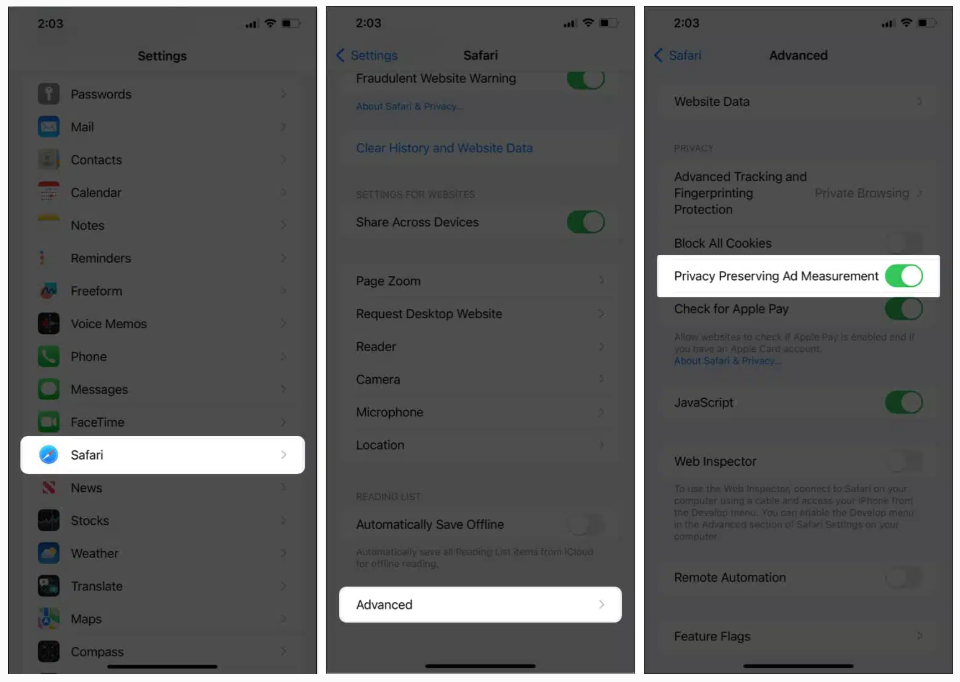
- Safari / iOS & macOS: Apple introduced Private Click Measurement to allow ad attribution without cross-site tracking. It is integrated into Safari.
- Firefox (experimental / PPA): Firefox has prototyped a privacy-preserving attribution system under Privacy-Preserving Attribution (PPA), aiming to deliver aggregate, anonymized ad metrics without identifying users.
- Other browsers and ad-tech providers are exploring related frameworks built on cryptographic anonymization, differential privacy, or aggregated reporting though standards are still evolving.
Because the technology is newer and still standardizing, not all browsers or ad networks implement it. But usage is growing, especially among privacy-concerned users and platforms.
Benefits & Drawbacks: What Privacy-Preserving Measurement Does and Doesn’t Do
Benefits
- No cross-site tracking or cookies: Browsing across different sites no longer builds a unified profile of you.
- Anonymized, aggregated reports: Advertisers learn about campaign performance as a group, not about your individual behavior.
- Better user privacy and compliance: Helps comply with data protection laws and reduces chances of third-party data leaks.
- On-device processing: Sensitive data stays on your device; you share only minimal metadata.
Drawbacks & Limitations
- Less granular data for advertisers: Without detailed user-level tracking, advertisers can’t know exactly who bought or clicked, only aggregated trends.
- Delayed reports & noise injection: To protect privacy, conversions may be reported after a delay, and data may be “noised,” reducing accuracy compared to traditional tracking.
Partial adoption only: Not all browsers, ad networks, or apps support privacy-preserving measurement. If you use unsupported platforms, standard tracking may still apply. - No ad targeting control: Privacy-preserving measurement handles conversions and attribution, not ad targeting or personalization. You may still receive generic ads.
Thus, while privacy-preserving measurement is a big improvement over intrusive tracking, it’s not perfect, and doesn’t solve all privacy issues in online advertising.
Should You Enable It, And How to Manage It
If you care about privacy but don’t mind seeing ads, enabling privacy-preserving ad measurement is a good balance. It lets ads remain functional and measurable — without giving up your identity.
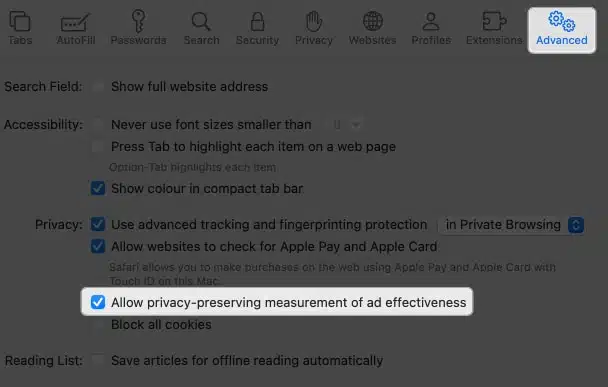
- On Safari: The setting is typically on by default. You can check or disable it under Settings → Safari → Privacy → “Allow privacy-preserving measurement of ad effectiveness.”
- On Firefox: If your version supports the experimental PPA API, you can enable or disable it via the privacy settings (often under “Website Advertising Preferences”).
- If you use other browsers or older versions, check their settings or documentation to see if similar features exist.
If you want maximum privacy, you might still prefer to block ads entirely or use privacy-focused browsers that disable all tracking. But if you accept some ads and want a middle path, privacy-preserving ad measurement is a solid step forward.
Final Thoughts
Privacy-preserving ad measurement represents the future of digital advertising. As the internet moves away from invasive tracking technologies, this new model bridges the gap between business needs and privacy rights. It enables accurate measurement without sacrificing user anonymity, a critical shift in the way ads, analytics, and the broader digital ecosystem operate.
From Apple’s PCM to Google’s Attribution API and Firefox’s PPA, the industry is converging toward a more ethical, transparent model of advertising. Users get privacy. Advertisers get insights. And the web becomes safer and more respectful of personal data.
FAQs
No. You’ll still see ads, but advertisers won’t get personal data about you. They’ll only receive aggregated, anonymized stats about ad performance.
Your clicks and conversions are tracked, but only in an anonymized, aggregated way. The browser handles processing and reports don’t include identifiable user data.
It’s much safer than traditional tracking. But no system is perfect. Because aggregated data is used, there’s still a small risk of re-identification in theory, and protection depends on correct implementation.
Safari (via Private Click Measurement) and Firefox (via its experimental Privacy-Preserving Attribution API) currently support it. Other browsers may adopt similar systems over time.
Yes, you’ll still get conversion and click metrics. But instead of user-level tracking, you’ll receive aggregate, anonymized reports. It’s less granular but privacy-friendly.
Yes, you can disable privacy-preserving measurement in your browser settings. This stops even anonymized ad-effectiveness data from being sent.