
You are traveling abroad, it’s past midnight, and your VPN suddenly stops working. You have a work call in a few hours, your usual websites are not loading properly, and the only thing between you and a long, frustrating night is the live chat button.
So when you open it, a chatbot replies instantly, but keeps sending you the same generic steps over and over: restart the app, choose another server, check your internet. Nothing works, and no real person appears. That’s the problem with many “24/7 VPN customer support” claims.
They sound reassuring until you actually need help and realize the support is slow, scripted, or barely staffed. Live chat is advertised everywhere in the VPN industry, but very few users know how to judge whether the help behind it is actually reliable.
Here’s what makes VPN live chat support worth trusting.
Why VPN Support Matters More Than You Think
VPN support is easy to treat as a customer service feature, but it plays a bigger role than that. If your VPN stops connecting, fails on public Wi-Fi, or breaks while you’re travelling, slow support is not just annoying; it can leave you exposed at the exact moment you expect the VPN to protect you.
That’s why good support says a lot about the VPN itself. A company that responds quickly, routes complex issues properly, and helps users fix problems in real time is usually not treating support as an afterthought. It has the people, systems, training, and product knowledge needed to back the service it sells.
Longevity matters here too. PureVPN has been in the VPN market since 2007, which means its support has had to evolve through new devices, stricter networks, streaming blocks, protocol changes, privacy concerns, and changing user expectations. A VPN company can claim to offer 24/7 support, but sustaining it for years takes a deeper level of operational maturity.
Industry averages represent aggregated figures from the top 10 VPN providers by user base.
How to Judge Whether VPN Live Chat Support Is Actually Good
Before you trust any VPN’s support claim, it helps to look at the same signals used across the wider tech and customer service industry. These benchmarks are not perfect rules for every company, but they do show what good support usually looks like in practice.
How Fast Does Someone Respond?
A strong live chat experience usually starts with a first response in under one minute. Zendesk describes one minute or less as a good live chat first reply time, with faster replies considered stronger.
That matters because live chat is the channel users turn to when they need help quickly. If a VPN stops working on public Wi-Fi, during travel, or before an important task, waiting several minutes can feel much longer than it sounds.
A slow first response can also point to thin staffing, weak overnight coverage, or a support system that depends too heavily on bots. Speed does not prove quality by itself, but it quickly shows whether “24/7 support” has real coverage behind it.
Does the First Agent Actually Solve the Problem?
First Contact Resolution, or FCR, measures whether the first support interaction solves the issue instead of only acknowledging it. SQM Group’s benchmark guidance places good FCR performance around the 70% to 79% range.
For VPN support, that matters because many problems are time-sensitive: connection failures, account access, server selection, billing questions, or app troubleshooting. Bots can make response times look fast, but they often fall short when the issue needs context. The quality shows up when the first agent can actually move the user closer to a fix.
Are Users Happy After the Chat Ends?
Customer Satisfaction Score, or CSAT, measures how users feel after a support interaction. Many industries consider a CSAT score between 75% and 85% good, while anything above 90% is considered excellent.
CSAT matters because it captures the user’s reaction right after the experience. A VPN can claim fast support on its website, but post-chat satisfaction shows whether users felt heard, guided, and helped.
Public review platforms can add another layer here, especially when the review volume is high. A VPN with 50 reviews and a 4.2 rating does not carry the same weight as one with thousands of reviews and the same score. Volume matters because it makes the pattern harder to fake or dismiss.
Would Users Recommend the Service?
Net Promoter Score, or NPS, asks whether users would recommend the service to others. NPS benchmarks vary by industry, but scores above 50 are often treated as strong, while lower-scoring categories like telecom and internet services are usually judged more harshly because users care so much about reliability, billing, and support.
For VPNs, NPS is useful because people rarely recommend a service for one reason alone. They usually recommend it when the product, support, price, and overall experience work together. A strong NPS can suggest that users are not only getting answers, but also feeling confident enough to stay with the service and tell others about it.
What Happens If the First Agent Cannot Fix It?
Good live chat support needs a clear escalation path. The first agent should be able to handle common issues, but more complex problems may need senior support, a ticket, billing help, or a technical team.
That matters because not every VPN issue can be solved in the first chat. A payment dispute, unusual device behavior, protocol issue, or platform-specific bug may need deeper investigation.
Good support does not make users restart the story every time the issue moves to another team. It keeps the context, routes the problem clearly, and gives the user a realistic next step instead of a vague “we’ll get back to you.”
Can Users Reach Support in More Than One Way?
A live chat button is useful, but it should not be the only way to get help. Strong support usually includes live chat, email or ticket support, a searchable support center, contact forms, and ideally in-app access.
That matters because VPN problems do not always happen in neat conditions. A user may be on mobile, unable to open a browser, dealing with an account issue, or looking for a written record of the conversation.
Website-only live chat can still be useful, but it is not the strongest version of support. In-app live chat is a better signal because users can reach help from the same place where the problem is happening, without leaving the app or searching for a support page.
Most users never think about what happens after the first chat message. But the structure behind that chat window is what decides whether your problem actually gets solved, or whether you are passed from one generic answer to another.
What Happens After You Open Live Chat?
A good VPN support system should not depend on one agent knowing everything. It should have clear layers: quick help for common issues, senior support for account or billing problems, technical teams for deeper product issues, and priority handling for critical cases.
For PureVPN, that path starts with 24/7 live chat available through the website and directly inside the app. In the app, users can go to More → Support → Live Chat without opening a separate browser.
Common connection, server, account, and app-related questions can be handled through live chat, while more complex billing, account, or technical issues can be moved into a support ticket and passed to the right team with the chat context attached.
The first reply matters, but the real value is in what happens next. Good VPN support should know when to solve the issue immediately, when to escalate it, and how to keep the user from starting over every time the problem moves to another team.
Which VPNs Have the Best Customer Support?
Which VPNs Have the Best Customer Support is a very valid question from customers. While many VPNs offer 24/7 live chat, PureVPN stands out for making support available without forcing users to leave the app. A closer look shows why:
- Support options: 24/7 live chat, in-app support, email, support tickets, contact form, and support center.
- What makes it different: PureVPN makes support easier to reach when something goes wrong. Users can start support from the website or inside the app, which helps when the problem is happening during the VPN experience itself.
- Why that matters: VPN problems are often time-sensitive. A failed connection, account issue, or device-specific error can interrupt work, travel, streaming, or secure browsing. PureVPN gives users a direct way to ask for help, continue the issue through tickets if needed, and use setup guides when they prefer to troubleshoot on their own.
How PureVPN’s Support Measures Up
Support claims are easy to make, so the numbers matter. Here’s a quick look at how PureVPN’s live chat support performs.
| Support Signal | PureVPN Performance |
| Years in operation | Since 2007 |
| Live chat availability | 24/7/365 on website and in-app |
| First response time | 35 seconds automated first response |
| First Contact Resolution | 80% |
| CSAT | 91.5% |
| Trustpilot score | 4.3/5 with 17,000+ reviews |
| Support channels | Live chat, support tickets, email, contact form, and support center |
PureVPN’s internal benchmark data puts the average first response time across top VPNs at under two minutes, which makes its 35-second automated first response notably faster. Its 80% FCR also sits above the common 70–75% support benchmark, while its 91.5% CSAT clears the 90% threshold often treated as excellent.
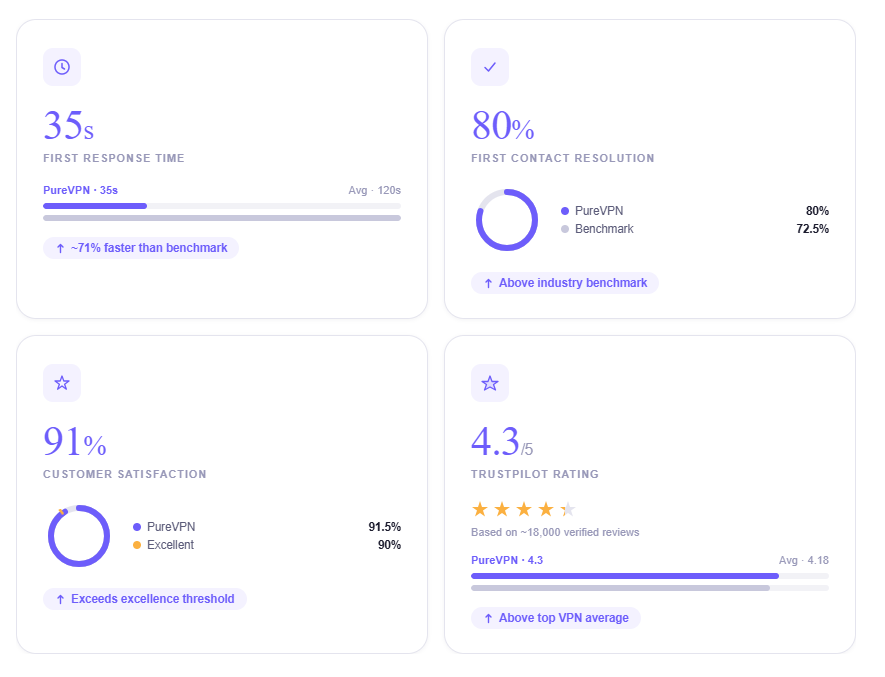
Trustpilot gives the public side of the picture. PureVPN’s 4.3/5 rating across around 18,000 reviews sits above the internal average measured across top VPNs, where the average was 3.8/5, or 4.18/5 when excluding ProtonVPN as an outlier.
The main takeaway is not only that PureVPN offers live chat. Many leading VPNs advertise round-the-clock support. The stronger signal is that PureVPN makes support easier to reach through both the website and the app, while its response time, resolution rate, CSAT, and public review volume show that the support experience is not just available, but consistently used and rated by real users.
What Sustained Trust Looks Like Over Time
Good support usually gets better with time. The more users a VPN supports, the more it learns about common issues, device-specific problems, payment questions, network restrictions, and the moments where users need help most. Over time, that knowledge should turn into better training, clearer troubleshooting paths, stronger internal tools, and faster escalation.
Public reviews are part of that trust picture too. A company that allows users to review its service openly, including negative experiences, is putting its support quality where people can see it. The score matters, but so does the willingness to respond, improve, and let patterns speak for themselves.
The same idea applies to privacy and infrastructure. No-logs audits, transparency efforts, security commitments, and public support channels all point to how seriously a VPN treats accountability. Support is not separate from that. It is one of the clearest places where users experience how the company operates when something goes wrong.
PureVPN has been in the VPN market since 2007, which means it has worked through major shifts in devices, protocols, streaming restrictions, privacy expectations, and network controls. That longevity does not replace performance data, but it does add context. A VPN can launch support quickly; keeping it useful over many years is much harder.
Frequently Asked Questions
Look for fast response times, real human help, clear troubleshooting, and a proper escalation path if the first agent cannot fix the issue. Good VPN live chat should also be easy to access from the website or app, not hidden behind multiple help center pages. Strong support is not just about replying quickly; it is about helping users get back to a secure, working connection.
Some VPNs do offer 24/7 live chat support, while others may limit human support to certain hours or rely more heavily on bots outside peak times. The best way to check is to look at the provider’s support page, open live chat at different times, and see whether you can reach a real agent.
A real 24/7 support experience should connect users to helpful answers at any time, not just send the same automated steps repeatedly. Bots can be useful for simple questions, but they should not be the only layer of support. If the chat keeps looping generic replies and never moves the problem forward, the “24/7” claim is not very useful.
Some VPNs require users to visit the website or support center to start a live chat. PureVPN lets users access live chat directly inside the app through More > Support > Live Chat, so they do not need to open a separate browser. In-app support is useful because users can ask for help from the same place where the issue is happening.
Start with the provider’s live chat or in-app support option if available, especially if you need help quickly while traveling. If live chat is not available, use the provider’s support center, email support, or ticket form and include your device, app version, country, network type, and the exact error you are seeing.
First Contact Resolution, or FCR, measures how often a support team solves the user’s problem in the first interaction. For VPN users, this matters because connection issues, account access problems, and server questions often need quick answers. A high FCR means fewer repeat chats, fewer delays, and less frustration when the VPN needs to work right away.
If an issue cannot be solved in the first chat, it can be moved into a support ticket and passed to the right team with the chat context attached. That may include billing support, account support, or a technical team depending on the issue. Good escalation keeps users from starting over every time the problem moves beyond the first agent.

Arsalan Rashid

May 21, 2026

5 months ago