
Most people do not remember to turn on their VPN every time they join public WiFi, open an app, or start browsing. An always-on VPN solves that problem by keeping the connection active automatically, so your internet traffic is protected without you having to switch it on every time.
But how exactly does it work, and is it different from features like auto-connect or an internet kill switch? In this guide, you’ll learn what an always-on VPN is, how it works, and whether keeping your VPN on all the time is the right choice for you.
What Is an Always-On VPN?
An always-on VPN is a VPN feature or device setting that keeps your VPN connection active whenever your device is connected to the internet. Instead of turning the VPN on manually each time, the connection runs in the background and helps protect your traffic automatically.
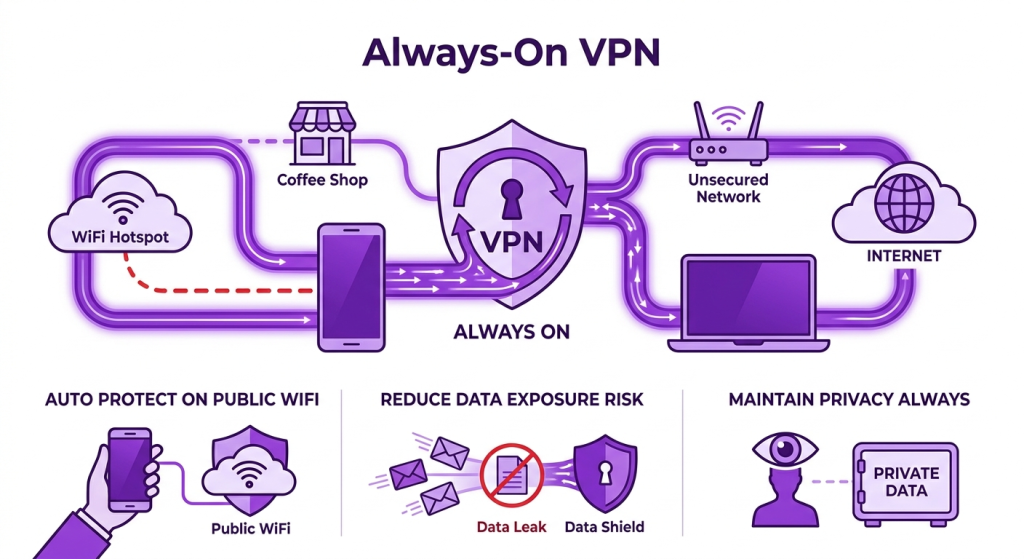
When paired with an internet kill switch or “block connections without VPN” setting, internet access can also be paused until the VPN connection is restored. The main purpose of an always-on VPN is simple:
- Protect users on public or unsecured WiFi
- Reduce the risk of accidental data exposure
- Maintain privacy without requiring manual action
- Keep your VPN connection active in the background
How Does an Always-On VPN Work?
An always-on VPN works by giving your device a rule: whenever there is internet access, the VPN should be active. So when your phone restarts, switches from mobile data to WiFi, or reconnects after losing signal, the VPN reconnects automatically.
The point is to remove the gap between going online and remembering to turn the VPN on. Once enabled, the device keeps the VPN as the preferred connection whenever internet access is available.
Why Use an Always-On VPN?
An always-on VPN can help in a few everyday situations:
- Stay protected when networks change: The VPN can reconnect when your device moves between WiFi, mobile data, home networks, or public hotspots.
- Use public WiFi with less risk: Always-on VPN reduces the chance of browsing, app activity, or login sessions passing through an unsecured network without protection.
- Reduce accidental IP exposure: If your VPN drops or your device reconnects, always-on behavior helps bring the VPN back without relying on you to notice.
- Keep remote work connections safer: Employees who access work tools, files, or systems can stay connected through a protected VPN connection more consistently.
- Cover background app activity: Some apps connect to the internet even when you are not using them. Keeping the VPN active helps cover those background connections.
Should You Always Keep Your VPN On?
Keeping your VPN on all the time is not mandatory, but it is usually the safer default. It is most useful when your device keeps changing networks, connects to public WiFi, or runs apps in the background without you thinking about it.
Keep your VPN on when you:
- Work remotely
- Use public WiFi hotspots
- Travel or use unfamiliar networks
- Want to reduce what your ISP can see
- Access banking, email, or work accounts
Keep your VPN off when you:
- Are troubleshooting a connection issue
- Use a website or app that does not work with the VPN
- Want a local service to detect your real location
- Need lower latency for local gaming
For most day-to-day use, leaving the VPN on gives you fewer gaps to worry about. If something breaks or slows down, turn it off only for that task, then switch it back on when you are done.
Always-On VPN vs Auto-Connect vs Kill Switch
Always-on VPN, auto-connect, and internet kill switch all support VPN protection, but they solve different problems.
| Feature | What It Does | When It Works |
| Always-On VPN | Keeps the VPN active as the default connection | Whenever your device has internet access |
| Auto-Connect | Connects the VPN automatically under selected conditions | When you join certain networks, open the app, or start your device |
| Internet Kill Switch | Blocks internet access if the VPN disconnects | Only when the VPN disconnects unexpectedly |
How to Use Always-On VPN with PureVPN
PureVPN supports Always-on VPN on Android through the app’s VPN settings. Here’s how to turn it on:
- Open the PureVPN app.
- Tap the More icon from the bottom-right corner.
- Tap VPN.
- Find Always-on VPN under the general settings.
- Tap Always-on.
- When the pop-up appears, tap Open Android Settings.
- Select the PureVPN app icon.
- Toggle Always-on VPN.
Note: Toggle “Block connections without VPN” if you want internet access to stop until the VPN connects.
Once enabled, your Android device will automatically connect to PureVPN whenever internet activity starts.
Frequently Asked Questions
Yes, if you want the VPN to stay on without thinking about it. It is useful on public WiFi, shared networks, and devices that move between WiFi and mobile data. The main benefit is simple: fewer moments where your connection is left unprotected because you forgot to turn the VPN on.
In the PureVPN Android app, open the app, tap the More icon, go to VPN, and find Always-on VPN under general settings. Then, tap Always-on, choose Open Android Settings, select the PureVPN app icon, and toggle Always-on VPN.
An always-on VPN keeps the VPN active in the background, so you do not have to connect manually every time. It helps on public WiFi, reduces accidental IP exposure, and keeps background app connections covered. It is perfect for people who want VPN protection to stay on by default.
It can use a little more battery because the VPN stays active in the background. On most modern phones, the difference is usually manageable, but it depends on factors like your device, VPN protocol, and server location.
Final Thoughts
Always-on VPN is not something every user needs, but it is useful when you want the VPN to stay active without relying on memory or manual checks. If you only use a VPN for specific tasks, manual connection may be enough. But if VPN protection is something you want running by default, always-on VPN is the easier option.

Arsalan Rashid

June 1, 2026

5 months ago