Your email could be compromised.
Scan it on the dark web for free – no signup required.
PureVPN has released its Q1 2026 Transparency Report, reporting zero subpoenas, zero court orders, and zero search warrants received during the quarter.
This comes at a time when digital services are under increasing pressure not just to respond to legal requests, but to retain user data in advance, fundamentally changing what companies can be compelled to provide.
The Story to Zero: What the Data Actually Shows
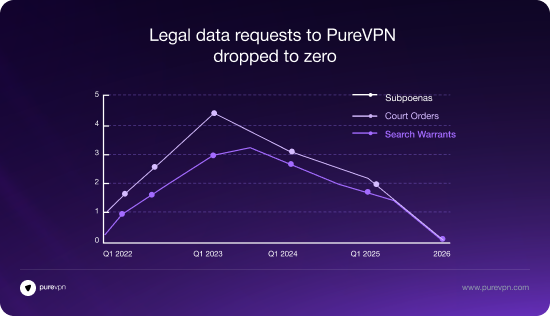
If you step back and look at the last few years, a clear pattern emerges.
It didn’t happen overnight.
Phase 1 — Exploration (2023–2024)
Authorities issued a steady flow of subpoenas. These are typically used to request basic subscriber information—names, emails, and IP logs.
Phase 2 — Escalation (Q1 2025)
When subpoenas didn’t produce useful data, the strategy changed.
There was a sharp spike in court orders and warrants—formal, judge-approved attempts to compel deeper access.
Phase 3 — Realization (Late 2025 → Q1 2026)
Requests dropped—fast.
By December 2025, only a single order remained.
By Q1 2026:
- Subpoenas: 0
- Court Orders: 0
- Search Warrants: 0
You can scan every number in this report, but one stands above the rest:
| Legal Request Type | Count |
| Subpoenas | 0 |
| Court Orders | 0 |
| Search Warrants | 0 |
Why Requests Dropped to Zero (And Stayed There)?
Our infrastructure follows a strict Privacy by Design model:
- No activity logs
- No connection logs
- No identifiable user records
- Minimal operational data (only what’s required to run the service)
That leads to a simple outcome:
If data doesn’t exist, it cannot be handed over.
Over time, this becomes visible externally. Regulators and agencies test systems. When repeated requests return nothing useful, behavior changes.
That’s exactly what happened here.
Q1 2026 Transparency Snapshot
Transparency isn’t only about legal requests. It also means showing what happens operationally across the network.
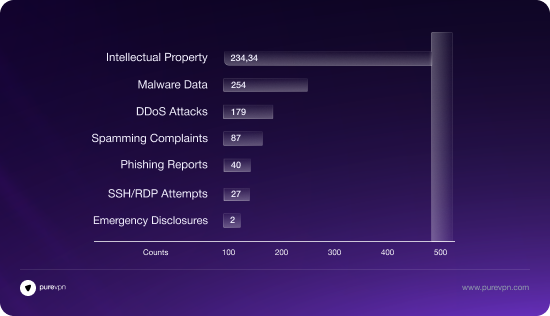
Here’s what we processed between January and March 2026:
Key Metrics
| Category | Description | Count |
| Intellectual Property | P2P infringement takedown notices | 23,434 |
| Malware Data | Botnet activity, port scanning | 254 |
| DDoS Attacks | Network-level attack attempts | 179 |
| Spamming Complaints | Email abuse reports | 87 |
| Phishing Reports | Phishing URLs hosted on IPs | 40 |
| SSH/RDP Attempts | Unauthorized access attempts | 27 |
| Emergency Disclosures | Life-threatening situations | 2 |
What These Numbers Actually Mean
- Most activity is automated
Botnets, scanners, and abuse systems constantly probe infrastructure. This is normal at scale. - DDoS and malware events are defensive wins
These are attempts, not breaches. - Emergency disclosures remain rare
Only 2 cases, both involving verified, imminent threats to human life.
That’s not just a statistic.
It’s a signal.
It tells you:
- Your activity isn’t being stored
- Your identity isn’t being mapped
- Your data isn’t sitting in a database waiting to be requested
Why This Matters Going Forward?
For this reporting period, PureVPN recorded zero legal requests.
That does not guarantee future quarters will look the same. Legal requests, enforcement patterns, and regulatory pressure can all change.
But this quarter still matters.
A zero-request reporting period creates a public benchmark. It gives users a clear view of where things stand today. Enforcement agencies test systems. When repeated requests return nothing useful, behavior changes.
The point is not to make a permanent claim.
The point is to publish the record clearly, quarter by quarter.
And for this quarter, that record is worth noting.