
A company may start with a few employees connecting to its private network from home to access files, internal tools, or business systems. As the team grows, more people need access at the same time, branch offices come online, and the number of VPN connections becomes harder to manage.
A VPN concentrator is designed for situations where remote users and branch locations need to connect through one centrally managed system.
In this guide, we will explain what a VPN concentrator is, how it works, when a business may need one, and which alternatives are available.
What Is a VPN Concentrator?
A VPN concentrator is a dedicated hardware device or virtual appliance that handles VPN connections at scale. It gives organizations a central point for managing large numbers of remote users, devices, or branch locations.
Unlike personal VPNs, which are used by individuals to protect a smaller number of connections, a VPN concentrator is designed for corporate environments where many VPN sessions need to run at the same time.
How a VPN Concentrator Works
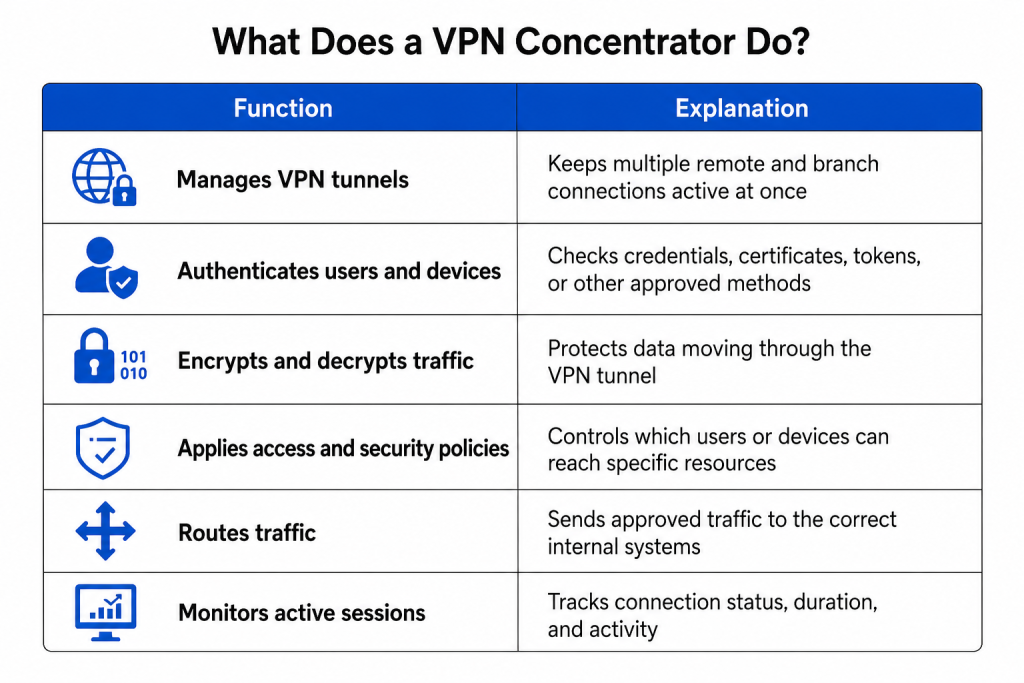
A VPN concentrator sits between remote users or branch networks and the private network they need to access. Each connection usually follows the same basic process:
- Connection request: A remote user, device, or branch office starts a VPN connection and sends a request to the concentrator.
- User authentication: The concentrator checks the required credentials, certificate, token, or other authentication details. If the request cannot be verified, the connection is rejected.
- Tunnel creation: Once authentication is complete, an encrypted tunnel is established between the remote device or branch network and the concentrator.
- Traffic routing: The concentrator routes traffic through the tunnel and applies the relevant access rules. Users can then reach the files, applications, or systems they have permission to use.
- Session management: While the connection remains active, the concentrator keeps track of the session and applies any security or routing policies. When the user disconnects, the tunnel is closed.
Who Uses VPN Concentrators?
Here are some of the main groups that use VPN concentrators:
Remote or Hybrid Organizations
Larger companies may have hundreds or thousands of employees connecting from home, while travelling, or from other locations. A concentrator gives the IT team one place to manage those sessions and control access to internal applications, files, and systems.
Multi-Location Companies
Businesses with branch offices, clinics, warehouses, campuses, or other sites may use a concentrator to manage connections back to the main network. People in different locations can then reach the same internal resources without each connection being handled separately.
Government Agencies
Government departments may use concentrators to manage secure access across different offices and remote teams. They may also need tighter control over authentication, session activity, and access to restricted internal systems.
Universities and Healthcare Providers
These organizations often have many users, several locations, and private systems that need controlled access. Universities may need to connect staff and researchers to internal services, while healthcare providers may need to link clinics, hospitals, and remote employees.
When Businesses Need a VPN Concentrator
A business may need a VPN concentrator when its current VPN arrangement can no longer handle the number or complexity of its connections. The decision usually depends on a few factors:
- Number of simultaneous connections: More remote users and devices mean more VPN sessions to authenticate, route, and monitor at the same time.
- Centralized authentication and policies: A concentrator may make sense when the IT team needs one place to manage access rules, authentication methods, and active sessions.
- Access to private systems: Businesses may need stronger control when employees regularly connect to internal applications, databases, servers, or shared files.
- Branch-office connectivity: Multiple locations can create more connections and routing requirements than a basic VPN arrangement is built to manage.
- Performance and availability: The system needs enough capacity to handle peak demand without becoming a bottleneck. Businesses may also need backup infrastructure if uninterrupted access is important.
Pros and Cons of a VPN Concentrator
If you are thinking about setting up a VPN concentrator, these are the pros and cons to consider:
| Pros | Cons |
| Centralizes VPN connections, access rules, and session management | Increases deployment, licensing, and maintenance costs |
| Supports a high number of simultaneous VPN sessions | Requires experienced IT staff to configure and manage |
| Applies consistent authentication and security policies | Creates a potential bottleneck if undersized |
| Makes active connections easier to monitor | Introduces a single point of failure without redundancy |
| Gives businesses more control over remote and branch access | Adds unnecessary complexity when existing infrastructure already meets the need |
VPN Concentrator Alternatives
A VPN concentrator is not the only way to provide secure remote or branch access. Check out the main alternatives and how they compare:
Site-to-Site VPN
A site-to-site VPN creates a secure connection between two networks, such as a branch office and company headquarters. It is better suited to permanent network-to-network links than individual remote-user access. A VPN concentrator can manage many remote sessions and, depending on the product, may also support branch connections.
VPN Router
A VPN router sends traffic from connected devices through a VPN tunnel. It may be enough for a home office, small business, or individual branch where several devices need to use the same connection. However, it usually offers less capacity, session monitoring, and access control than a VPN concentrator.
Cloud VPN
A cloud VPN uses cloud-hosted infrastructure instead of a dedicated appliance on the company premises. It can connect users, offices, or private networks to cloud resources without requiring the business to maintain the underlying hardware. It may be easier to scale than a VPN concentrator, but the business has less direct control over the infrastructure.
Frequently Asked Questions
A VPN concentrator manages multiple VPN connections from one central system. It authenticates users and devices, creates encrypted tunnels, routes approved traffic, applies access rules, and monitors active sessions.
Yes. Large organizations, government agencies, universities, healthcare providers, and multi-location businesses still use VPN concentrators where many remote or branch connections need to be managed at once.
A physical VPN concentrator is usually installed at the edge of the private network, often behind or alongside the firewall. It needs to receive incoming VPN connections before routing approved traffic to internal systems. A virtual one may run in a data center or cloud environment, depending on where the business hosts its applications and network resources.
Yes. Traditional VPN concentrators are dedicated hardware devices, but many modern options are available as virtual appliances that run on servers or cloud infrastructure.
You may need one if your current VPN arrangement struggles with a growing number of remote users, branch offices, access policies, or simultaneous connections. Smaller businesses may not need a separate concentrator if their firewall, router, or cloud platform already provides enough VPN capacity and management features.

Arsalan Rashid

June 19, 2026

4 months ago