
Privacy-focused companies sometimes publish a simple public statement to show they have not received secret legal requests.
“We have not received any secret government requests for user data.”
That is called a warrant canary. If the message suddenly disappears or stops getting updated, it may suggest the company received a legal request and can no longer talk about it publicly.
A warrant canary is useful, but only when it sits alongside stronger trust signals like audits, clear policies, and transparency reports. So how does it actually work, and should you trust it? Let’s find out.
What Is a VPN Warrant Canary?
A VPN warrant canary is a regularly updated statement published by a VPN provider to say it has not received secret legal demands, such as national security letters, gag orders, or similar requests.
The idea comes from the old coal mining practice where miners used canaries as an early warning for toxic gases. If the bird became sick or stopped behaving normally, miners knew something was wrong. VPN canaries work in a similar way.
As long as the statement remains updated, users may take it as a sign that nothing has changed. If the statement disappears or stops updating, some may see that as a warning sign, but it is not direct proof of a legal request.
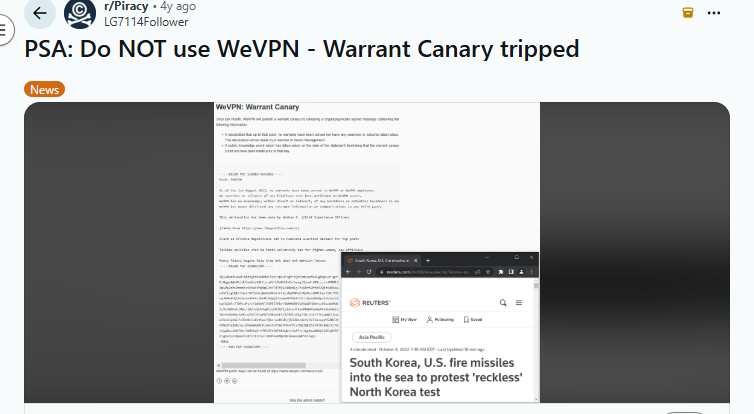
Why Do VPN Providers Use Warrant Canaries?
There are two main reasons why VPN services use warrant canaries:
Increases Transparency
Some VPN providers operate under laws that can stop them from disclosing certain government data requests. A warrant canary gives them a way to publish a regular public statement without making a direct disclosure. Warrant canaries are not limited to VPNs, with encrypted email providers, cloud storage companies, and secure messaging apps using them too.
Builds User Trust
VPN users care about logging policies, data requests, surveillance risks, jurisdiction, and how a provider responds to legal pressure. A warrant canary gives them one more thing to check. It does not prove that a provider is safe, and it does not protect users on its own. It only shows that the provider is willing to keep a public statement updated for users to review.
How a VPN Warrant Canary Works
A VPN warrant canary depends on regular updates . The update itself is the signal users search for. Here is how that typically looks like:
Step 1: The VPN Publishes a Statement
The provider publishes a public statement saying it has not received certain legal demands, such as a national security letter, gag order, or similar request. For example, it may say: “As of May 2026, we have not received any national security letters or gag orders.”
Step 2: Users Watch for Updates
The statement is usually dated and updated on a set schedule. Some providers update warrant canaries monthly, while others may update them more often. If the canary keeps getting updated, users may treat that as a sign that nothing has changed.
Step 3: A Missing Update Becomes the Signal
If the canary disappears or stops getting updated, users may read that as a warning sign. The provider is not directly saying it received a legal request, but the missing update may suggest that something has changed.
Are Warrant Canaries Actually Effective?
Warrant canaries can be useful, but they have limits. Supporters see them as transparency tools because they give users something to monitor when a provider may not be allowed to disclose certain requests directly.
A regularly updated canary can increase accountability and make legal pressure harder to hide completely. If a VPN provider keeps the statement visible and current, users may treat that as a positive trust signal.
The problem is that a missing update does not prove what happened. It could point to legal pressure, but it may also be a delay, a policy change, a technical issue, or simple internal mismanagement.
A warrant canary can support trust, but it should not carry more weight than a clear no-log policy, independent audits, transparency reports, or privacy-focused infrastructure. Those are the things that decide how much user data a VPN provider can actually hand over
Warrant Canary vs Transparency Report
A warrant canary and a transparency report both help users judge how a VPN provider handles legal requests, but they are not the same thing. Take a look at how they differ in the table below:
| Aspect | Warrant Canary | Transparency Report |
| Purpose | Signals that no covered request has been received. | Shows requests received and handled |
| Format | Short public statement | Detailed public report |
| Update Frequency | Set schedule | Monthly, quarterly, or yearly |
| User Checks | Whether it is still visible and current | Request count, type, and data disclosure |
| Main Limitation | Missing update does not prove anything | Only shows what can be disclosed |
| Best For | Extra trust signal | Stronger transparency record |
Do All VPNs Have Warrant Canaries?
No. Warrant canaries are optional, and not every VPN provider uses one. Some providers prefer transparency reports, independent audits, or no-log systems because these give users clearer evidence than a missing or unchanged statement.
So, the absence of a warrant canary does not automatically mean a VPN is less trustworthy. It just means users should look at the provider’s wider privacy and transparency record instead.
What Should You Look for Instead of Just a VPN Warrant Canary?
A warrant canary can help, but it should not be the main reason you trust a VPN. Look for stronger trust signals, such as:
- Verified no-log policy: A no-log policy matters more when it has been checked by an independent audit, not just claimed on a website.
- Transparency reports: These show how many legal or government requests a provider receives and whether any user data was disclosed.
- Privacy-friendly jurisdiction: A provider’s legal base can affect how it handles data requests and retention rules.
- Security infrastructure: Strong encryption, IP leak protection, secure VPN protocols, and clear app controls still matter.
How PureVPN Builds Trust Beyond a Warrant Canary
PureVPN builds trust through stronger privacy signals than a warrant canary alone. Its no-log policy has been independently assessed to confirm that it does not monitor, store, or share users’ VPN activity.
The VPN service also publishes transparency reports to show how data requests are handled, operates from the British Virgin Islands, and includes strong encryption, IP and DNS leak protection, and modern VPN protocols inside its apps.
Frequently Asked Questions
They are legally uncertain. A warrant canary may help users notice a change, but its strength depends on the country, the wording, and the type of order involved. It is safer to treat it as an early warning sign, not legal protection.
No. A warrant canary does not block data requests or protect your account by itself. It only gives users something to monitor. The real question is whether the VPN stores data that could be useful if requested.
There is no fixed rule. Some providers update them monthly, others do it more often. What matters is whether the provider follows a clear schedule, because a canary loses value if users do not know when it should be updated.
A gag order limits what a company can say about a legal request. A warrant canary works the other way around: the company keeps saying nothing has happened until that statement changes, disappears, or stops being updated.

Arsalan Rashid

June 15, 2026

4 months ago