
How do you know if a VPN is trustworthy? You are not the only one to wonder because some VPNs are, well, shady. According to a TechRadar investigation, 77% of 3,471 Android VPN apps on the Google Play Store failed basic transparency and accountability checks, with many lacking proper websites, clear privacy policies, or reliable support.
A VPN encrypts your internet connection and hides your IP address, helping boost your privacy and access unavailable regional content. However, once you connect, you are still placing a lot of trust in the VPN provider to handle your traffic carefully, avoid storing activity logs, secure its apps properly, and respond responsibly to legal requests.
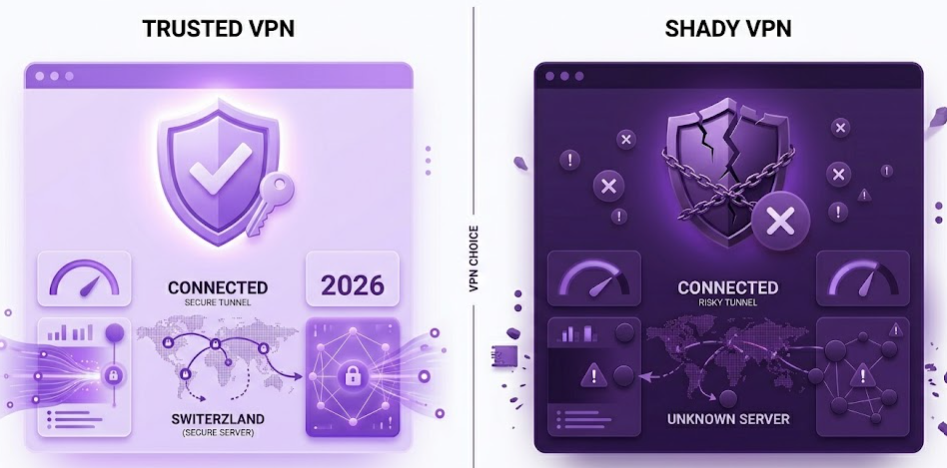
If you are choosing a VPN service in 2026, it takes more than just evaluating app-store ratings or pricing. You need to look at proof of trustworthiness, such as no-log policies, independent audits, transparency reports, jurisdiction, and security features. In this guide, we will show you how to identify a trustworthy VPN.
Trustworthy VPN Checklist
Here is a quick checklist you can use to judge whether a VPN is worth trusting:
| Trust Factor | What To Look For |
| Clear privacy policy | Clear data collection and no-log terms |
| Independent VPN audits | Repeated third-party no-log audits |
| Transparency reports | Request counts and log disclosures |
| VPN jurisdiction | Clear legal base with no forced data retention |
| Modern VPN protocols | Modern protocols, outdated ones removed |
| Essential security features | Encryption, kill switch, and leak protection |
| Real-world reputation | Recent reviews and app-store ratings |
| Customer support quality | 24/7 help and clear support channels |
What Features Make a VPN Trustworthy?
A trustworthy VPN should make its claims easy to verify. Before you subscribe, look for these signals:
A Clear Privacy Policy
A trustworthy VPN should not make you dig through vague legal wording to understand what happens to your data. Its privacy policy should explain what the service collects, what it does not collect, why certain data is needed, and whether any information can be tied back to your VPN activity.
Look for clear answers on whether the VPN stores browsing activity, DNS queries, original IP addresses, assigned VPN IP addresses, connection timestamps, sites visited, outgoing traffic, or content accessed. If the policy uses broad phrases like “we may collect connection data” without explaining what that means, treat it as a red flag.
When you look at PureVPN’s privacy policy, it explains what data is collected for account, payment, support, diagnostics, and add-on purposes. Plus, it explicitly states that no logs are kept that can identify or help monitor user activity.
Independent VPN Audits
A VPN can claim it keeps no logs, but users cannot inspect its servers, infrastructure, or internal systems. Independent audits show whether an external firm has reviewed the VPN’s logging practices instead of leaving users to rely on marketing copy.
Repeated audits carry more weight than a one-time badge. VPN apps, servers, and infrastructure change over time, so a provider that keeps going through external assessments gives users a stronger trust signal.
PureVPN has completed four no-log audits, reaffirming that it does not log users’ origin IPs, assigned VPN IPs, specific connection times, or activities after connecting to a VPN server. The latest assessment covered VPN servers and supporting infrastructure across multiple countries.
Transparency Reports
A trustworthy VPN is open about what happens when outside parties ask for user information. Legal requests, court orders, emergency disclosures, copyright complaints, spam reports, and infrastructure abuse claims can happen. The important part is whether the VPN explains how it handles them.
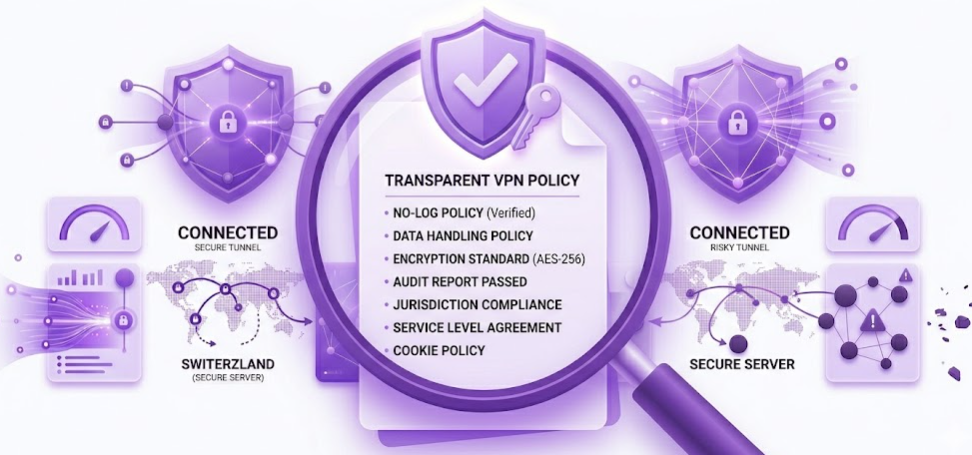
Transparency reports give users a clearer view of that process. They show what kinds of requests the provider receives, how often they come in, and whether the company has user logs to share. Without that reporting, users are left guessing.
PureVPN publishes a Transparency Report every quarter, showing how many such requests it receives and whether any user logs were stored or shared. Its Q1 2026 report shows no user logs stored or shared with third parties, which supports its no-log position.
VPN Jurisdiction
A VPN’s jurisdiction tells you where the provider is legally based. Some countries have mandatory data retention laws, which can require companies to store certain user data for a set period. If a VPN operates under those rules, its privacy claims deserve extra scrutiny.
You should also look at whether a VPN is based inside the 5, 9, or 14 Eyes alliances, which are intelligence-sharing groups involving countries such as the United States, United Kingdom, Canada, Australia, and New Zealand. While being outside these alliances can be a good sign, it does not automatically make a VPN trustworthy (proof still matters).
PureVPN relocated its headquarters from Hong Kong to the British Virgin Islands after concerns grew around Hong Kong’s long-term autonomy from China. The move was important for user privacy because the BVI offers a privacy-friendly legal environment and has no mandatory data retention laws.
Modern VPN Protocols
VPN protocols are not just technical labels buried in the app settings. They decide how the VPN connection is built, how your data travels through the encrypted tunnel, and how well the VPN performs across different networks.
A trustworthy VPN should support protocols like WireGuard, OpenVPN, and IKEv2/IPsec, while moving away from outdated ones, such as PPTP, SSTP, and L2TP/IPsec, which no longer meet modern security expectations. They could also result in a less reliable connection, making video calls or file uploads a pain if you are using a VPN to work from home.
PureVPN offers modern VPN protocols and comes with an Automatic Protocol Selection feature, which chooses a suitable one based on your current network conditions. It has also discontinued older options to better protect its users.
Essential Security Features
A trustworthy VPN protects you even when the connection does not behave perfectly. If the VPN drops, your traffic should not quietly fall back to your regular internet connection. WebRTC, DNS, or IPv6 leaks can also expose information outside the VPN tunnel.
Look for strong encryption first, then essentials like a kill switch, DNS leak protection, IPv6 leak protection, and WebRTC leak protection. Encryption protects your data, while these safeguards help stop accidental IP or DNS leaks.
PureVPN covers these basics and also includes split tunneling, which lets you choose which apps use the VPN connection. That gives users the core protection expected from a VPN and more control over how the connection is used.
Real-World Reputation
The reputation of a VPN service has to hold up outside its own website. Reviews are not perfect proof, but they show how the service performs for real users after checkout, especially around connection reliability, app experience, billing, and support.
Look for patterns instead of one angry review or one glowing comment. Recent reviews, app-store ratings, support responses, and independent coverage can show whether a VPN’s public claims match everyday use.
PureVPN gives users more than its own claims to look at. It currently holds a 4.3/5 rating on Trustpilot, while its iOS app shows a 4.4/5 rating on the App Store. That feedback does not replace audits or transparency reports, but it does show how real users rate the service after using it.
Customer Support Quality
A trustworthy VPN does not disappear when something breaks. Connection issues, account problems, billing questions, and device-specific errors can happen, so support quality becomes part of the trust picture.
Customer support must be easy to reach, not hidden behind generic help pages. Live chat, email support, tickets, a clear support center, and in-app help are all useful signs. Fast replies matter, but the real test is whether the support team can solve the problem or move it to the right team without making users start over.
PureVPN provides 24/7 live chat through its website and inside the app through More > Support > Live Chat. Users can also reach out through tickets, email, and contact forms, while the support center has guides for those who want to troubleshoot on their own.
Frequently Asked Questions
A free VPN can be trusted only if it clearly explains what data it collects, how it makes money, and whether its no-log claims have been audited. If those answers are vague, avoid it.
PureVPN is easy to put on a trustworthy VPN shortlist. It has repeated no-log audits, quarterly transparency reports, BVI jurisdiction, modern protocols, essential security features, 24/7 support, and strong ratings on Trustpilot and the App Store. That gives you enough to judge the service on proof, not just promises.
A VPN based inside the 5, 9, or 14 Eyes is not automatically untrustworthy, but its privacy claims need closer scrutiny. Check its logging practices, audits, transparency reports, and jurisdiction details before trusting it.
No. A trustworthy VPN can encrypt your connection and hide your IP address, but accounts, cookies, browser fingerprinting, and unsafe browsing habits can still reveal who you are.
Yes, an audited VPN is generally more trustworthy because an external firm has reviewed its claims or logging practices. Repeated audits are even better because VPN apps, servers, and systems change over time.

Arsalan Rashid

June 5, 2026

4 months ago