
When you use a VPN, you trust the provider with your sensitive internet traffic, so privacy claims alone are not enough. A provider may promise strong encryption, secure apps, and a no-logs policy, but users need some way to know whether those claims have been tested.
A VPN audit helps answer that question. It is a formal review of a VPN service’s security, privacy practices, infrastructure, or no-logs claims. In this article, we’ll explain what a VPN audit is, what it checks, where its limits are, and how to read audit results before trusting a VPN provider.
What is a VPN Audit?
A VPN audit checks whether a VPN provider is actually doing what it claims. For example, if a VPN says it keeps no logs, uses secure servers, or protects user data in a certain way, an audit looks for evidence behind those claims.
The review can cover different parts of the service, such as apps, servers, logging systems, data handling, and internal processes. Third-party audits matter more because the review is done by an outside security firm rather than the VPN provider itself.
Why Do VPN Audits Matter?
VPN audits matter because they help users:
- Check no-logs claims: Many VPNs say they do not keep logs, but an audit can review whether the provider’s systems and policies support that claim.
- Look beyond marketing: Instead of relying only on privacy promises, users get a review that looks at how the VPN actually operates.
- Understand what was tested: A useful audit explains whether it looked at apps, servers, infrastructure, logging systems, privacy policies, or internal controls.
- Spot transparency gaps: Missing dates, vague scope, or unavailable reports can make an audit less useful.
- See how findings were handled: Some audits identify issues or improvement areas. Users can check whether the provider fixed them and shared the outcome.
What Do VPN Audits Usually Check?
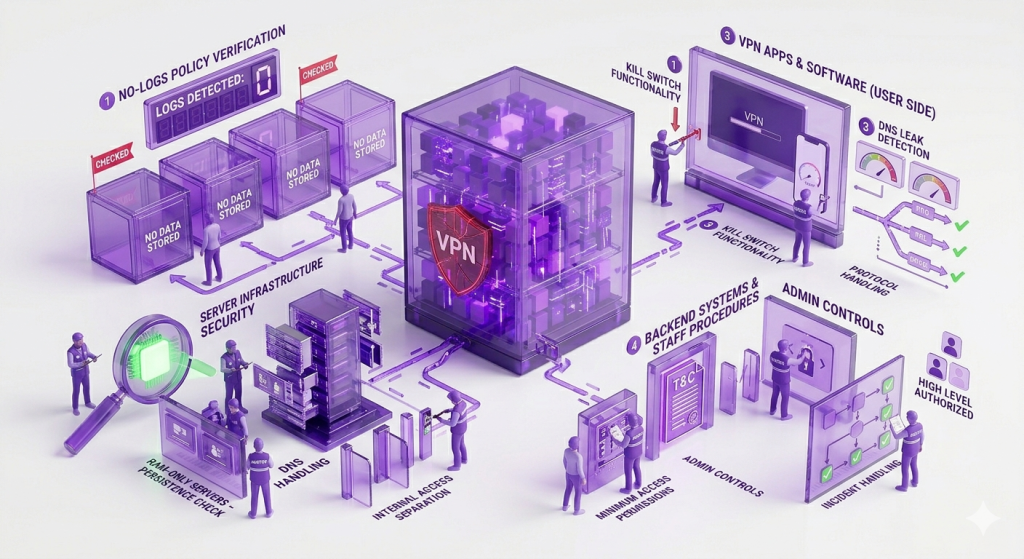
VPN audits can cover different parts of a provider’s service, depending on the scope of the review. Common areas include:
No-Logs Policy
A no-logs audit checks whether the VPN is actually not storing the data it says it does not collect. That can include browsing activity, real IP addresses, DNS requests, timestamps, or connection records. If a VPN says it keeps no logs, the audit should show how that claim was tested.
Server Infrastructure
A server audit looks at the systems that carry user traffic. It may check server access, RAM-only servers, DNS handling, encryption, and how server access is separated internally. Poor server controls can create privacy risks even if the company’s policy sounds strong.
VPN Apps and Software
An app audit checks the VPN app people actually install. It may test the kill switch, protocol handling, DNS leaks, permissions, and other parts of the app that affect real-world protection. A weak app can still expose users even when the server side is secure.
Backend Systems and Staff Procedures
Some audits look at who inside the company can access sensitive systems, such as admin accounts, staff permissions, login controls, incident handling, and internal data access. The fewer people who can touch sensitive systems, the lower the risk of misuse or mistakes.
Types of VPN Audits
VPN audits are never the same; sometimes they focus on one aspect of the service more than others. The two main types are:
Security Audits
A VPN security audit focuses on the technical side of the service. It looks at the apps, encryption protocols, server configuration, and infrastructure to see whether they are built securely. Auditors may also test for vulnerabilities that could weaken the app, expose traffic, or put user data at risk.
Privacy Audits
A VPN privacy audit checks how the provider handles user information. Auditors may review policies and data practices to see whether usage records, connection logs, IP addresses, or DNS requests are being stored. It shows whether the provider’s privacy claims match how the service works.
Differences Between Internal and External VPN Audits
Internal audits can help a VPN provider improve its own systems, but external audits carry more weight for users because the review comes from outside the company. Here’s how the two compare:
| Factor | Internal Audit | External Audit |
| Done by | The VPN provider’s own team | An independent third-party auditor |
| Main purpose | Find issues internally and improve systems | Check whether the VPN provider’s privacy claims actually hold up |
| Transparency | Usually kept private and not shared with others | More likely to be published or summarized |
| Bias risk | Higher, because the company reviews itself | Lower, though scope and reporting still matter |
| Best used for | Internal checks, fixes, and preparation | Building user trust and supporting claims publicly |
Limitations of VPN Audits
VPN audits offer useful insight into a provider, but they also have limits users should understand:
- Audits are time-specific: An audit only reviews the service as it existed during the audit period. Apps, servers, ownership, policies, and internal practices can change later.
- Scope can be limited: Some audits only check one part of the service, such as the browser extension, no-logs policy, or apps. Anything outside that scope is not covered.
- Reports may not show everything: Some providers publish a summary instead of the full report, which can make it harder to see what was tested and what was found.
- Auditor credibility matters: An audit from a known, experienced security firm carries more weight than a vague audit claim with no named auditor or clear methodology.
- Audits are one part of trust: A clean audit is a strong trust signal, but users should still consider the provider’s privacy policy, ownership, jurisdiction, and transparency reports.
How to Read a VPN Audit Before Trusting It
A VPN audit is only useful if you understand what was actually reviewed. Before trusting an “audited” claim, check for these details:
Verify Who Did the Audit
An audit from a reputable third-party cybersecurity firm carries more weight than a vague claim with no named auditor. Look for the firm’s name, experience, and whether it has worked on security or privacy audits before.
Examine the Audit Scope
Check what the audit actually covered. Some audits review only the app, browser extension, no-logs policy, or server infrastructure. If the audit only checked one area, do not assume the entire VPN service was tested.
Look for Public Details
A useful audit should tell users when the review happened, what was tested, and what kind of report was released. Some providers publish full reports, while others share summaries. The more context available, the easier it is to understand what the audit actually proves.
Confirm If the Findings Were Addressed
Audits can find issues, weak areas, or recommendations for improvement. Has the provider fixed those issues and shared the outcome? A clean audit badge means less if there is no date, scope, auditor name, or follow-up detail behind it.
Is PureVPN Independently Audited?
Yes. PureVPN has undergone four independent no-log audits to support its privacy claims. The results reaffirm that PureVPN does not log users’ original IP address, assigned VPN IP address, exact VPN connection time, or activity after connecting to a VPN server.
The review covered PureVPN’s VPN servers and supporting infrastructure across different countries between February 16 and February 22, 2023. Post-assessment validation was also completed in March and April 2023, which adds more weight than a one-time review alone.
The no-log report can be requested directly from PureVPN’s no-log assessment page if users want to review the assessment details before trusting the claim.
Frequently Asked Questions
No, VPN audits are not mandatory. Providers choose whether to run them, who audits them, and how much of the report they share. An audit is a trust signal, not a default requirement.
No. An audit can verify specific claims within a defined scope, but it does not guarantee complete privacy forever. The audit only reflects what was reviewed at that time.
There is no fixed rule, but recurring audits are better than one old report. VPN apps, servers, policies, and ownership can change, so newer audits give users more relevant proof.
Most free VPNs do not publish detailed independent audits. Some may still be safe, but users should be more careful if there is no named auditor, no report, and no clear privacy policy.
A no-logs claim is the provider saying it does not store user activity or connection data. A no-log audit checks whether that claim matches how the provider’s systems and policies actually work.

Arsalan Rashid

June 15, 2026

4 months ago